PDF interior
What you will see inside
Real PDF pages: cover, executive summary, charts and competitive tables.
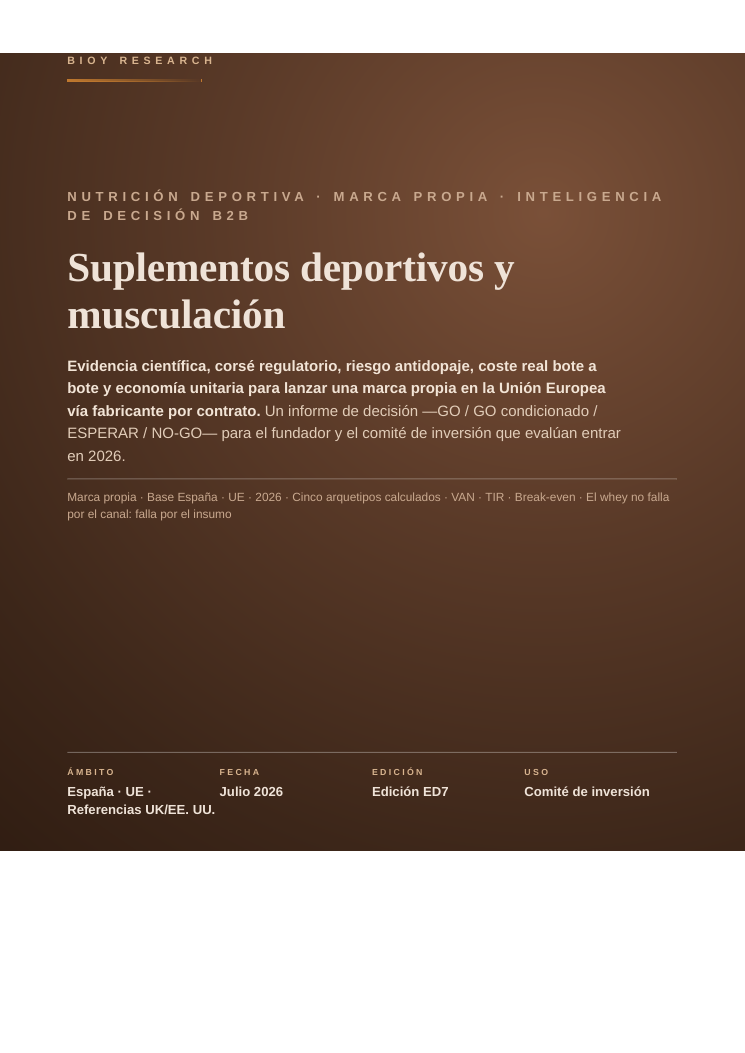
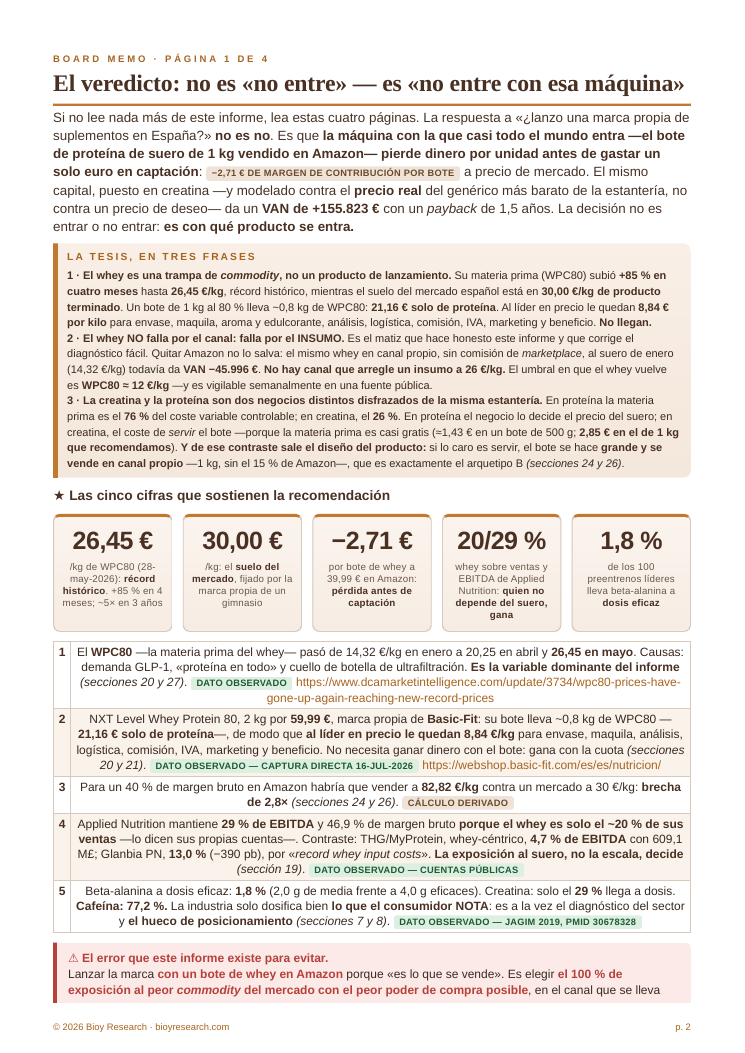

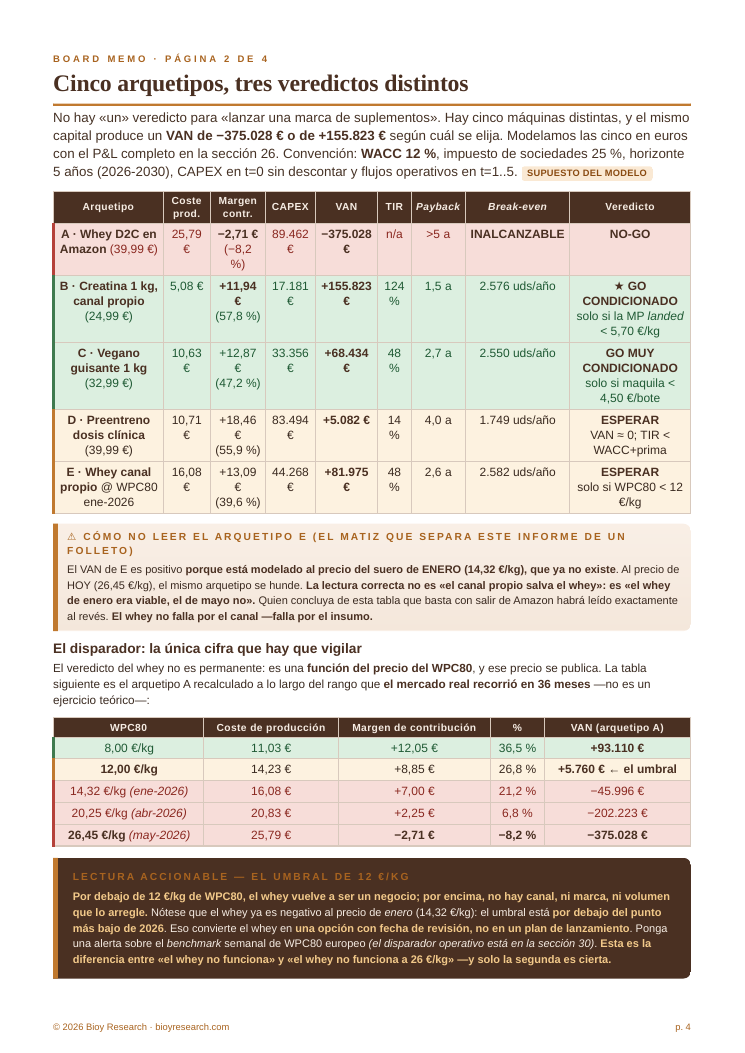
Written for the founder and the investment committee weighing an own-brand sports supplement line in the EU (based in Spain), built with a co-packer and sold across D2C, marketplace, retail and gyms. This is not a nutrition guide or a list of what to take: it is the folder on which the launch is approved or rejected, with the financial model inside and the cost worked out tub by tub.
Real PDF pages: cover, executive summary, charts and competitive tables.
A decision report, not an overview of the fitness sector. Every figure comes out of a financial engine, and every decisive claim carries its source, its date and the confidence we place in it.
Everybody starts with the same tub, because it is the one that sells most. The report rebuilds its real cost from the raw material —which rose 85 % in four months— and shows why that is not the point: the market's price floor is not set by a competitor who needs to make money on the tub, but by someone using it as a loss leader. You do not compete against that floor with a new brand. The cost matrix tells you, product by product, where you actually stand in that picture before you sign with a co-packer.
Regulation 1924/2006 is not a style guide: it is a straitjacket, and it decides your label, your product page and your advertising. We verified the full EU Register, claim by claim, and the result surprises even people who have spent years in the sector: of the entire arsenal on the market, only two actives may legally say what they are for. The report brings what you may write, in what exact wording, what is forbidden to say even when true, and how that reorders the decision of which product to launch —because a product that cannot explain itself costs twice as much to sell.
The typical business plan says "we sell on the marketplace and on D2C at the same time". The report runs each channel through its own cost waterfall with the official rate cards —Amazon Rate Card, logistics, returns, Ecoembes 2026, the cost of acquiring the customer— and shows what is left at the end of each. The conclusion reorders the go-to-market: the channel that looks like the short cut takes a share of the price most founders do not discover until year two. All four are there: D2C, marketplace, retail and gyms, each with its contribution margin.
The ingredient–goal–evidence–dose matrix crosses every active with its goal, the level of evidence under the AIS and IOC frameworks, and the dose at which it actually works. Then it holds that against the real market: 98.2 % of leading pre-workouts fall short of the effective dose of the ingredient they advertise most (Jagim, 2019). There is a positioning decision there and a cost decision, and they are the same one: dosing properly gets paid for in the cost sheet. The report puts both sides of that calculation on the table.
If an athlete tests positive, the athlete answers for it —and your brand answers next, in court and in the press. Cross-contamination at the co-packer's plant is not a hypothesis: the report brings the real cases, how they happened, and the cost of certifying the batch against programmes such as the Cologne List. If you sell to gyms, to clubs or to anyone who competes, this section is not optional: it changes which co-packer you can use and what every tub costs you.
There is no single verdict for "starting a supplement brand": there are five archetypes, and the same engine separates them —two make it through and others do not. All five run through a year-by-year P&L, NPV, IRR, payback, break-even and a sensitivity tornado, with the assumptions auditable one by one so your CFO can redo the numbers, argue with them and break them. Plus two binary tests with a numeric threshold: one call to the co-packer and one to the raw-material supplier tell you whether your case exists, before you spend anything.
The SKU benchmarking does not quote consultancy reports: it collects real competitor prices captured on 16 July 2026, with the date on every data point so you know exactly what is ageing. On top of that, the filed accounts of Applied Nutrition, THG, Glanbia and Bulk —the margins that are really made in this sector, published by the companies themselves in their own accounts, not estimated by us.
Before publishing we put the thesis through an adversarial review briefed explicitly to refute it. It caught us applying two different yardsticks, and fixing that cost us 56 % of the NPV of our own recommendation. It is published in the report, with its before and after. Every claim that moves the verdict goes into a register of 36 traced claims, each with its source, its date and the confidence we place in it —saying so when the confidence is low. With direct links so you can verify it yourself. All inside the PDF.
Download a free sample with the cover and the full table of contents.
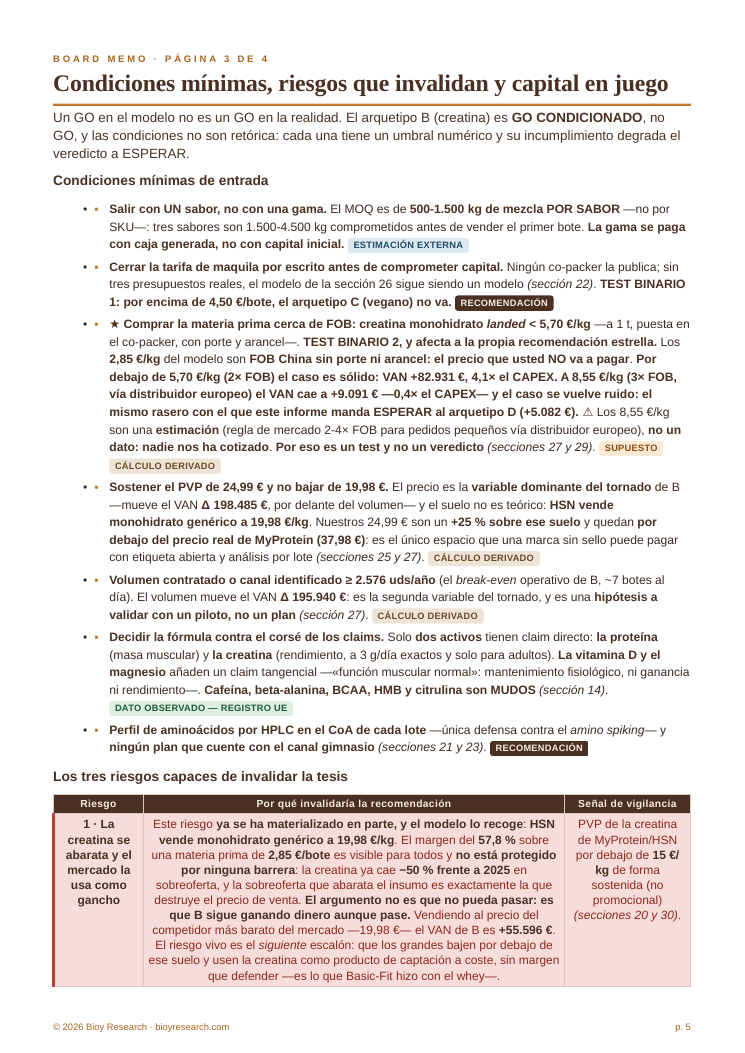
The sample includes the cover and the contents, so you can see the full scope of the report. The analysis, the financial model and the verdicts are in the full edition.
For the founder or the investment committee weighing the launch of an own-brand sports supplement line in the EU —the base case is a company based in Spain— manufacturing through a co-packer and selling across D2C, marketplace, retail and gyms. It is a business decision report: it approves or rejects a launch, with the financial model inside.
Not for a consumer looking for what to take: it is not a supplementation guide and it recommends nothing to anyone for their training. Not for a gym deciding what to stock behind the counter: the report reasons from the brand, not from the point of sale. And not for a sports physician or dietitian after clinical literature: here the evidence is used to decide what to formulate and what may be said on the label, not to advise a patient. It is a business decision report, and only that.
It depends on the archetype, which is why there are five. The same financial engine separates them: some make it through and others do not, and each verdict comes with its conditions and its break-even point. There are also two binary tests with a numeric threshold —one on the co-packer and one on the raw material— that a single phone call resolves: if your case does not clear those two thresholds, the report tells you before you spend anything.
A 179-page PDF, instantly downloadable. Everything is inside the PDF: the analysis, the evidence matrix, the claims straitjacket, the financial model with the year-by-year P&L, the scenario matrix and the auditable assumptions one by one. There are no separate annexes or loose files: with the assumptions table inside, your CFO can redo the numbers in their own spreadsheet.
The financial model reasons in euros (€), because the base case is a brand based in Spain selling into the EU, and that is the currency in which it bears its costs and sets its prices. The report sells for €3,499 per single licence, as an instant-download PDF.
The report is available in Spanish, English, German and French. Each version is a full edition, not a summary: the same analysis, the same financial model and the same verdicts, adapted to the language.
It will move, and the report is built expecting it. Competitor prices are captured with their date (16 July 2026), so you know exactly what is ageing. And the risk matrix does not stop at describing: every risk carries its watchable threshold and its review trigger, including the input price that weighs most in the model, which has a threshold you can follow week by week in a public source. The report does not hand you a snapshot: it hands you what to watch and when to decide again.
Before publishing, we put the report's thesis to the explicit task of destroying it, angle by angle. It caught us applying two different yardsticks, and fixing that cost us 56 % of the NPV of our own recommendation: the verdict changed. It is published in the report, with its before and after, including our own mistakes. It is the part that gives most confidence in the final verdict.
Five archetypes with a verdict, the real tub-by-tub cost, the claims straitjacket verified against the EU Register, and the financial model so you can redo it with your own numbers.
Buy the report · €3,499