PDF interior
What you will see inside
Real PDF pages: cover, executive summary, charts and competitive tables.
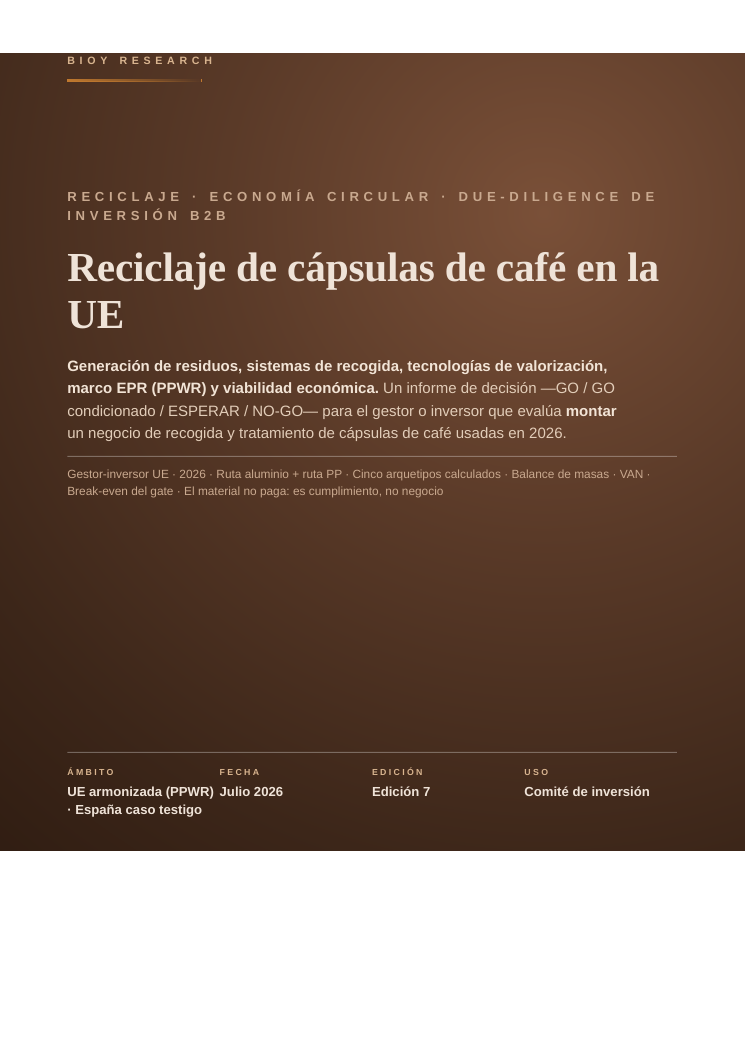
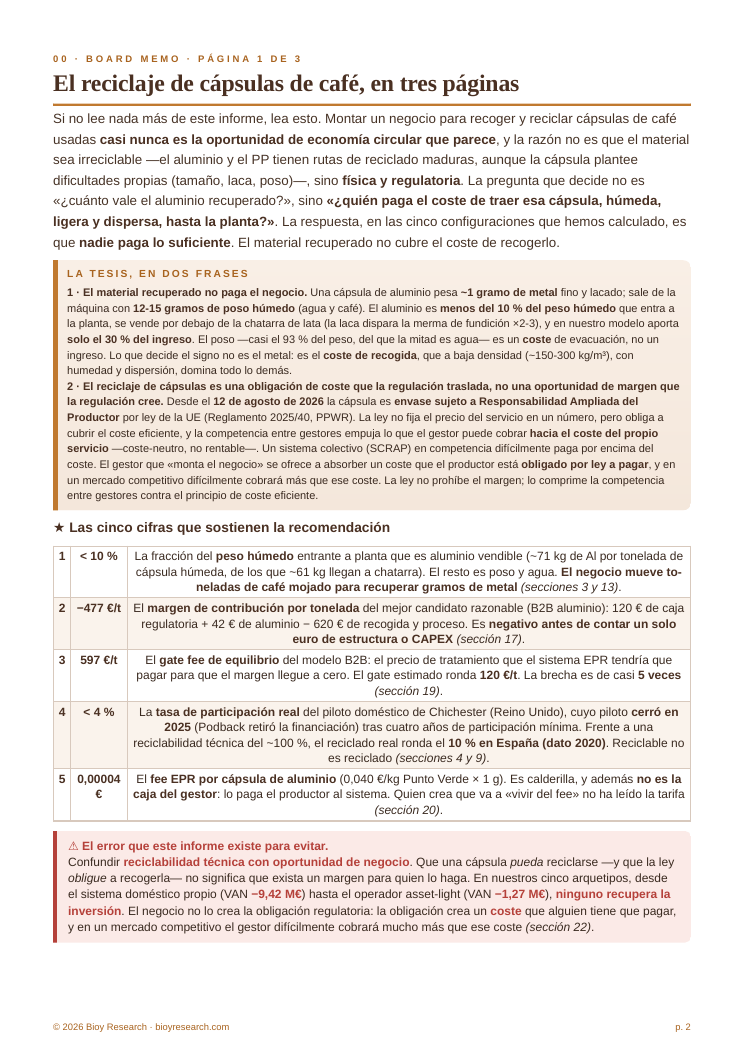
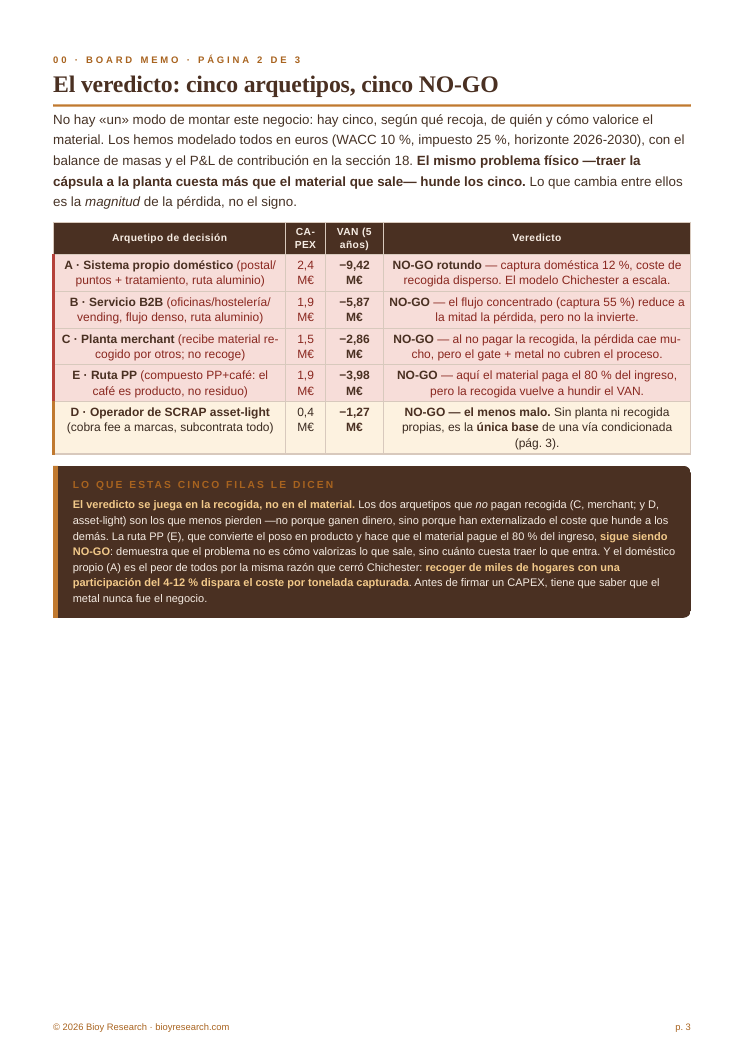
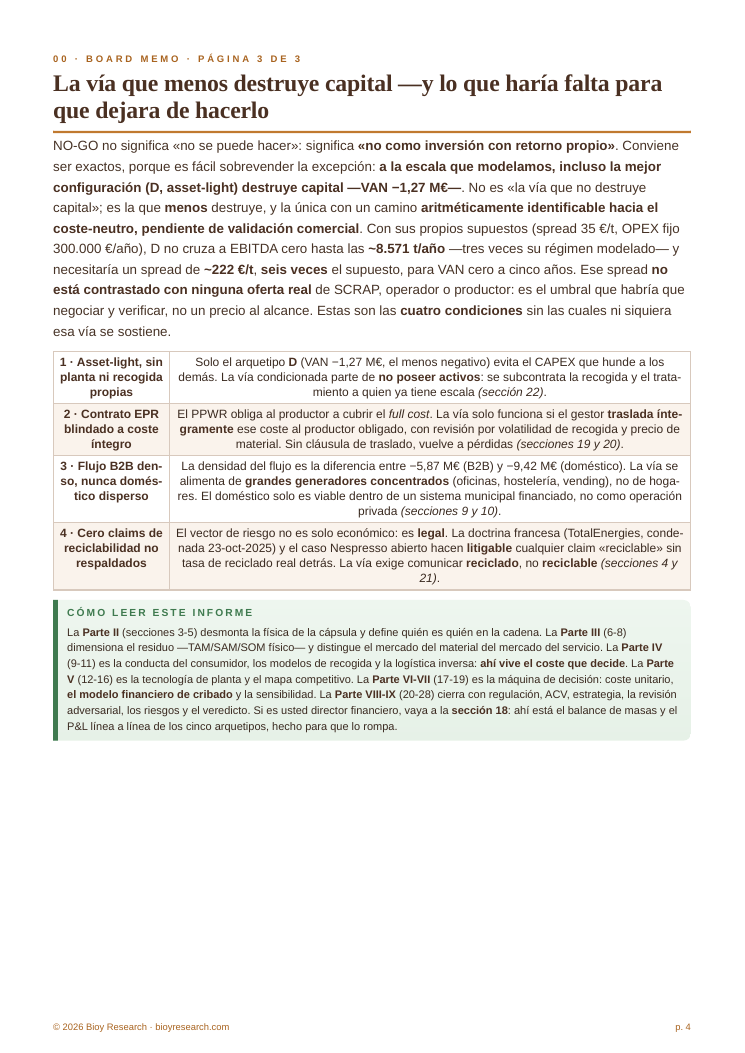
Written for the investment committee of a waste operator, or for an investor weighing whether to build the collection and treatment of used coffee capsules in the EU. This is not a panorama of the circular economy: it is the arithmetic, done in euros, of whether that business stands up. Five real configurations —own household scheme, dense B2B, merchant plant, asset-light operator and the plastics route— through the same financial engine, and the answer to the one question that decides it: who pays the cost of collection.
Real PDF pages: cover, executive summary, charts and competitive tables.
A decision report, not a sector report. Every figure comes out of a reproducible financial engine, and every decisive claim carries its source, its date and the confidence we attach to it —including what we have NOT been able to verify.
An aluminium capsule is ~1 gram of thin, lacquered metal that leaves the machine carrying 12-15 grams of wet grounds. The report runs the full mass balance per tonne accepted at the plant: how much aluminium goes in, how much comes out as saleable scrap, how much reaches ingot after lacquer burn-off losses, and what the wet coffee that has to be moved and disposed of really weighs. That balance, not the metal price, is what governs the arithmetic.
The costliest thesis error in the sector is confusing the fee a producer pays into the collective scheme with the treatment price the operator charges. They are different things, of different orders of magnitude. The report separates the five possible revenue sources, quantifies how much the recovered material really contributes against the regulatory pot, and explains why the PPWR's full-cost-coverage framework constrains the price an operator can aspire to charge.
Own household scheme, concentrated B2B service, merchant plant taking third-party material, asset-light operator subcontracting everything, and the plastics route where the coffee stops being waste and becomes product. Each with its year-by-year P&L for 2026-2030, its CAPEX, its NPV and its break-even point, all derived from the same mass balance so that they are comparable with one another.
Against a technical recyclability close to 100%, the real recycling rates published range from 5% to 35% depending on who calculates them and on what base. The report separates each figure with its declared denominator, distinguishes audited from self-declared, and sets out the legal risk vector this opens: French case law on environmental claims, Directive 2024/825 and the cases already decided against defendants.
From when the capsule is packaging subject to Extended Producer Responsibility under EU law, which PPWR article says so, when the producer register comes in and what obligation arrives in 2028 for soft capsules. With the real tariffs of Ecoembes and CITEO, the eco-modulation that rewards mono-material, and the 2030 recycling targets verified against the text.
The report does not stop at the result: it identifies the variable that dominates the verdict, measures how far it would have to move to invert it, and says whether that value is reachable in the real market. It includes the adversarial review —nine attempts to break its own thesis— and the full record of what we could not verify, which is also the agenda of the pilot it proposes.
Five pages of the report, exactly as delivered.
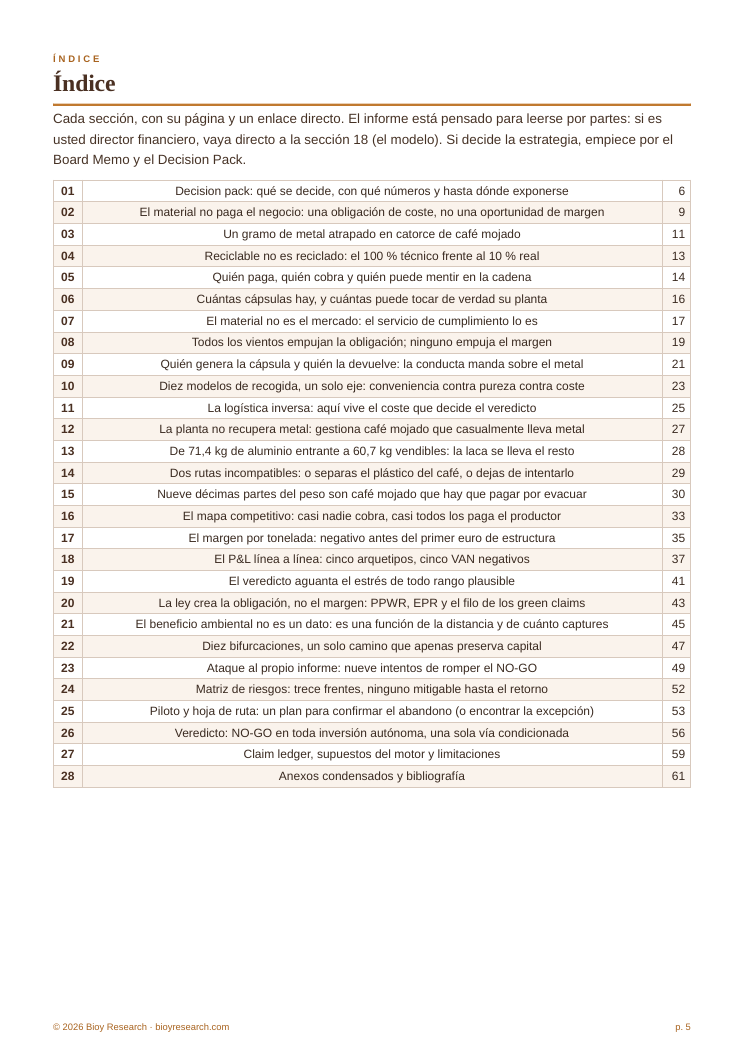
The figures in the images come from the report's financial engine.
For whoever is weighing putting capital into building the collection or the treatment of capsules: a waste operator wanting to enter the stream, an investor studying the sector, or a logistics operator considering the service. It is not written for the coffee brand meeting its EPR obligation, but for whoever would provide that brand with the service.
The EU as harmonised by the PPWR, with Spain as the test case (RD 1055/2022, Ecoembes) and system contrasts in France (CITEO, Projet Métal), the United Kingdom (Podback), Italy (Milan) and Austria (ARA+KTV). The model's figures are in euros.
It gives an explicit verdict —GO, conditional GO, WAIT or NO-GO— for each of the five configurations, with the NPV of each and the minimum conditions that would have to be met. It also says what steps it would take before committing a single euro of CAPEX.
Every decisive claim carries its source and an evidence label: observed data, external estimate, derived calculation, model assumption or inference. The report openly declares which parameters it has NOT been able to verify against contracts or measurements —it is a screening model for deciding, not an audited valuation— and turns those gaps into the agenda of the pilot it proposes.
The full 65-page PDF, in English, with instant download after payment. Individual licence.
The report answers with numbers: five configurations, one financial engine and a verdict for each.
Buy the report · €3,499