Home  /  Reports  /  Mikel Coffee: franchise due diligence
Franchise due diligence · Edition 7 · Jul 2026

Mikel Coffee: the file for whoever is about to buy the franchise

Written for the SME with the money on the table, asking whether buying a Mikel Coffee franchise —or opening several— recovers the capital or merely pays a salary. This is neither a brand brochure nor a biography of the freddo: it is the forensic file with which you sign or walk away, with the economic engine of a store inside, the owner's shadow salary booked into the accounts, the network reconciled country by country against what the brand advertises, and the verdict worked out on paper for each type of buyer.

77 pages · Edition 7Subject: Mikel Coffee franchiseFormat: PDFLanguages: EN/ES/DE/FR
€3,499/ individual licence
  • Instant-download PDF, 77 pages
  • The economics of a typical store modelled on 2026 Greek costs —collective-agreement wages, rent, dual VAT of 24/13%, delivery commission—, from the €185,000 CAPEX to the line-by-line P&L and the 7% EBITDA, with the owner's shadow salary booked into the accounts, which reverses the verdict
  • The distinction that decides everything: between margin on sales and return on capital, between the operator's salary and what the money gives back, and the sales threshold above which the store stops losing capital and the one it would take to yield what its risk demands
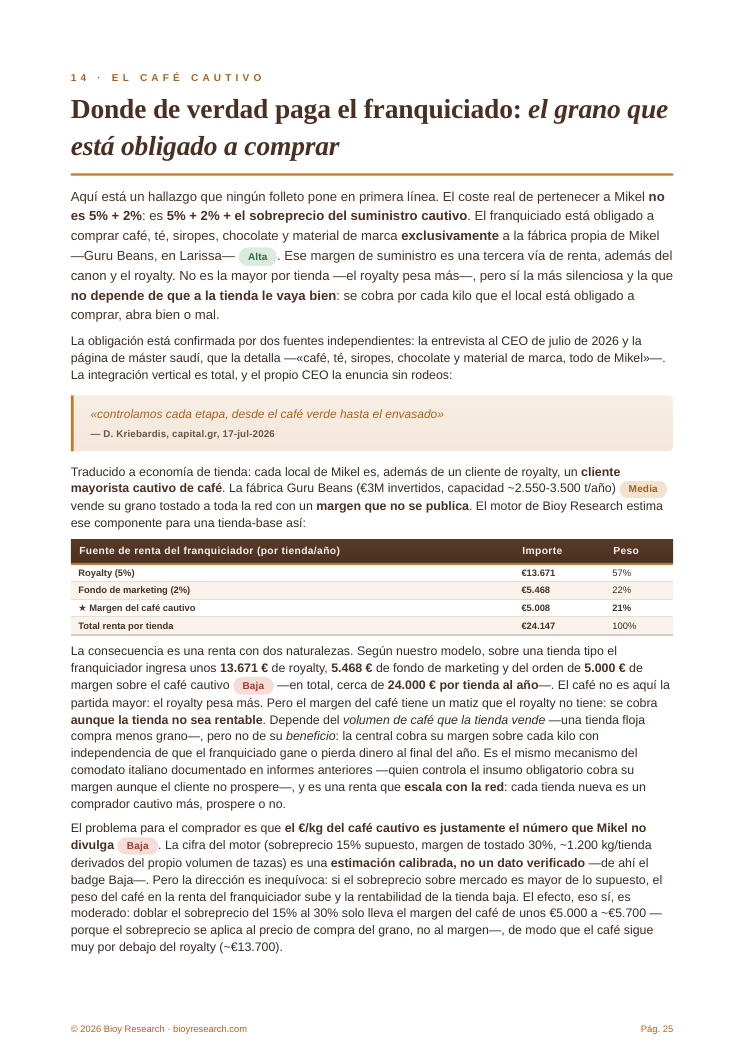
  • The franchisor's three income streams —royalty, marketing and the margin on the coffee the franchisee is obliged to buy from its own factory—, and why the coffee is charged even when the store makes no money
  • The network of ~418 stores reconciled country by country against the "400+ in 19 countries" narrative: ~88% in three countries, the advertised markets without a single locatable store, and the verdict for each purchase option
Buy and download Download free sample
Secure payment · Automatic delivery to your email
PDF interior

What you will see inside

Real PDF pages: cover, executive summary, charts and competitive tables.
PDF interiorPDF interiorPDF interior
What's included

From the brochure to the real accounts

Each section answers a concrete question asked by whoever is about to put up the money, separating what the brand advertises from what a record certifies.

The accounts of a store, with the owner's salary inside

From the real €185,000 CAPEX to the line-by-line P&L: sales, food cost, collective-agreement wages, rent, dual VAT, delivery commission, up to a 7% EBITDA. And the step almost no brochure takes: booking the owner's market salary into the accounts. With it, the return on capital is negative. The question it answers is not "does the store make money?" but "does it give me back my capital or pay me a wage?"

The threshold and the sensitivity: what it would take to be worth it

The sales volume above which the capital stops losing, and the one it would take to yield what its risk demands —well above the base case—. With its sensitivity matrix: volume rules, not geography. And the market's two franchise options resolved as scenarios, not as a footnote: both come out NO-GO.

How the franchisor makes money —and why it does not depend on you making money

The three income streams per store: royalty (5%), marketing (2%) and the margin on the coffee the franchisee is obliged to buy from the brand's own factory. The coffee is charged even when the store is not profitable: it varies with what it sells, not with what it earns. That is why the system can grow in outlets while each outlet earns little.

The advertised network versus the reconciled network, and the verdict by option

The store-by-store reconciliation of the network of ~418 outlets: ~88% in Greece, Turkey and Cyprus, the advertised markets without a single locatable store, the US outlet that shows as closed and remains on the map. And the accounts of the Greek parent company —€16.7M in sales, 65-89% in receivables—. It closes with a verdict for each type of buyer.

Contents

Brand, market, franchise, store economics, network and verdict

01 Buying a Mikel is not buying an investment: it is buying yourself a job, and an expensive one
02 What a brand advertises is not what a record certifies
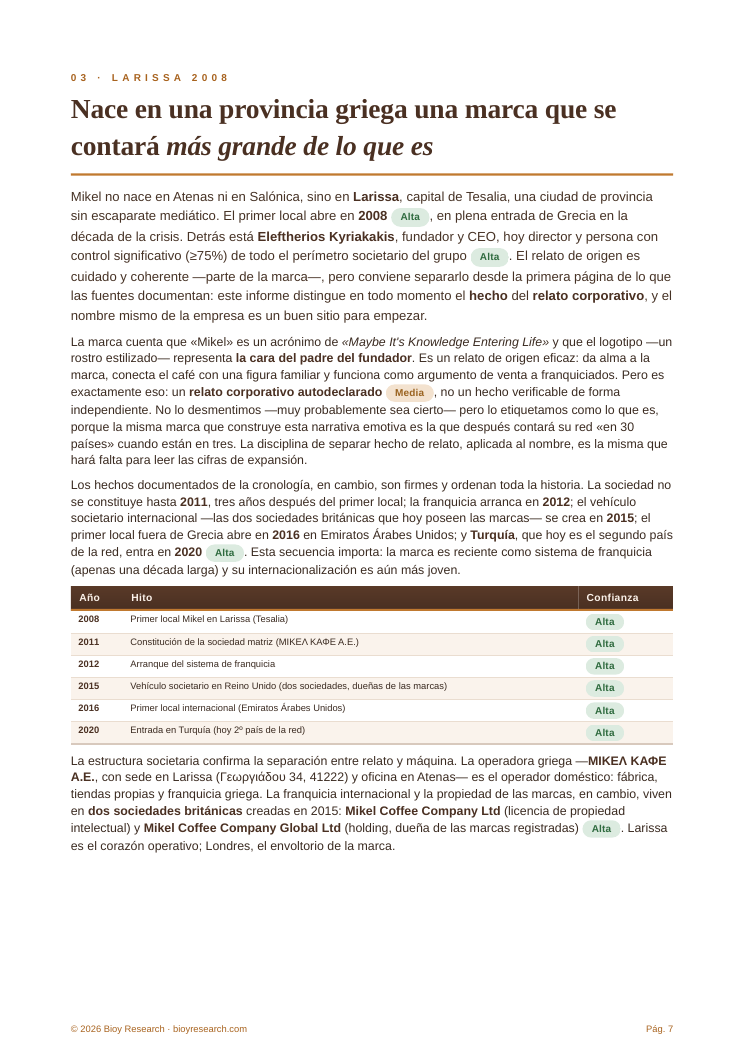
03 In a Greek province a brand is born that will tell itself bigger than it is
04 In Greece the café does not sell coffee: it sells a seat and time
05 The Greek chain market is no longer growing: it is a share game, not an expansion one
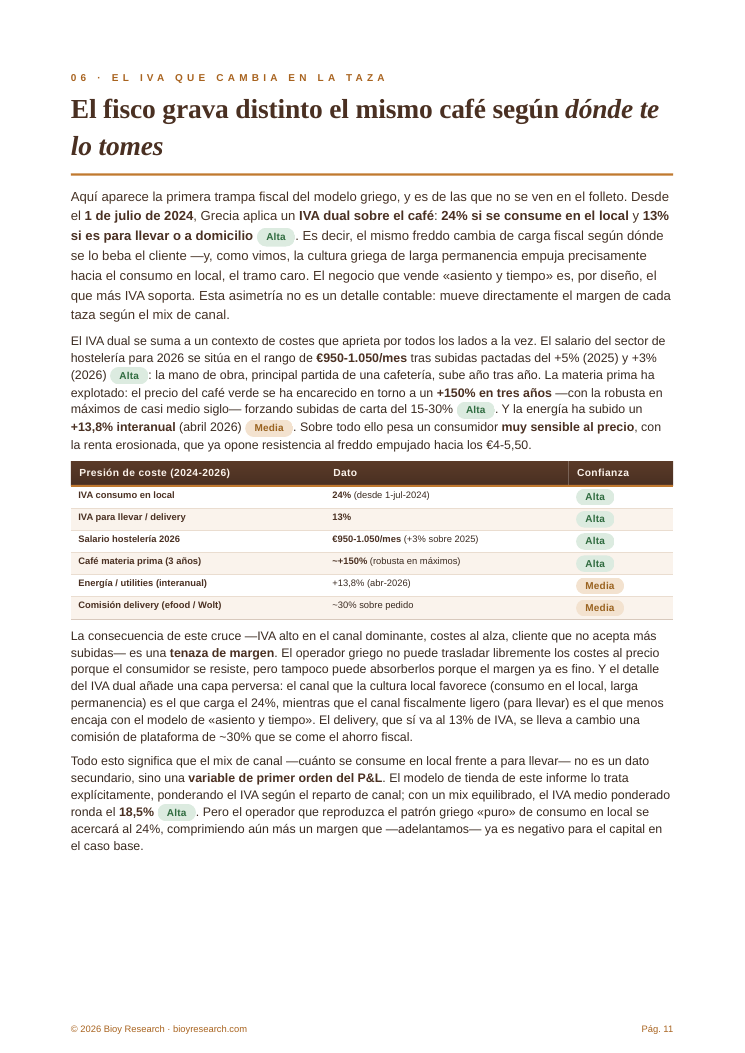
06 The taxman taxes the same coffee differently depending on where you drink it
07 Mikel's advantage is Greek and only travels to warm climates
08 A community that is advertised, an asset almost anyone can copy
09 A ticket of ~€3 and a customer who can no longer pay €5
10 Own coffee, entry-level prices and a cup consistency the network does not guarantee
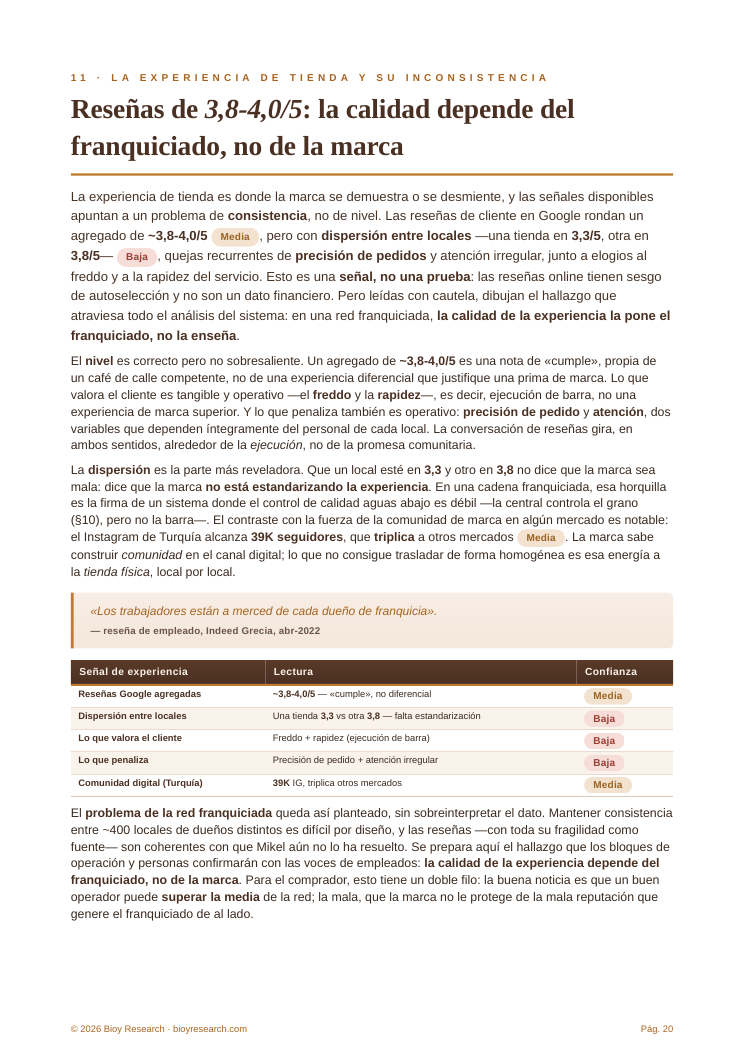
11 Reviews of 3.8-4.0/5: quality depends on the franchisee, not the brand
12 Two axes not to be confused: contractual level and store format
13 The 5% you see —and the 2% that goes separately
14 Where the franchisee really pays: the beans it is obliged to buy
15 The brochure number that does not hold up
16 Among the most expensive to enter —and one of the few that charges a royalty
17 The own roastery: when selling coffee is the real business
18 Distribution through the brand's own network and exposure to green coffee at record highs
19 The freddo flow: tickets, shifts and the peak-hour challenge
20 The same cup in ~400 stores: the challenge with no public audit
21 The labour risk the brand does not control
22 The real CAPEX of a Mikel: €185,000, and the hardware is the least of it
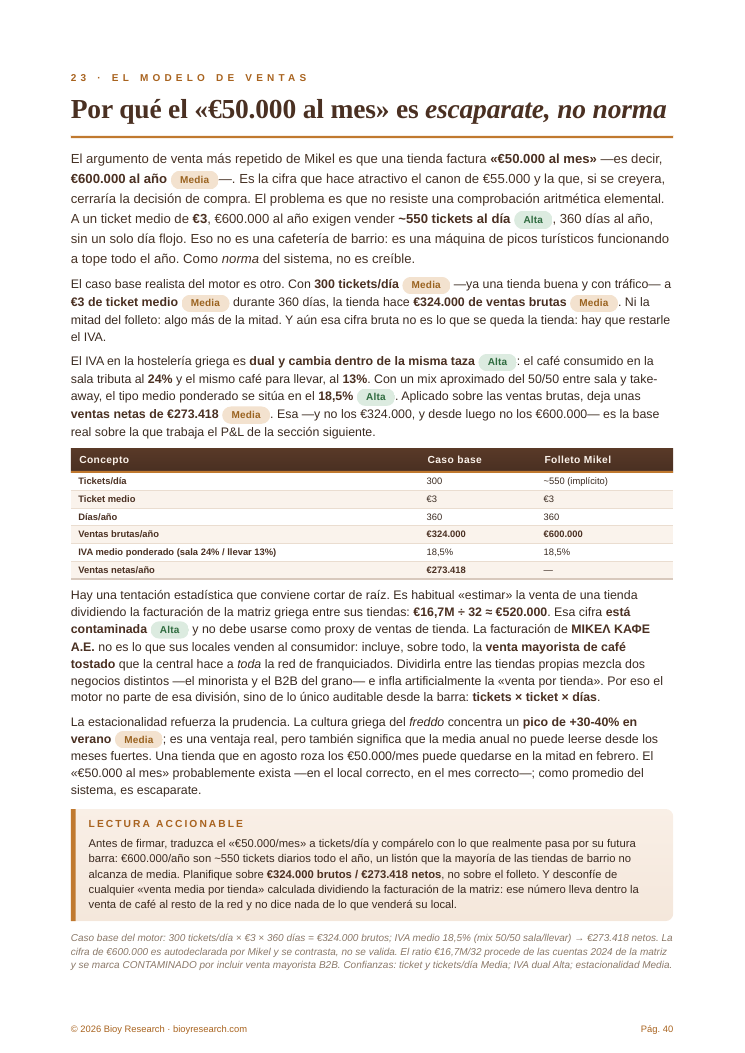
23 Why the "€50,000 a month" is a shop window, not a rule
24 The accounts of a store: from €324,000 to the 7.0% EBITDA
25 Self-employment or investment: the owner's salary reverses the verdict
26 What it would take to be worth it: volume rules, not geography
27 An expensive self-employment: NO-GO as a capital investment
28 Profitable by a whisker: a story of network, not of profitability
29 Working capital rules: a profit with the cash tied up
30 Three income streams, and the coffee one is the one that does not depend on profit
31 The brand lives in London, the business in Larissa: and the flow between the two is invisible
32 A real network told as if it were three things at once
33 What is really there, country by country: ~400 real stores, but ~88% in three countries
34 The network misleads in both directions: inflated in breadth and broken in the locator
35 The markets that were there in 2021 and are not in 2026: an invisible international churn
36 The freddo only travels to warm climates: expanding north is betting against your own advantage
37 How Mikel enters a country: the master franchisee and the risk of the partner who does not open
38 Mikel is not the leader: third by share, fourth by turnover
39 A real brand, a fragile advantage: what is defensible is narrow
40 What can go wrong, with its threshold
41 The favourable thesis versus the opposing one: what would topple the conclusion
42 For each buyer, an answer
43 Annex A — The network country by country, with its confidence level
44 Annex B — The numbers of a typical franchise, in a table
45 Annex C — Traceable sources and bibliography
46 Annex D — How a store's economics is calculated: equations, assumptions and limits
A Annex E — The terms that do not mean what they seem
Preview

A look inside

Professional design, verified data and clear tables in every section.
previewpreviewpreviewpreviewpreview

A sample of a few pages from the report. The full version includes all tables, figures and sources.

Clear pricing

The analysis you need, at an accessible price

Premium sector report

USD 2,000–4,750
Extensive reports focused on market size and its evolution, with deep macro-level detail.

Bioy Research report

€3,499
Decision-focused analysis: competitive map, density by city, economics and entry insight.

Bespoke study

€1,500–6,000
Tailored analysis for one specific site, with an on-site visit and a custom quote.
Frequently asked questions

Before you buy

What format do I receive?

A 77-page PDF ready to read on any device or print. You receive it by email immediately after payment.

Who is this report for?

For the SME or investor evaluating whether to buy a Mikel Coffee franchise —or open several— who needs to know whether it recovers the capital or merely buys a job. Secondarily, for anyone studying the coffee franchise model as a category.

Is this a brand brochure?

No. The report distinguishes throughout between what is advertised and what is verified, between the company's sales and the system's, and between the operator's salary and the return on capital. The brand is real and the freddo works; the report puts the accounts in front of you, without sugar-coating.

Is the economic model a black box?

No. Annex D publishes the equations, the assumptions, their sources and their limits, so the reader can reproduce every figure in the store economics and substitute the parameters with those of their own case.

What is NOT included?

It is not bespoke consultancy or a contract reviewed for your specific case. It is a due diligence of the model, with its method and its data, which you apply to your own purchase decision.

Which languages is it available in?

This report is available in Spanish, English, German and French.

Before you sign, know whether you are buying an investment or an expensive job

It puts in front of you the one account that decides: the return on capital with your salary inside, and the price of the coffee the brand does not publish.

Buy the report · €3,499