PDF interior
What you will see inside
Real PDF pages: cover, executive summary, charts and competitive tables.
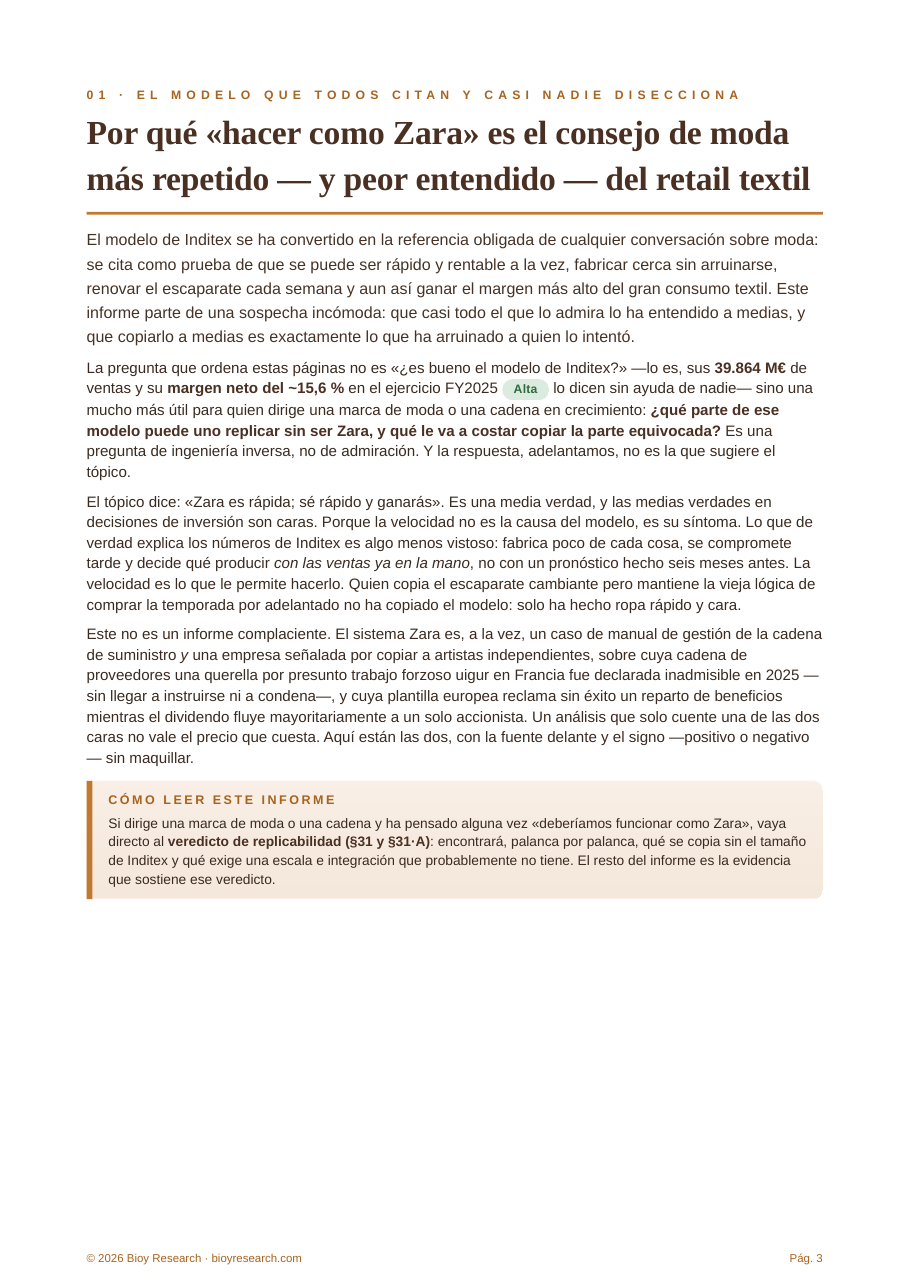
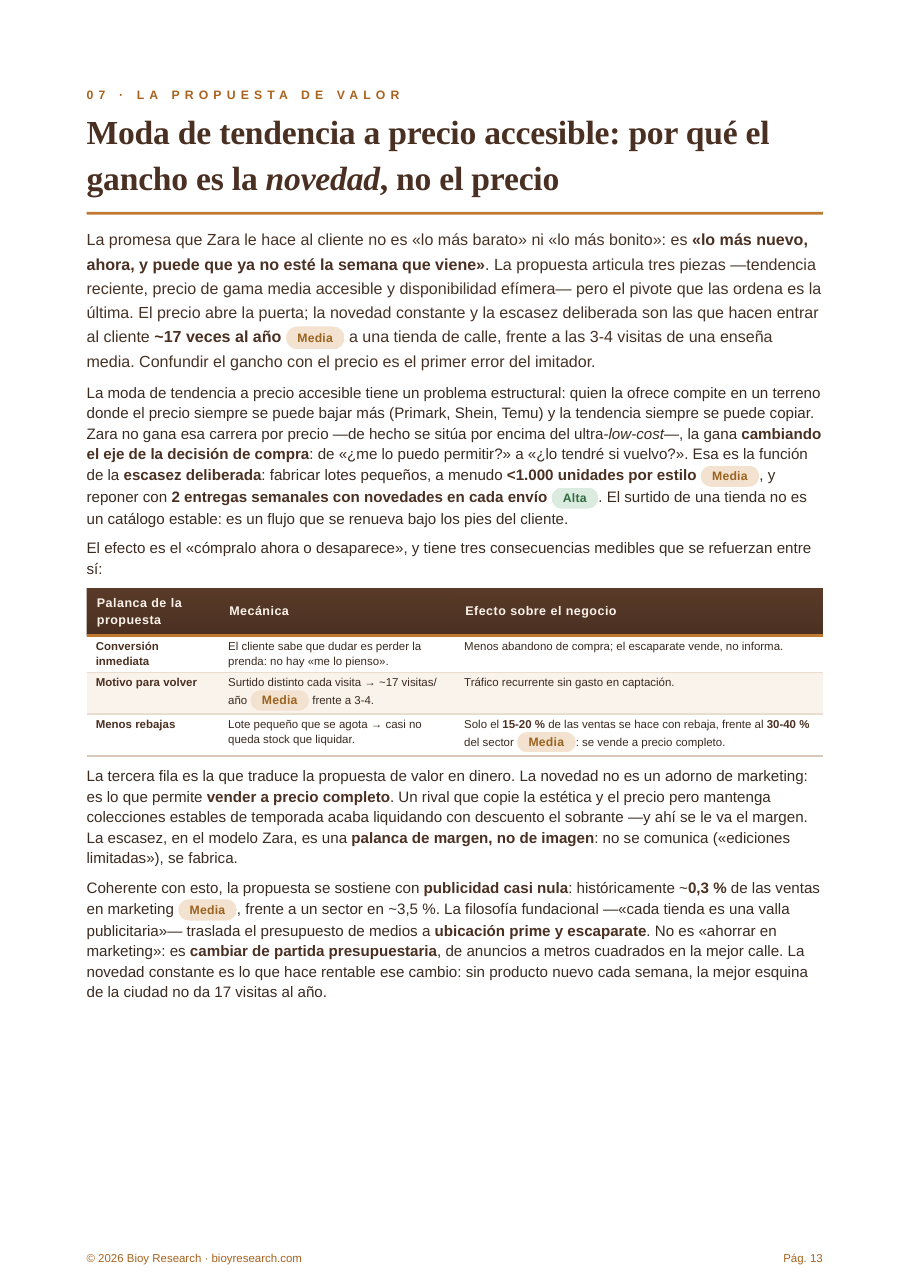
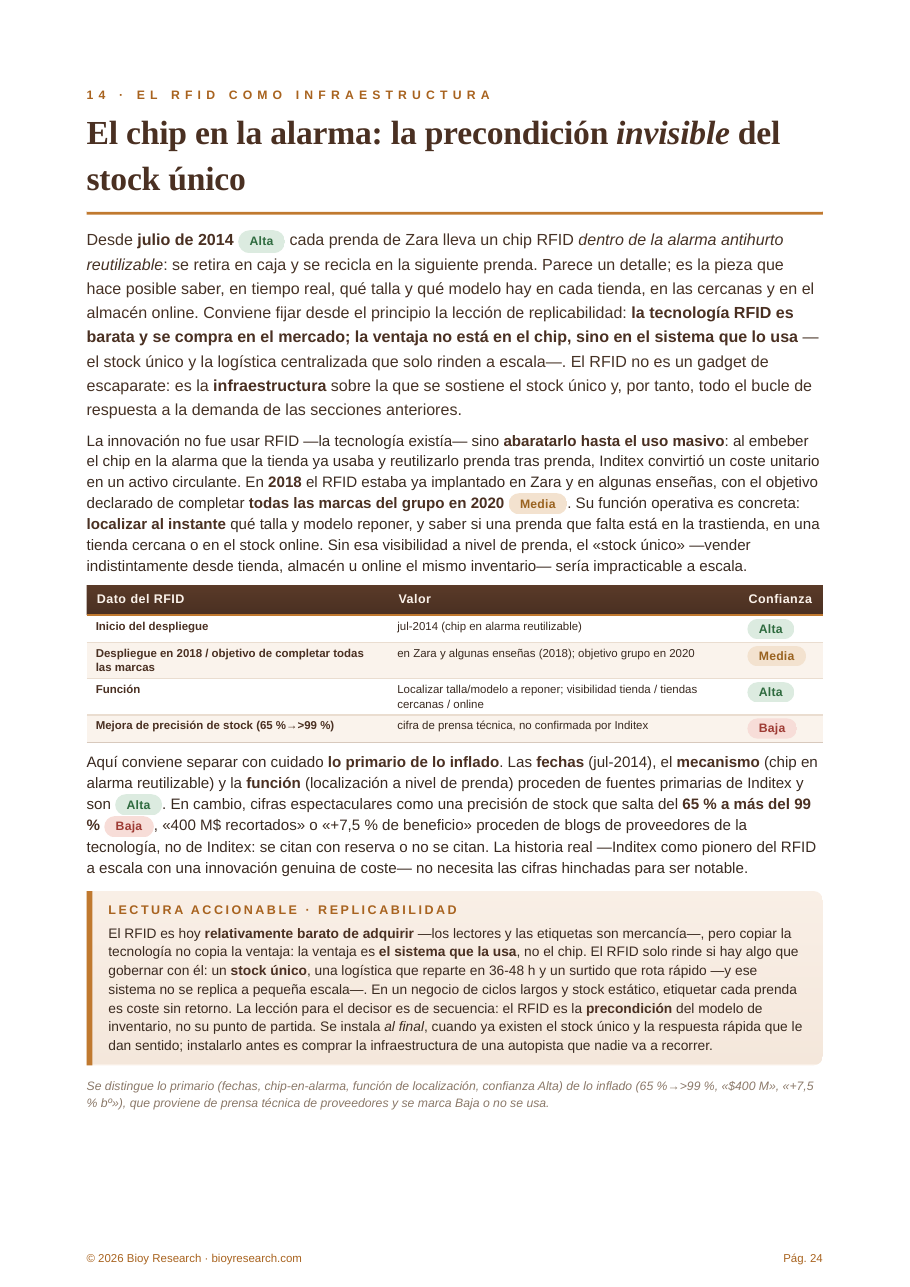
An analysis for anyone running a fashion brand or a growing chain who has ever thought "we should operate like Zara." This is not a company biography: it is a reverse-engineering of the Zara system, piece by piece, to separate what another brand can replicate without Inditex's size from what stays anchored to scale. With the real arithmetic of margin and working capital, proximity sourcing as it actually is today, the supply chain with both sides verified, a benchmark against H&M, Shein, Primark, Uniqlo and Mango, and a quantified model that puts numbers —not adjectives— on the imitator's decision.
Real PDF pages: cover, executive summary, charts and competitive tables.
Each section answers a specific question asked by someone running a fashion brand who wonders what of the Zara system they can take into their own business.
How accessible pricing, weekly renewal and margin are sustained at the same time: gross and net margin, turnover, working capital and markdown depth, each figure with its source and confidence, separating what the external auditor signed off from what the company merely declares. The question is not "is the model good?" but which parts of it depend on size and which do not.
What Inditex's "close by" really means, why the most-quoted figure counts factories rather than garments, which link is controlled in-house and why the most expensive work —sewing— is outsourced. And where the map is shifting, with the concentration risk that creates.
The audit programme and the sector's first global framework agreement, set against the litigation and allegations —each with its court, date and exact procedural status, distinguishing what was ruled inadmissible from what was proven and from a party's unproven claim. No sugar-coating in either direction.
H&M, Shein, Primark, Uniqlo and Mango, and what each teaches about what can be copied without scale and what cannot. Plus an economic model with published equations —reproducible by the reader— that translates the verdict into euros by product type, with its sensitivity matrix and tornado analysis.
Professional design, verified data and clear tables in every section.
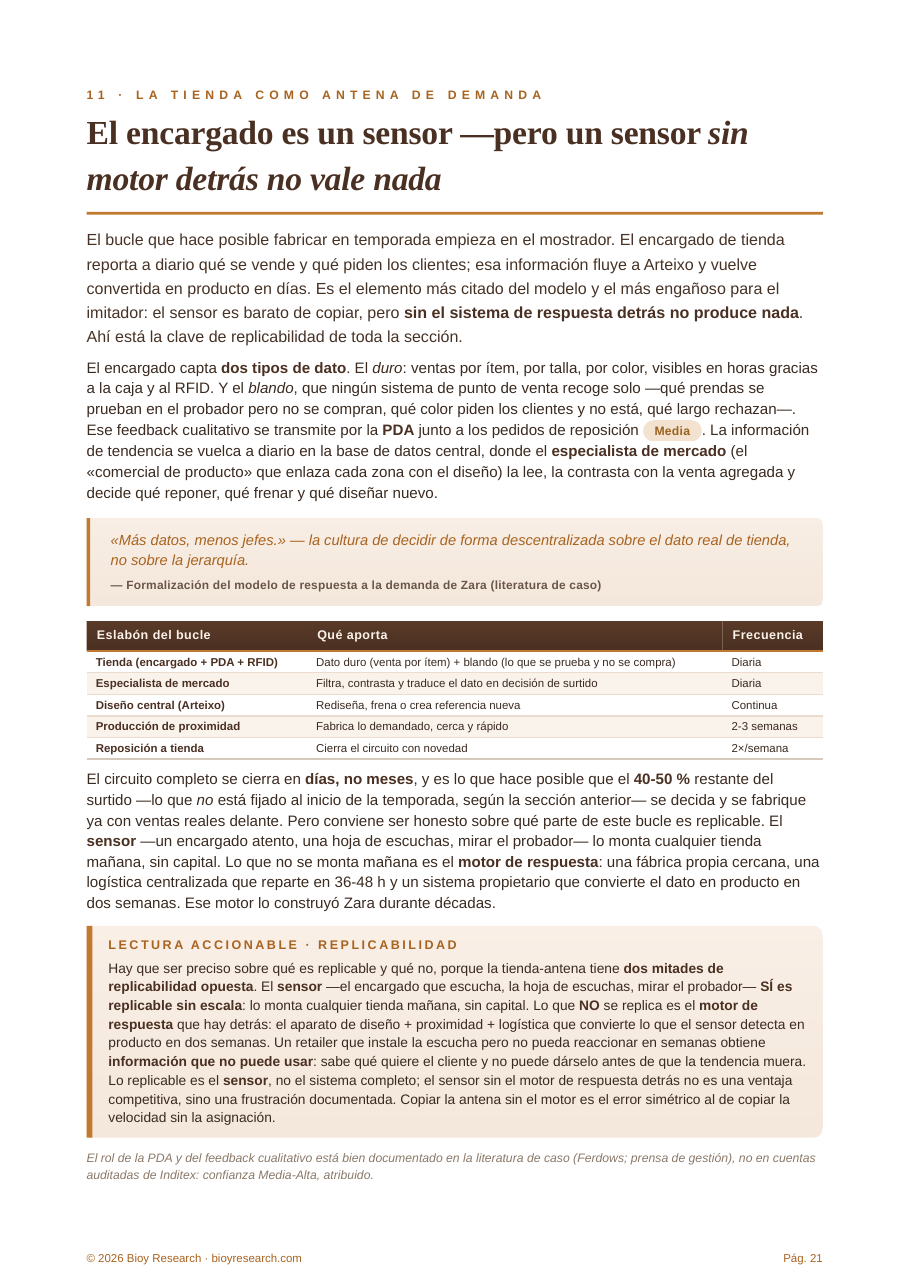
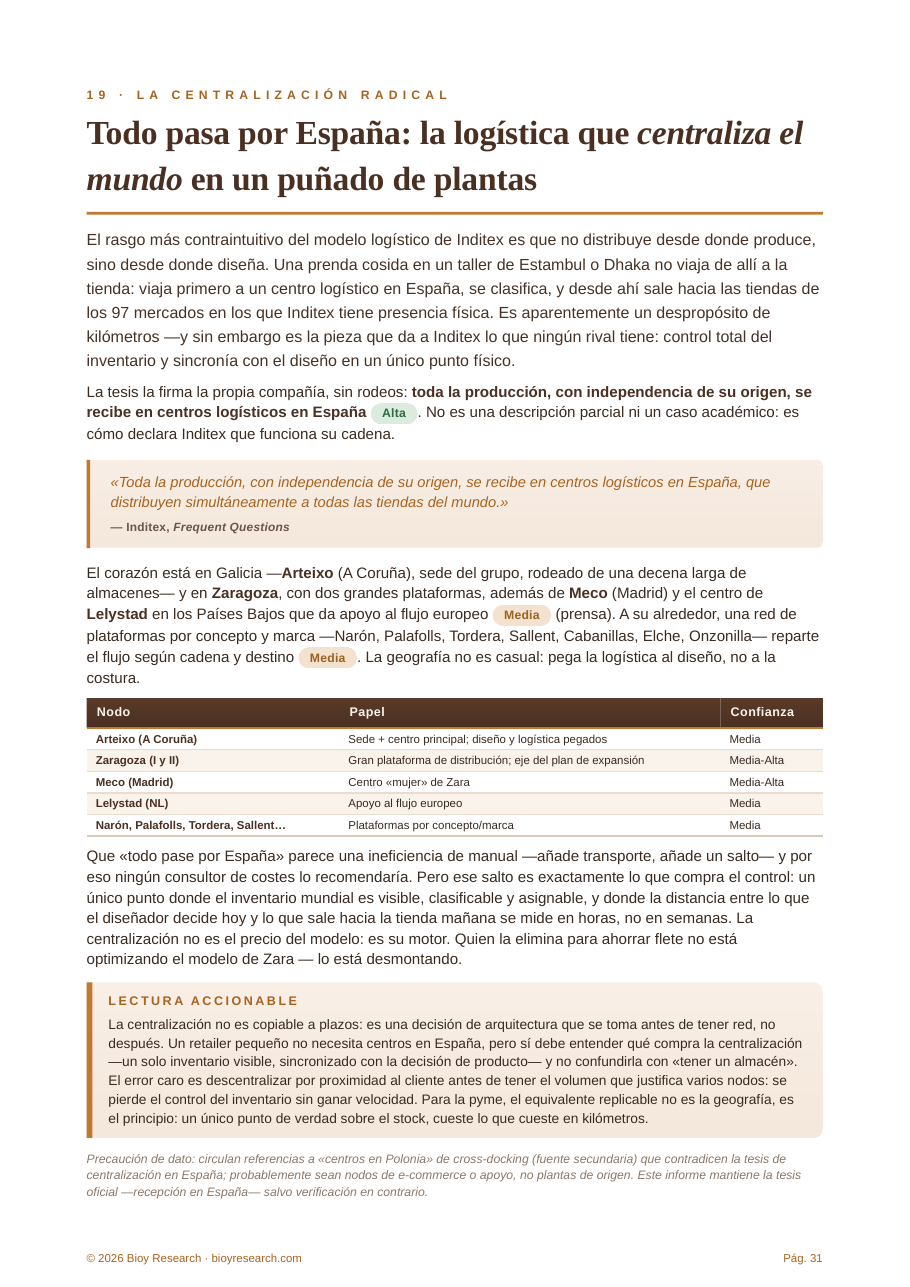
A sample of a few pages from the report. The full version includes all tables, figures and sources.
A 72-page PDF ready to read on any device or print. You receive it by email immediately after payment.
For anyone running a fashion brand, a growing chain or a textile SME who wonders whether the Zara system is a roadmap or a mirage. Secondarily, for the manufacturer or investor who needs to understand what really sustains the sector's margins.
No. The report presents both sides of the model with the source in front: it is at once a textbook case in supply-chain management and a company with litigation and allegations, each with its exact procedural status. It does not sugar-coat in either direction.
No. Annex D publishes the equations, the assumptions, their sources and their limits, so the reader can reproduce every figure in the quantified chapter and substitute the parameters with those of their own business.
It is not bespoke consultancy or a plan for your specific company. It is an analysis of the model, with its method and its data, which you apply to your own case to decide what to copy and what not to.
This report is available in Spanish, English, German and French.
It saves you the imitator's costliest mistake: copying the visible half of the model without the half that sustains it.
Buy the report · €990