PDF interior
What you will see inside
Real PDF pages: cover, executive summary, charts and competitive tables.

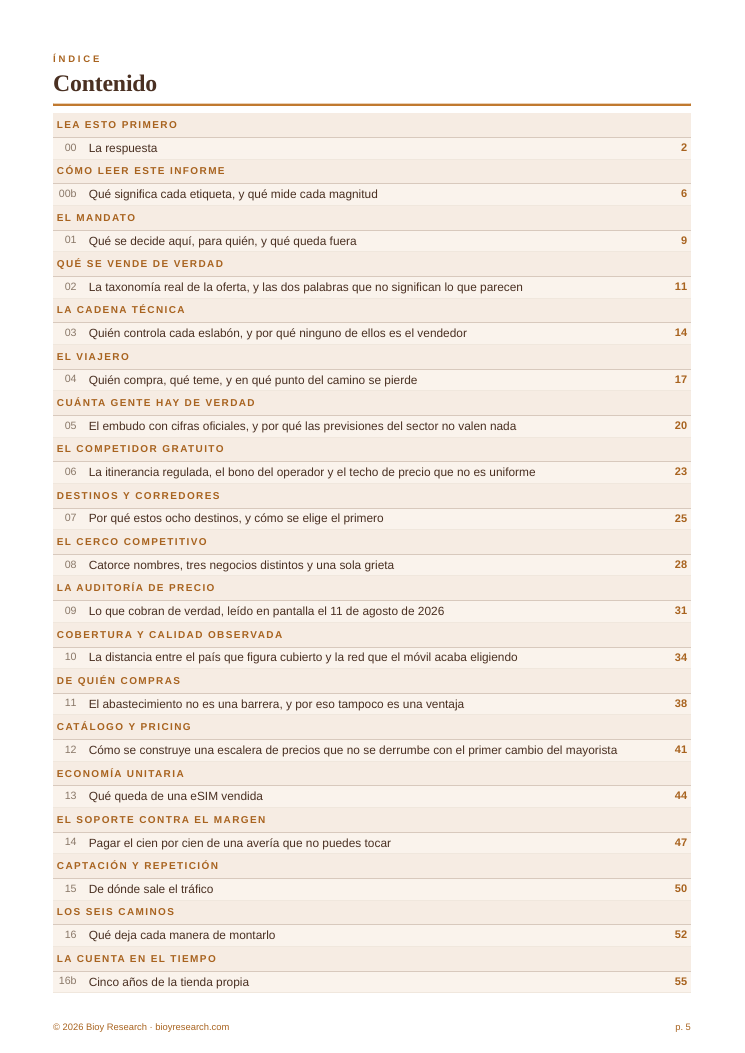
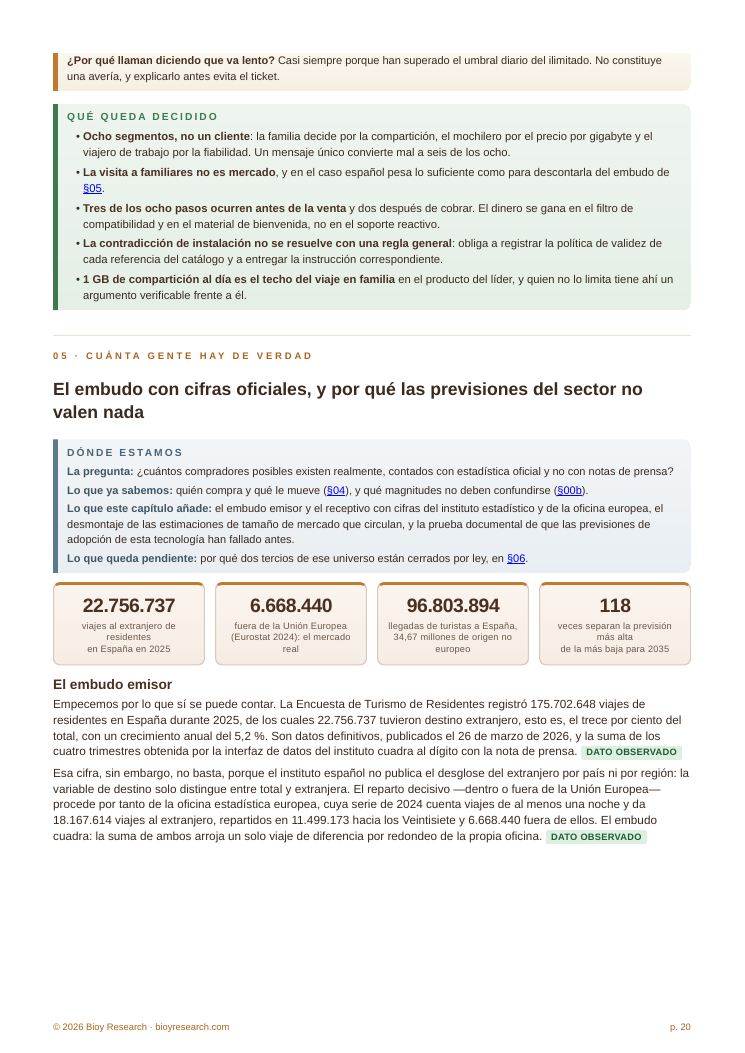
Written for anyone thinking of selling mobile data under their own brand: the digital entrepreneur who sees a business with no stock, the travel agency that wants a new line, the comparison site that already has traffic and the tourism business serving foreign visitors. Six ways of building it, run through one economic engine: what outbound market is actually left once you remove the trip that already carries roaming included, what the screen charges today against what the wholesaler costs, what the CNMC requires before the first line is sold, and what survives of each sale once the click that brought it has been paid for.
Real PDF pages: cover, executive summary, charts and competitive tables.
Each comes out of the same economic engine, is published with its source and its confidence grade, and can be redone with the buyer's own assumptions. Whatever could not be verified is declared in the same table as whatever could.
The sector counts its market in travellers and in app downloads. This report counts it in trips that can buy something. Of all trips abroad by residents in Spain, 63.3% are to a country where the traveller's own plan already covers data at no extra cost: that traveller is not a lost customer, it is a customer who never existed. What remains is 6.67 million trips outside the EU (Eurostat 2024), and the entire funnel of the report is built on that base —not on the headline total— step by step, with the source of every filter.
The prices in this report are neither estimated nor quoted from third parties: they were audited by going into the Airalo and Holafly storefronts across eight destinations and recording what is charged for which bundle, with a cut-off date of 11 August 2026. The table is published in full, destination by destination, so you can redo any comparison, drop the destination that looks atypical to you and check where every figure comes from. Eight destinations chosen on an explicit criterion, and the report explains why those eight and how the first one to go after is picked.
The competitive map of this sector is usually published as a list of brands that appear to compete with one another. The report shows that those fourteen brands are running three different businesses, with cost and acquisition structures that bear no resemblance, and that comparing them on bundle price is comparing unlike magnitudes. Out of that comes the single crack the work identifies as workable, and what it would take to get through it.
The report went looking for wholesale rates and found exactly one in public: Citrus Mobile's. The other fifteen wholesalers contacted or located refer you to opening an account before they will show a price. Rather than filling the gap with a plausible figure, the report publishes what there is, calls it by its name and spells out the consequence: if the cost of supply is only knowable after you have committed, sourcing stops being a barrier to entry —but it cannot be your competitive advantage either.
Reselling eSIMs in your own name from Spain is not selling a travel accessory: it is providing an electronic communications service, and article 6.2 of Act 11/2022 requires notifying the start of activity and registering in the Operators Register. The report cites the doctrine behind it and documents enforcement proceedings opened in July 2026 against an operator in the sector for precisely not having done so —proceedings opened, not a final penalty, and the report keeps the distinction carefully—. It is the requirement most often discovered too late.
The terms you read in eSIM storefronts exclude the right of withdrawal with wording that does not fit the legal ground they invoke. The report explains why the exclusion is badly built, what that means for anyone copying those terms onto their own site, and publishes it as an open risk: there is no ruling that settles it, and saying otherwise would be inventing a certainty that does not exist. It also covers the unlimited-data claim the sector advertises that has already been declared misleading.
The place of supply of a telecommunications service to a consumer is determined by rules of its own, and Implementing Regulation (EU) 282/2011 points to the card's code. Translated: two identical sales can be taxed in different places depending on which SIM is delivered, and that is where the model's largest tax exposure sits. The report explains the mechanism, says what would have to be settled before the first line is invoiced, and is explicit about what it does not do: it hands you the reasoning and the sources, not a binding ruling in your name.
Six models —own-brand storefront, mobile app, single-corridor specialist, white label for a tourism business, corporate account and affiliation— go through the same engine, with the same rules and the same assumptions, so the comparison between them is clean. Each comes with its five-year account under three scenarios, and the report takes the sale apart to the end: what share of the price goes on supply, what share on the payment gateway, what share on supporting a fault you cannot touch because the network belongs to someone else, and what share survives the cost of bringing the buyer in.
A tourist buys an eSIM for one trip and does not come back until the next one, if at all. That makes acquisition the axis of the business rather than one more budget line. The report walks through where traffic comes from in this sector, what each channel costs, what happens with the captive channel —the only one this work sees closing— and what it costs to open it, and closes with the levers measured in a tornado, so you can see which ones really move the result and which are noise.
The traceability register publishes the engine's 87 parameters one by one, with value, source, date and confidence grade, and declares the 10 gaps that could not be closed instead of papering over them with an estimate. And a whole chapter documents the attempts to destroy this report: the attacks made on it, the errors they found, the old figure, the current one and why the first was false. It is published because a due diligence that does not show its corrections is asking for an act of faith.
Download a free sample with the cover and the full table of contents.
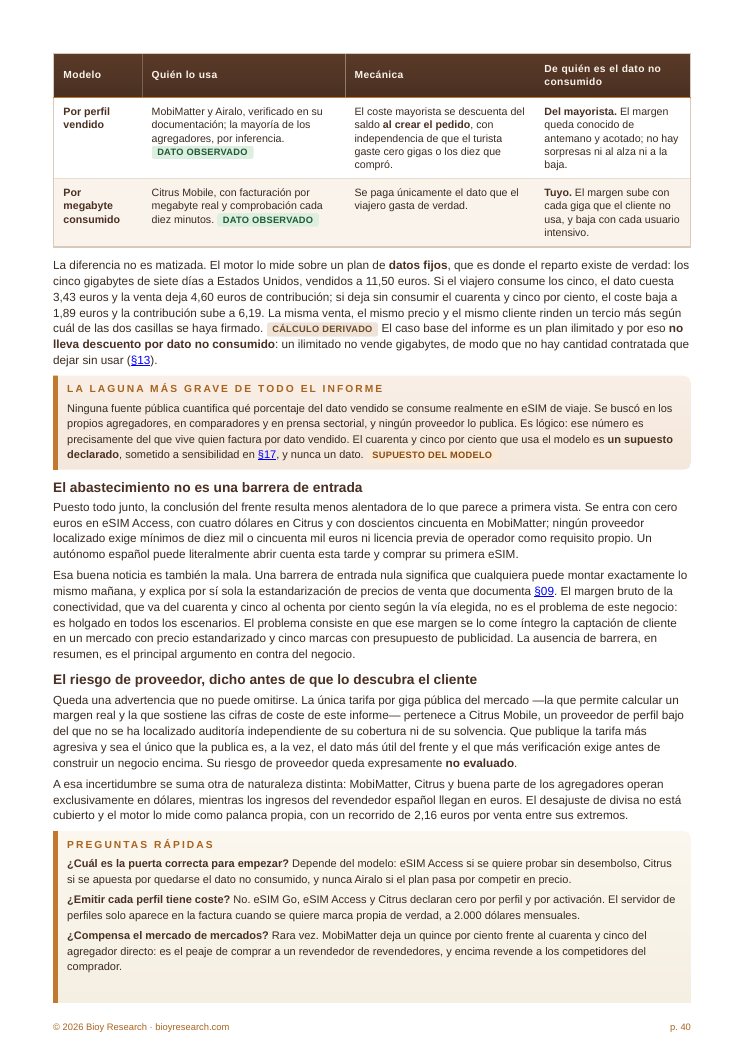
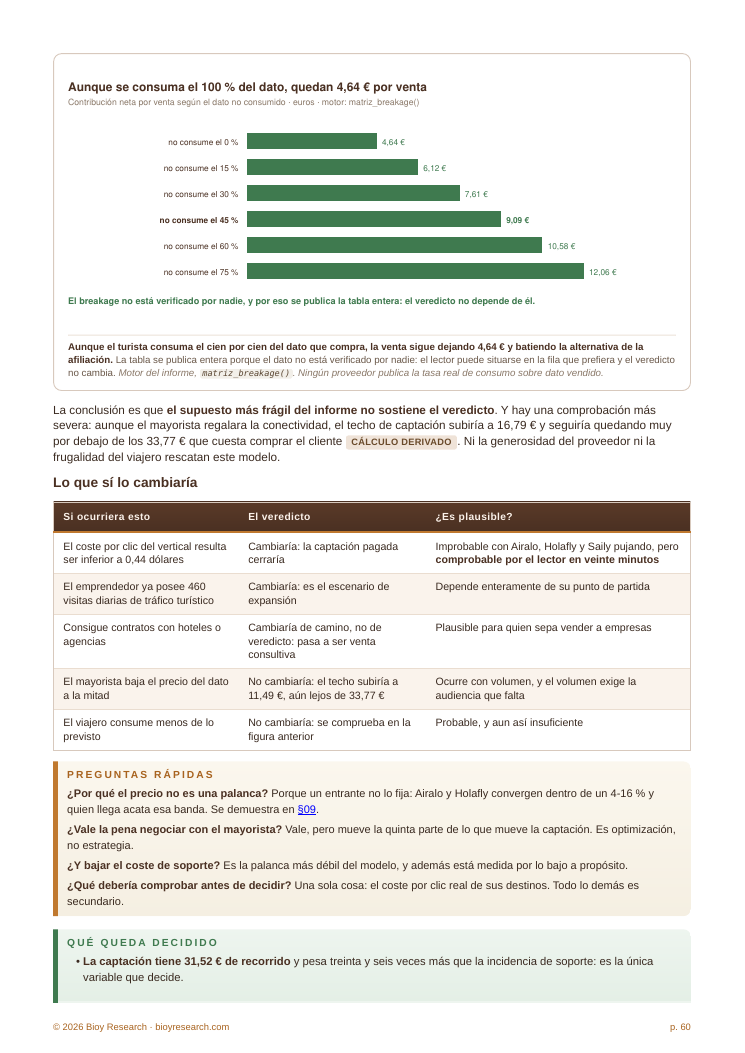
The sample includes the cover and the table of contents, so you can see the full scope of the report. The analysis, the financial model and the verdicts are in the complete edition.
For anyone considering reselling data eSIMs under their own brand from Spain: the digital entrepreneur who sees a business with no stock and no logistics, the travel agency or tour operator wanting a new line on customers it already has, the comparison site or travel publisher with traffic to monetise, and the tourism business —hotel, hostel, car hire— serving foreign visitors that could sell it over the counter. Someone deciding alone, on a defined budget and without an analysis department behind them. It is not a technical eSIM manual, nor a guide for the traveller choosing a plan.
Own-brand storefront, mobile app, single-corridor specialist, white label for a tourism business, corporate account and affiliation. All six go through the same economic engine, with the same rules and the same assumptions, so the comparison is clean: each with its cost structure, its five-year account under three scenarios and its own verdict. The report also explains which lever separates one from another, and it is not the one usually assumed.
The retail prices come from an audit of our own: Airalo and Holafly read on screen across eight destinations, with a cut-off date of 11 August 2026 and the table published in full. The market figures come from official sources: the breakdown of trips abroad by residents in Spain comes from Eurostat 2024, and from there the report builds the funnel down to the market that can actually buy something. On the wholesale side, what exists is published as it is: a single public rate located (Citrus Mobile) against fifteen wholesalers who refer you to opening an account, declared as a gap instead of filled with an estimate.
The report devotes four sections to the framework: registration in the CNMC Operators Register imposed by article 6.2 of Act 11/2022 on anyone reselling in their own name —with the doctrine cited and enforcement proceedings opened in July 2026 against an operator in the sector, which the report presents as proceedings opened and not as a final penalty—; the right of withdrawal, which the sector excludes badly and which is published here as an open risk with no ruling to settle it; the VAT place of supply, where the card's code governs under Implementing Regulation (EU) 282/2011; and the operational risk no lawyer fixes, the visited network cutting off the traffic.
That is precisely the first question the report answers, and with a figure: Regulation (EU) 2022/612 runs until 30 June 2032, and 63.3% of trips abroad by residents in Spain go to a country where data already comes included in the plan. What is left outside the EU is 6.67 million trips (Eurostat 2024). The report also explains why the regulated price ceiling is not uniform and what part is played by the travel add-on the traveller's own operator already sells.
Yes. The engine's 87 parameters are published one by one with their value, source, date and confidence grade, and it is flagged which ones enter the sensitivity analysis. The 10 gaps that could not be closed are declared as such, in the same typeface as everything else. The tornado shows which levers move the result most, so you know where to start swapping our figures for yours.
In Spanish, English, German and French: 109 pages in Spanish and English, 117 in German and 112 in French, with 32 sections, 8 figures, a clickable table of contents and every source linked. All four versions come out of the same calculation engine and the same evidence base, so the figures and the conclusions are identical; only the language changes. It is delivered as a PDF download after purchase; the licence is individual.
Edition 8, the highest we publish, with a data cut-off of 11 August 2026. The report identifies what forces a review —the audited prices, which the storefronts move almost daily; the wholesale rate, opaque as a matter of sector policy; and the regulatory front, with proceedings under way and a roaming regulation in force until 2032— and recommends a review horizon. The parameter register indicates which figures are most sensitive to the passage of time.
Six ways of building it through one economic engine, the outbound funnel with official Eurostat figures, eight destinations and fourteen competitors audited and dated, sourcing with the only public wholesale rate that exists and the fifteen that are not public, the CNMC regime with its article and its live proceedings, the right of withdrawal and VAT explained under their rules, a five-year account with three scenarios, tornado and cash, 87 parameters traced with 10 gaps declared, and a whole chapter on the errors the report's own reviews uncovered.
Buy the report · €990