PDF interior
What you will see inside
Real PDF pages: cover, executive summary, charts and competitive tables.
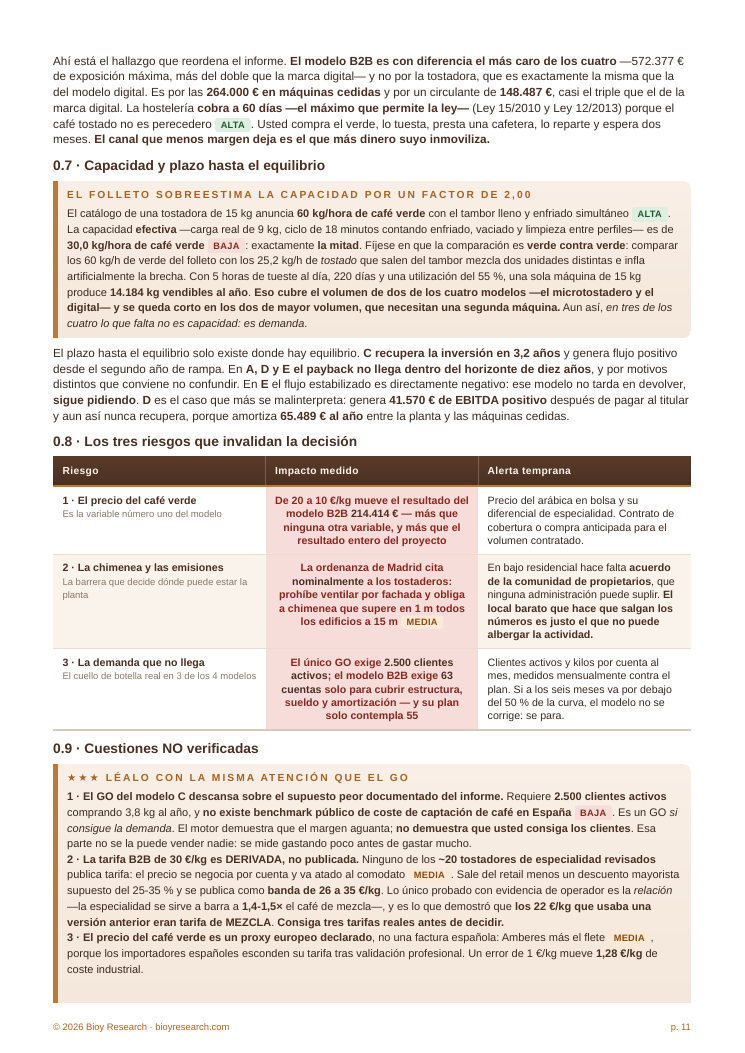
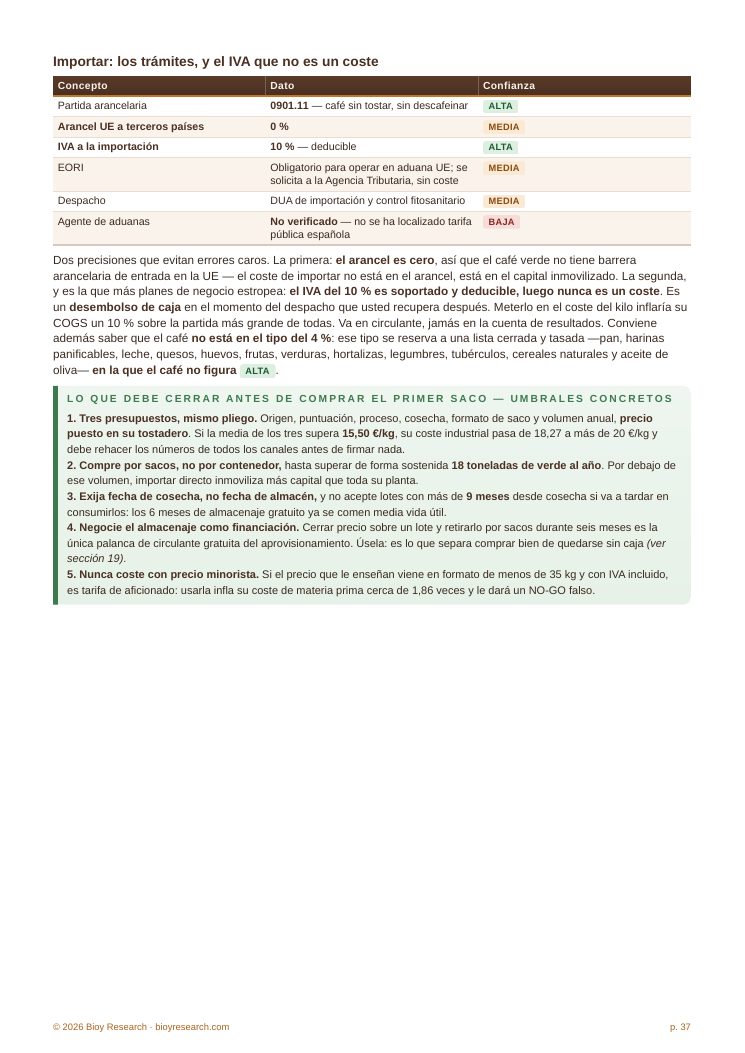
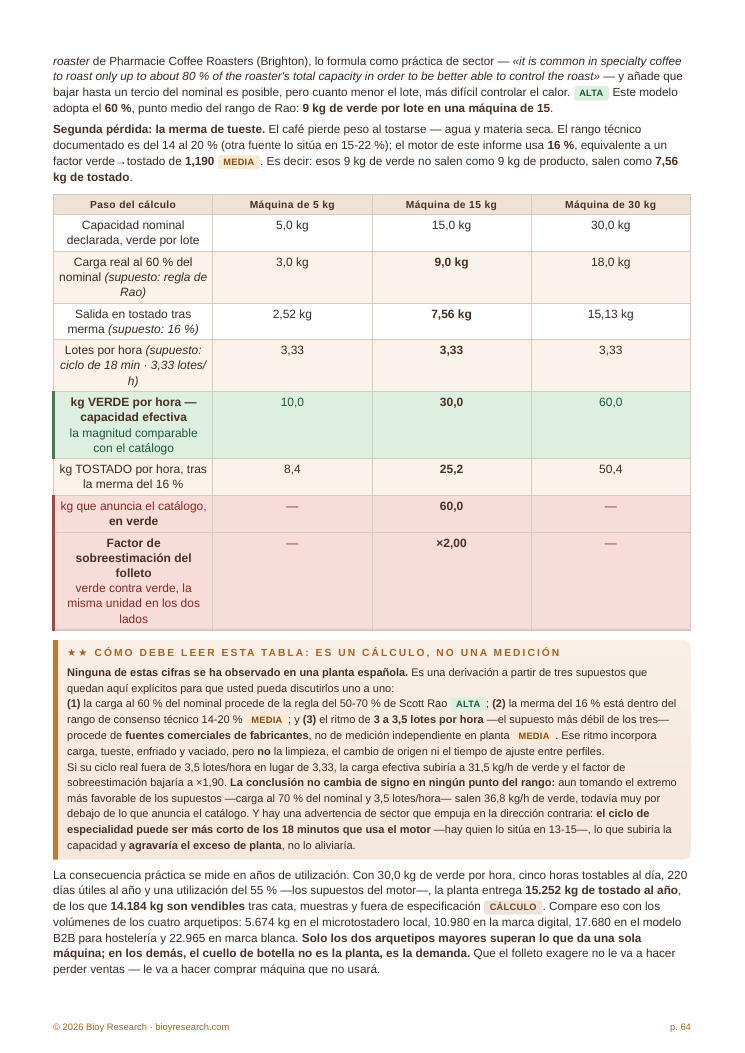
Written for the entrepreneur or small business with the money on the table, asking whether an artisan roastery recovers the capital or merely pays a salary. This is not a roasting manual or a machinery maker's brochure: it is the folder you sign or walk away with, with four archetypes modelled at Spanish 2026 costs and the owner's market salary deducted before any talk of profit.
Real PDF pages: cover, executive summary, charts and competitive tables.
A decision report, not an overview of the specialty coffee scene. Every figure comes out of a financial engine whose assumptions are published one by one, and every decisive statement carries its source, its date and the confidence grade we give it.
The project's instinct is usually about the machine: which roaster, how many kilos, which brand. The report shows with the model that the roaster does not decide the outcome of any of the four archetypes. What decides it is the price differential —what you pay for green coffee and what you manage to charge for it roasted— and the channel you place it in. In the sensitivity tornado, those two levers are worth 209,953 € of swing each; the other seven, 42,513 € on average: nearly five to one, lever against lever.
Almost every business plan in the sector counts the kilo wrong. Between roast loss and operational loss —cuppings, samples, product past its window—, every kilo of green coffee that enters the plant turns into about 781 sellable grams: a factor of 1.280 green kilos per kilo you invoice. The report walks the whole conversion chain, applies it across the four P&Ls and shows what happens when it is forgotten at any of its four links.
A roastery that pays its owner a market salary and does not return a single euro on the capital invested is not an investment: it is self-employment. The report puts that salary at 35,890 € a year —gross pay plus the RETA (Spanish self-employed social security) contribution— and deducts it in all four P&Ls before calculating the result. That criterion alone changes the verdict on three of the four archetypes compared with how the sector presents them.
Roasting it yourself saves 3.23 € per kilo against putting it out to contract. But having a plant costs, in costs that exist only because you have it, 30,934 € a year in the B2B model: it takes 9,574 kilos a year for that saving to pay for that structure. The threshold is not a single number —it ranges from 2,024 to 14,741 kilos depending on the archetype— and crossing the cost threshold does not mean the project pays back the capital: on NPV, maquila wins in one of the four.
Selling coffee to the hospitality trade in Spain almost always means handing over the espresso machine and the grinder under comodato, tied to an exclusive supply contract. That is 4,800 € per account that no business plan budgets for and that in the B2B archetype adds up to 264,000 € of CAPEX —more than the entire plant, which costs 159,890 €—, plus the technical service and the training for each bar. The report models that whole circuit, with its replacement and its recovery.
Registration with the RGSEAA (Spanish food business register), APPCC (the Spanish HACCP food-safety plan) and batch traceability, the business activity heading, the IVA (Spanish VAT) rate applied to what you sell, the owner's status as a company director under RETA, and the Impuesto de Sociedades (Spanish corporate income tax) brackets in force from 2027, with the carry-forward of tax losses. It includes what the European deforestation regulation (EUDR) does and does not require of you as a roaster, which is not what is usually said.
The report includes the case against itself: the errors it carried while it was being built, how they were caught and what each correction changed. One of the planned archetypes —the roastery with its own coffee shop— was withdrawn, and the report explains why: it was badly framed, it carried the costs of a hospitality business and invoiced like a roastery. No amount of correcting figures fixes a badly framed model.
Download a free sample with the cover and the full table of contents of the report.
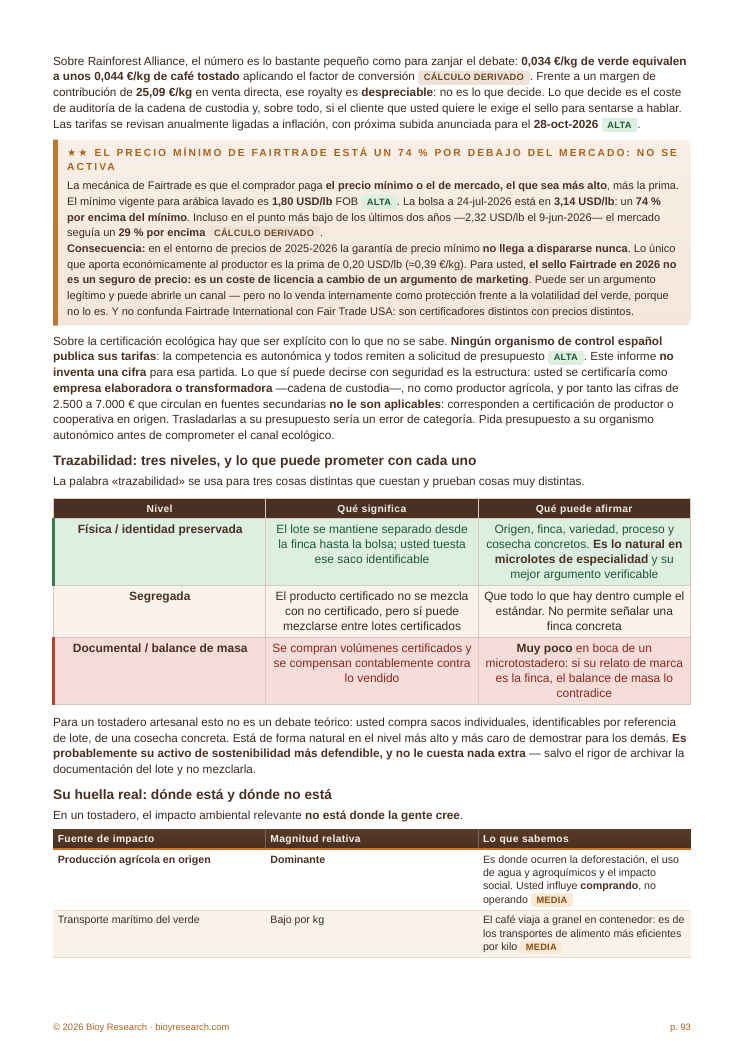
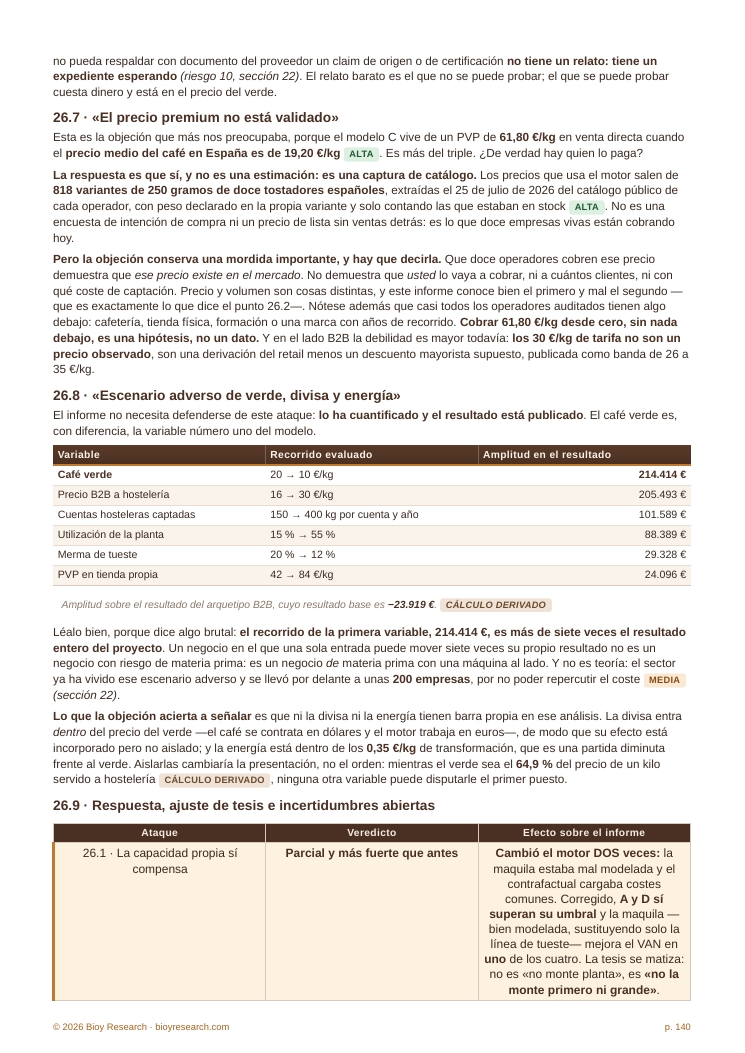
The sample includes the cover and the contents, so you can see the full scope of the report. The analysis, the financial model and the verdicts are in the complete edition.
For the entrepreneur or small business assessing whether to set up an artisan coffee roastery in Spain and wanting to know whether the project recovers the capital. It is not a roasting manual or a course on roast profiles: it is a financial decision report. Each of the four archetypes has its own verdict and its own roadmap.
Micro-roastery with local sales; digital brand with its own plant; B2B production for the hospitality trade; and private label roasting for third parties. All four are modelled with the same financial engine and at Spanish 2026 costs, so that their results are comparable with one another. A fifth planned archetype —the roastery with its own coffee shop— was withdrawn after the adversarial review, and the report explains why.
It gives a verdict per archetype, with the figure in front of you: only one of the four pays back the capital invested. The other three pay the owner a market salary without returning the capital, or not even that. The report does not sweeten the result: if a model loses money, it says so with the NPV, the IRR and the break-even in plain sight.
Yes, and that is one of its central questions. The report calculates the real industrial cost per kilo against the maquila rate and establishes from how many kilos a year owning a plant pays off, archetype by archetype. In one of the four, maquila also wins on NPV, not just on unit cost.
The report publishes the full traceability register: every figure the model uses, with its value, its unit, its source, its consultation date and its confidence grade, plus which assumptions are sensitive to the result. The sensitivity tornado tells you which variables really move the verdict and over what realistic range they have to be moved.
Scope Spain, with 2026 data and prices, and the tax framework including the Impuesto de Sociedades brackets in force from 2027. The sources carry their consultation date in the traceability register, so that you can check what may have changed since.
A 178-page PDF, for immediate download after purchase, with a single licence. You can see the cover and the full table of contents in the free sample before deciding.
Four archetypes with a verdict, the real cost per kilo against maquila, the comodato CAPEX that nobody budgets for and and every assumption in the model published with its source, so you can redo the arithmetic yourself.
Buy the report · €3,499