PDF interior
What you will see inside
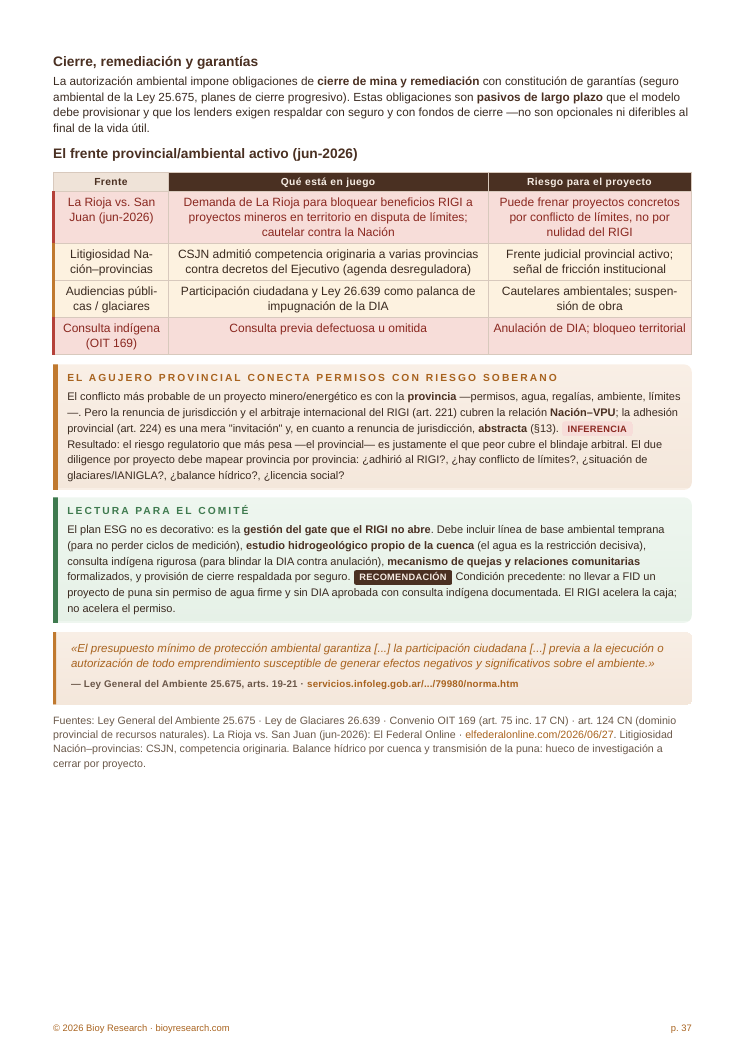
Real PDF pages: cover, executive summary, charts and competitive tables.
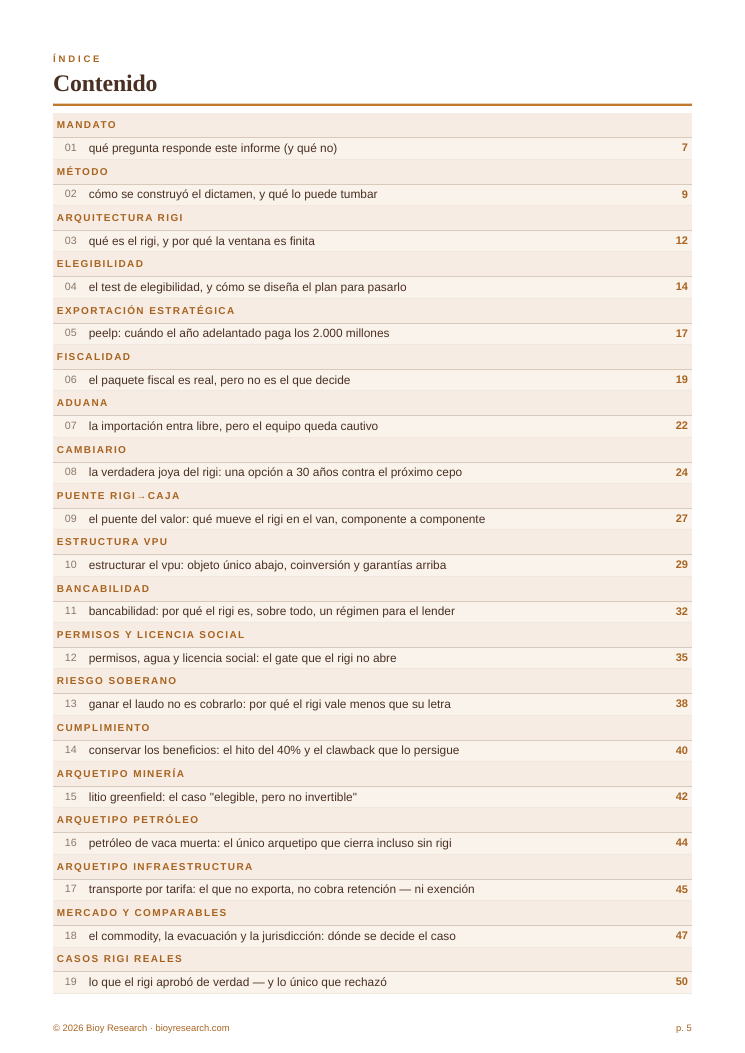
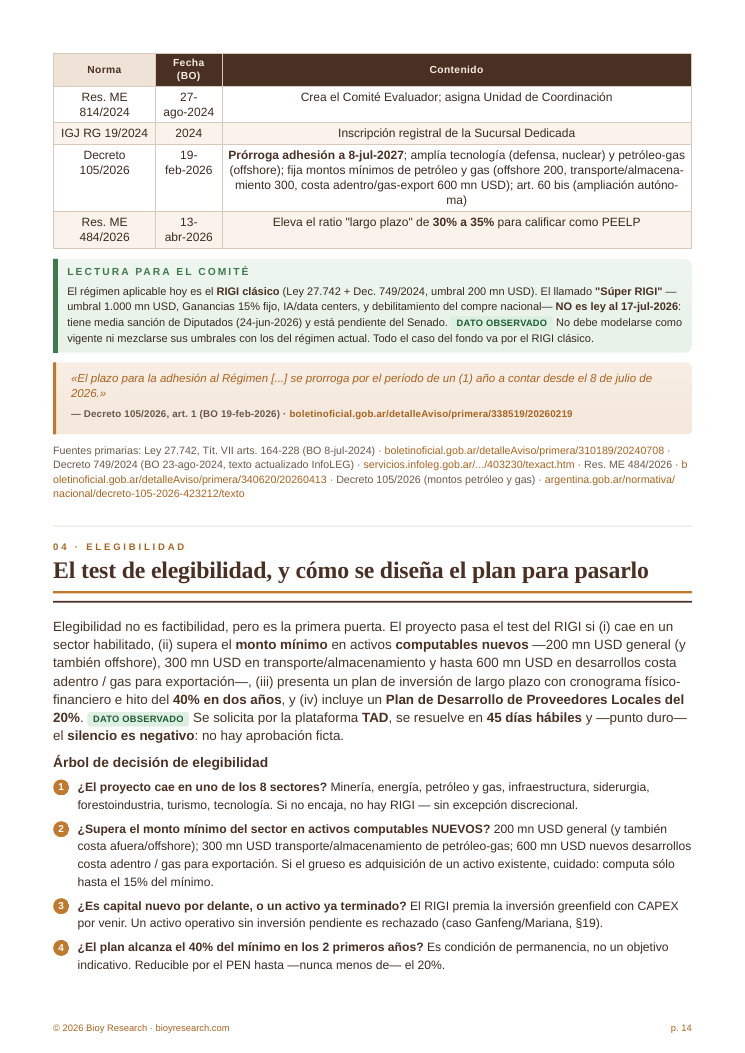
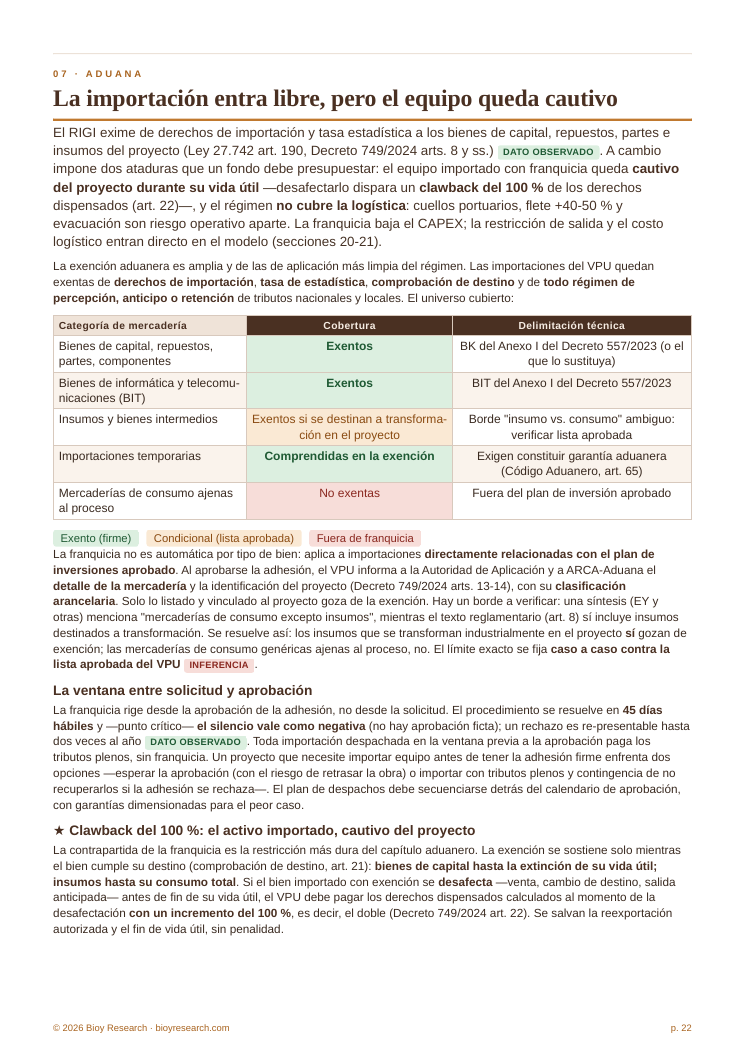
Written for the investment committee of an infrastructure or natural-resources fund weighing whether to finance a large-scale Argentine project under the RIGI (the Large Investment Incentive Regime). This is not a brochure for the regime: it is the folder on which the disbursement is approved or rejected, with the financial model inside and the project-finance waterfall already worked out on paper.
Real PDF pages: cover, executive summary, charts and competitive tables.
An investment decision file, not an overview of the regime. Every figure comes out of a financial engine, and every decisive claim carries its source, its date and the confidence we place in it.
The intuition sells: "the project got into RIGI, so it must be good." It does not follow. Regime approval is an administrative act about the eligibility of the vehicle —the SPV— and its fiscal and FX benefits; it says nothing about whether the deposit has grade, whether there is a way to get the product out, or whether the offtake is signed. The report separates the two questions everyone conflates —is it eligible? and is it investable?— and shows why a project can be approved and still be a NO-GO.
The headline is about the corporate income-tax cut, and that is the line item everyone looks at first. But what really moves the NPV of a 30-year project in Argentina is not the rate: it is the stability —fiscal, customs and regulatory— locked in for three decades, and above all the phased access to foreign currency and the free availability of the export cash. The report rebuilds the incentive piece by piece and shows where the regime's real value lives, which is almost never where the brochure points.
RIGI promises 30 years of stability and international arbitration. On paper it is a strong guarantee; in practice, Argentina carries a track record of arbitral awards —expropriations, rule changes, controls— that no article of a law repeals. The report puts that record on the table with names and dates, explains what a stability clause really protects against a change of government and what it does not, and why the committee should model sovereign risk as an explicit discount, not a footnote.
The expensive mistake is not getting the tax rate wrong: it is falling in love with the resource and forgetting how it leaves the country. A world-class lithium deposit with no transmission or logistics, or a Vaca Muerta well with no pipeline capacity under contract, is not a project: it is a stranded option. The report shows —archetype by archetype— that the dominant variable of the verdict is evacuation capacity and secured offtake, not the size of the fiscal incentive. The bottleneck is not the mine or the well: it is the pipe and the ship.
There is no single verdict for "investing in Argentina via RIGI": there are four situations, and the same regime is a yes in one and a no in another. Greenfield lithium, Vaca Muerta unconventional, transport infrastructure (an evacuation pipeline) and the RIGI framework itself as a cross-cutting thesis. All four run through the same engine —project cash flow, NPV, IRR, DSCR, break-even, project-finance waterfall and breakeven point— so your CFO can redo the numbers, argue with them and break them. In dollars, because that is the currency in which the project is financed and paid.
A project can show a positive NPV and still not get financed. The project-finance waterfall, the debt-service coverage ratio (DSCR), the conditions precedent and the reserve accounts matter as much as the equity IRR. The report brings the SPV structure, the conditions-precedent matrix and what a senior lender demands before moving a single dollar —what separates a project that is profitable on paper from one a real bank actually disburses.
Before publishing we put the thesis through an adversarial review briefed explicitly to refute it: the real value of the incentive, the effective protection of RIGI, the evacuation bottleneck, the long-term price of the resource. The chapter tells you which objections held, which knocked us down and what we changed —including our own mistakes. And every claim that moves the verdict goes into a register with its source, its date and the confidence we place in it, saying so when the confidence is low or when a figure is merely a party's own claim. With direct links so you can verify it yourself. All inside the PDF.
Download a free sample with the cover and the full table of contents.
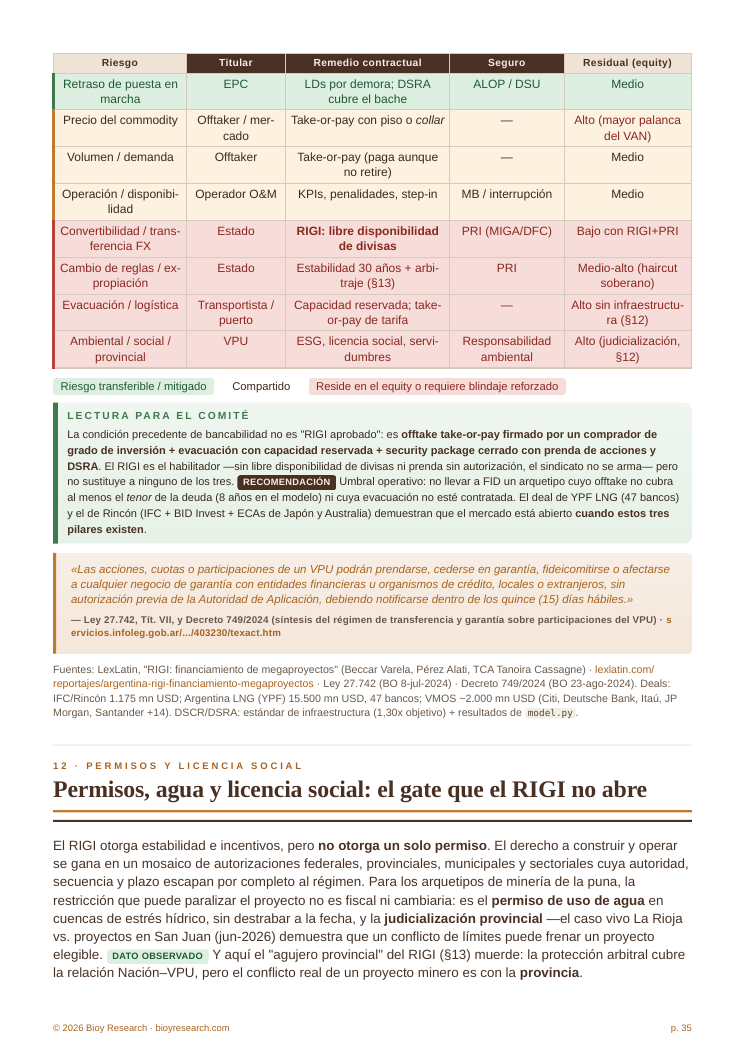
The sample includes the cover and the contents, so you can see the full scope of the report. The analysis, the financial model and the verdicts are in the full edition.
For the investment committee of an infrastructure or natural-resources fund —and the deal team that advises it— weighing whether to finance a large-scale Argentine project under RIGI. It is not a brochure for the regime or a macroeconomic overview: it is an investment due-diligence file, built for three real archetypes —lithium, Vaca Muerta and evacuation infrastructure— plus the RIGI framework itself as a cross-cutting thesis.
No, and that is one of the report's central theses. RIGI approval is an act about the eligibility of the vehicle and its fiscal and FX benefits; it says nothing about the grade of the resource, evacuation capacity or offtake. The report deliberately separates eligible from investable: a project can be approved and still be a NO-GO. If your investment thesis takes the project as sound because "it got into RIGI", it has a hole in it, and the report shows you where.
It depends on the archetype, which is why there are four. Each one runs through the same financial engine and receives a verdict —GO, conditional GO, WAIT or NO-GO— with the explicit conditions precedent where the verdict is conditional. The report does not give a generic "yes to Argentina": it gives a verdict per archetype, with the numbers already run so your committee can redo them, argue with them and break them.
Because they are the constraint that governs the verdict. A world-class resource with no transmission, no pipeline capacity under contract or no firm buyer is not an investable project: it is a stranded option. The report shows, archetype by archetype, that the dominant variable of the sensitivity tornado is evacuation capacity and secured offtake, not the size of the fiscal incentive. The bottleneck is not the resource: it is how it leaves the country and who buys it.
The financial model reasons in US dollars (USD), because that is the currency in which a large-scale resource project in Argentina is financed, offtakes are signed and an international fund measures its return. The report sells for €3,499 per single licence, as an instant-download PDF.
The report is available in Spanish, English, German and French. Each version is a full edition, not a summary: the same analysis, the same financial model and the same verdicts, adapted to the language.
Before publishing, we put the report's thesis to the explicit task of destroying it, angle by angle: the real value of the incentive, the effective protection of RIGI against sovereign risk, the evacuation bottleneck and the long-term price of the resource. The review chapter tells you which objections held, which knocked us down and what we changed, including our own mistakes. It is the part that gives most confidence in the final verdict.
Four archetypes with a verdict, the real constraint that decides, sovereign risk with names and dates, and the financial model so you can redo it with your own numbers.
Buy the report · €3,499