PDF interior
What you will see inside
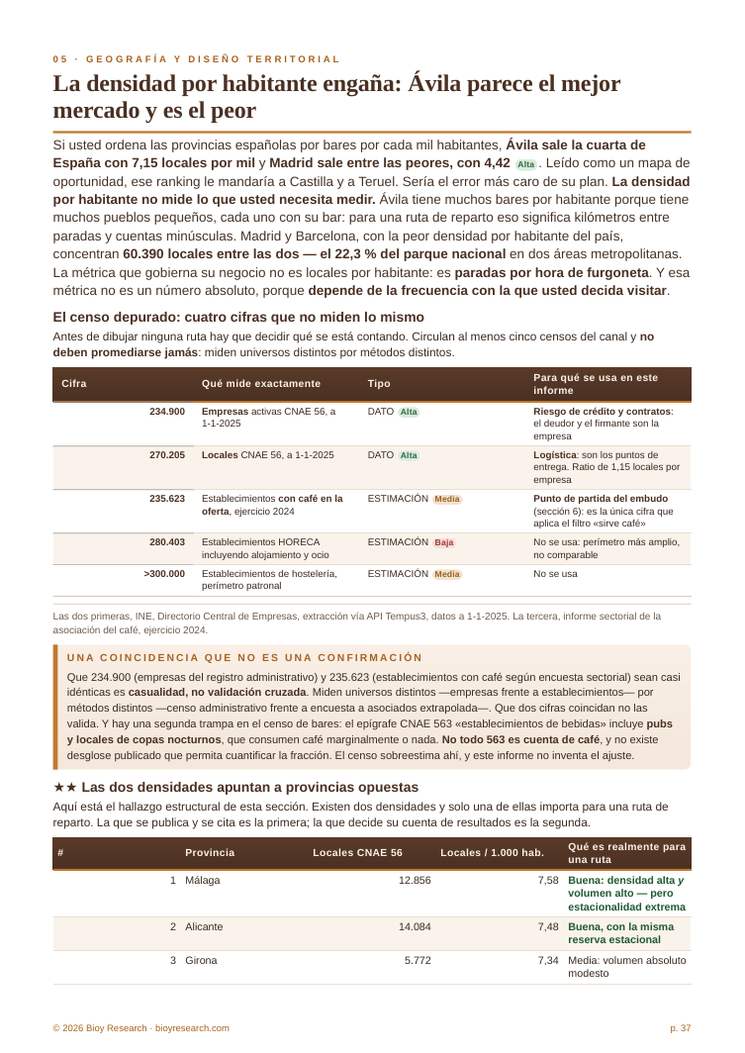
Real PDF pages: cover, executive summary, charts and competitive tables.
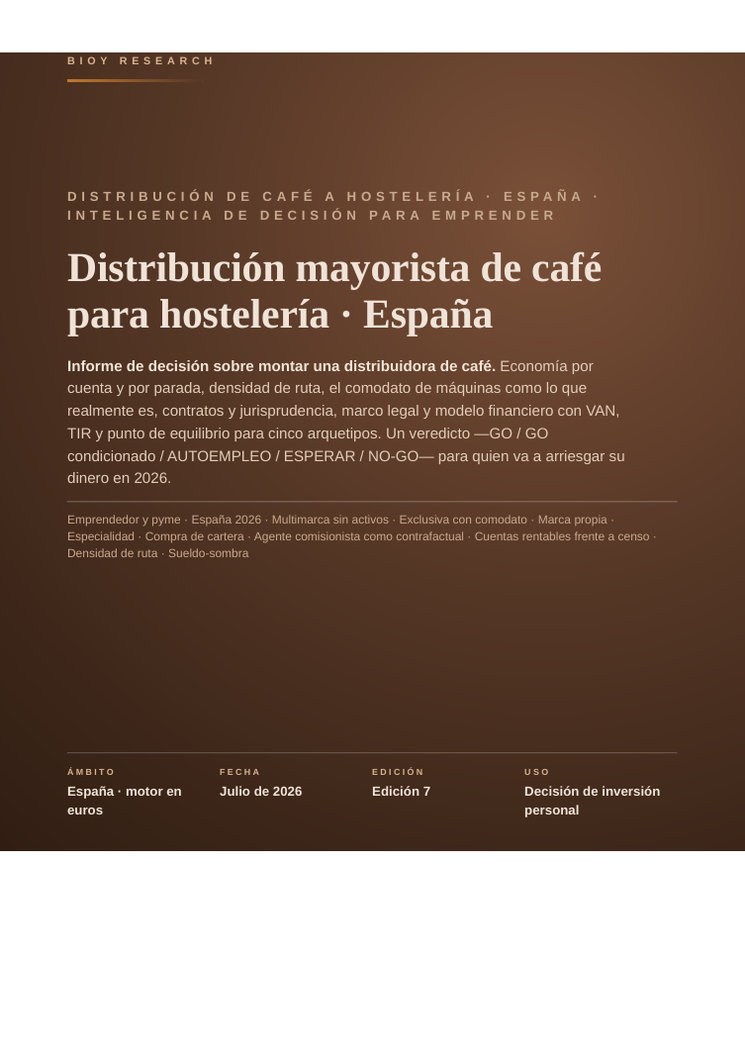
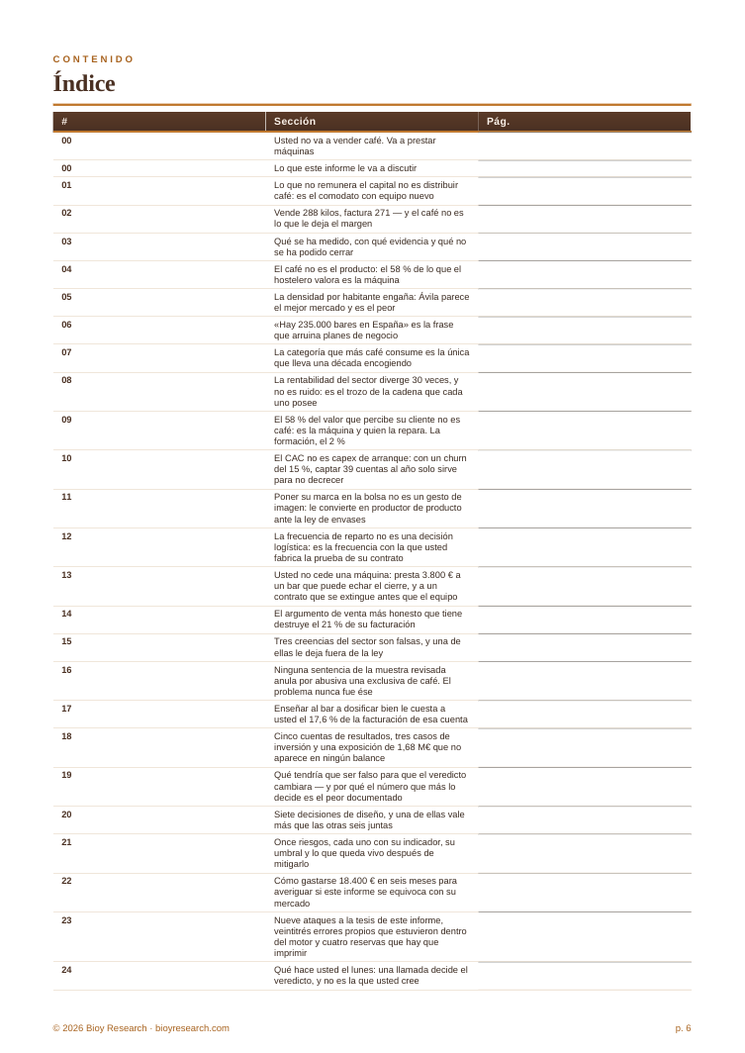
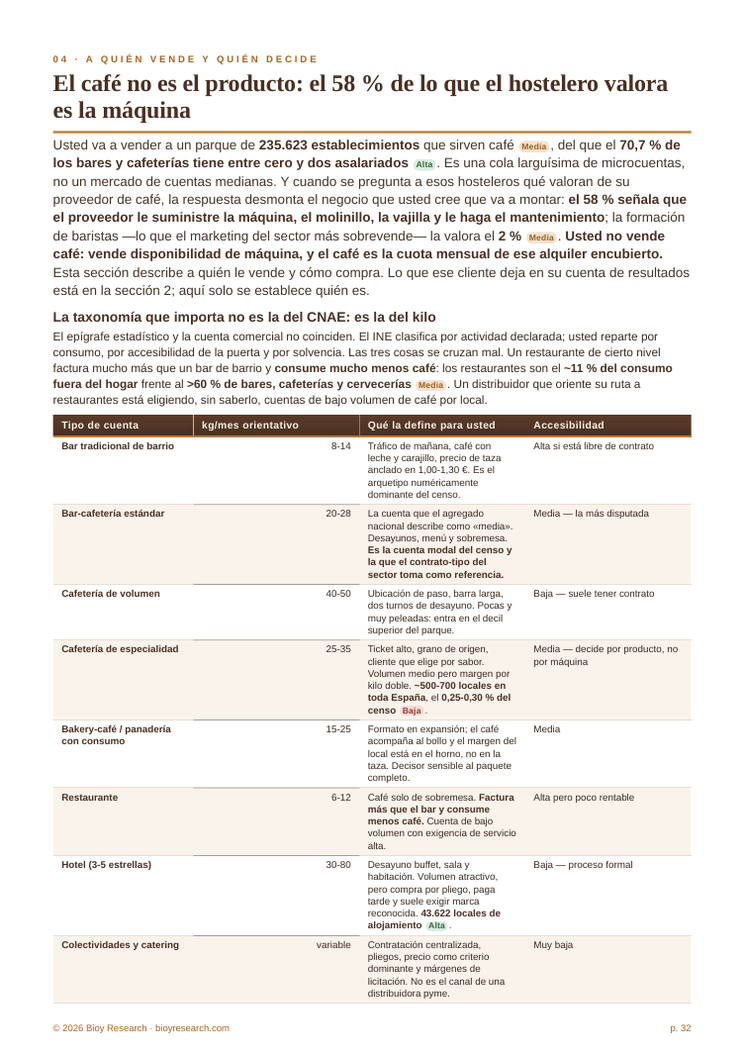
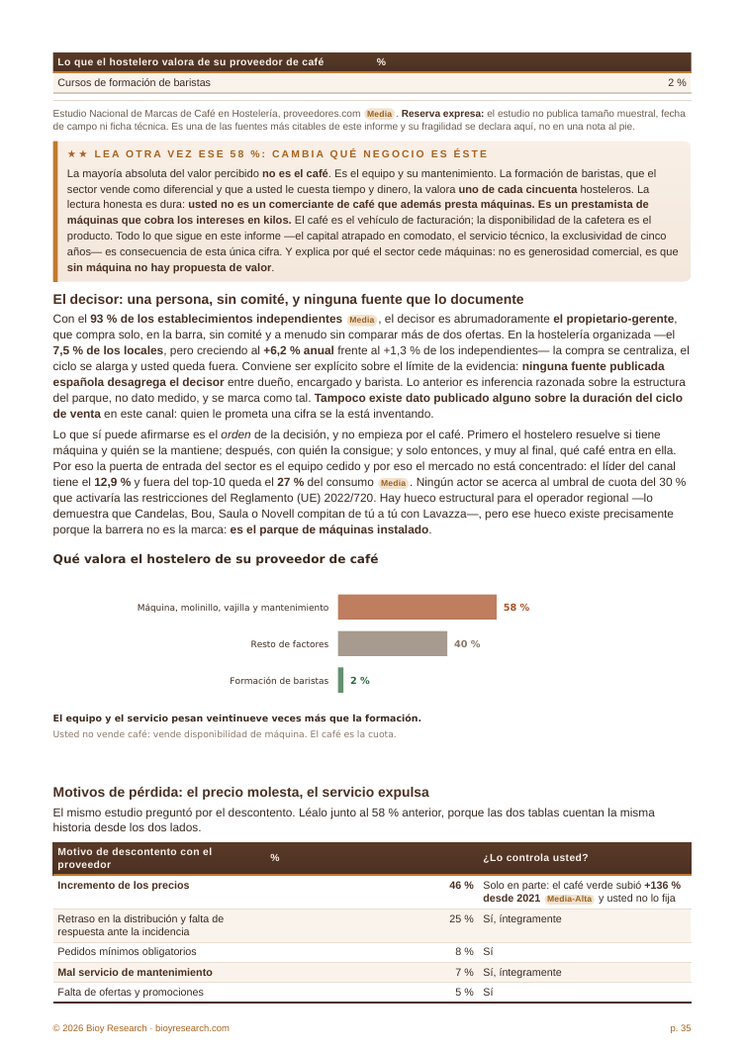
Written for the entrepreneur or small business weighing up whether to set up a coffee distribution business serving bars and restaurants, and who wants to know whether it pays a return on capital or simply buys them a job. This is not a sales manual or a machinery manufacturer's brochure: it is the folder you sign or walk away with, with five business models run through the same financial engine at 2026 Spanish costs and the owner's market salary deducted before any talk of profit.
Real PDF pages: cover, executive summary, charts and competitive tables.
A decision report, not a tour of the coffee sector. Every figure comes out of a financial engine whose assumptions are published one by one, and every decisive statement carries its source, its date and the confidence we place in it.
The Spanish hospitality census is the first figure to appear in every business plan in the sector, and it is the first one that misleads. The report runs it through four successive filters — venues already belonging to a chain with central purchasing, those tied to a live exclusive with another distributor, those that fall short of the minimum consumption that makes visiting them viable, and those that fail the credit screen — and what survives at the end of the funnel is a fraction of the starting point. That number, not the census, is the market you will be building your route on.
Serving a customer carries a cost that exists whether or not the customer buys much: the driver's stop, the sales call, the point-of-sale materials, the technical service on the loaned machine, and the financing of the credit you extend. The report calculates the consumption threshold below which an account destroys margin — 18.1 kilos a month in the base case — and shows what proportion of the accessible census falls below that line. Winning customers below the threshold is not growth: it is buying losses one at a time.
Loaned equipment (comodato) — handing over the espresso machine and grinder in exchange for an exclusive supply agreement — is the practice that orders the entire sector and the axis of this report. In the exclusive distributor model it means €395,200 of machines that you pay for, that never set foot in your warehouse, and that are written off only if the contract lasts. The report models the whole cycle by cohorts: replacement, wear, withdrawal, recovery, and what happens when the account closes before the equipment has paid for itself.
The profit and loss of a single customer, line by line: the 24 kilos a month they buy, the free coffee you give away and never invoice, the price you charge, the cost you buy at, delivery, sales commission, materials, bad debt, and the depreciation of your equipment. What is left at the bottom is that account's real contribution. Put that payback period next to how long contracts actually last and you have the central problem of the business.
A driver covers a bounded number of accounts a day, and that number varies sharply between a dense town centre and a dispersed metropolitan area: 190 versus 113 accounts per route in the model. From that comes the minimum viable scale, the exact moment you have to add the second van and the second driver, and why growth is not a smooth curve but a staircase whose steps sink the margin just after each one.
The security behind the loaned equipment is an exclusive supply contract, and the Spanish courts have spent years narrowing which parts of that contract are actually enforceable: the maximum admissible term, the validity of penalty clauses for breach, what happens when the publican sells the business on, and whether the new owner is bound or not. The report sets out that case law with the official reference for each ruling, so you can check every judgment one by one.
Multi-brand with no assets; exclusive distributor with loaned equipment; own-label coffee under the distributor's brand; speciality coffee specialist; and buying an existing book of accounts. All five run through the same engine, with the same discount rate and the same owner's salary deducted, so their results are comparable with one another. The gap between best and worst exceeds two million euros of net present value, and the ranking is not the one the volume of assets each demands would suggest.
Download a free sample with the cover and the full table of contents.
The sample includes the cover and the contents, so you can see the report's full scope. The analysis, the financial model and the verdicts are in the complete edition.
For the entrepreneur or small business assessing whether to set up a coffee distribution business serving bars, cafés and restaurants in Spain, and who wants to know whether the project recovers its capital. It is not a sales-technique manual or a barista guide: it is a financial decision report. Each business model closes with its own verdict and its own roadmap.
Multi-brand with no assets, distributing third-party brands without lending machines; exclusive distributor with loaned equipment (comodato), the sector's classic model; own-label coffee under the distributor's brand; speciality coffee specialist; and buying a book of accounts already up and running. All five are modelled with the same financial engine and at 2026 Spanish costs, so their results are comparable with one another.
It gives a verdict per model, with the figure in front of you. The report does not sugar-coat the outcome: whatever each model does to your capital, it says so with the NPV, the IRR and the break-even in plain sight, and it shows what the owner's market salary does to each result once it is deducted.
It is the free loan of the espresso machine and grinder to the publican in exchange for an exclusive supply contract. It is the practice that orders the sector and the one that decides the outcome: you pay for the equipment, it is installed on premises you do not control, and it is written off only if the contract lasts long enough. The report models it by cohorts — purchase, replacement, wear, withdrawal and recovery — and sets alongside it the case law on how far that exclusivity is actually enforceable.
The report publishes the full traceability register: every figure the model uses, with its value, its unit, its source, the date it was consulted and its confidence rating, plus which assumptions are sensitive to the result. The sensitivity tornado tells you which variables really move the verdict and over what realistic range they have to be moved.
Scope Spain, with 2026 data and prices, and a tax framework that includes the corporate income tax bands in force from 2027. The judgments cited carry their official reference and the sources their consultation date, so you can check what may have changed since.
A 229-page PDF, available for instant download after purchase, under a single-user licence. You can see the cover and the full table of contents in the free sample before deciding.
Five business models each with its verdict, the real funnel behind the hospitality census, the profit and loss of a single bar line by line, the loaned-equipment CAPEX that decides the outcome, and every assumption in the model published with its source so you can redo the numbers yourself.
Buy the report · €3,499