PDF interior
What you will see inside
Real PDF pages: cover, executive summary, charts and competitive tables.
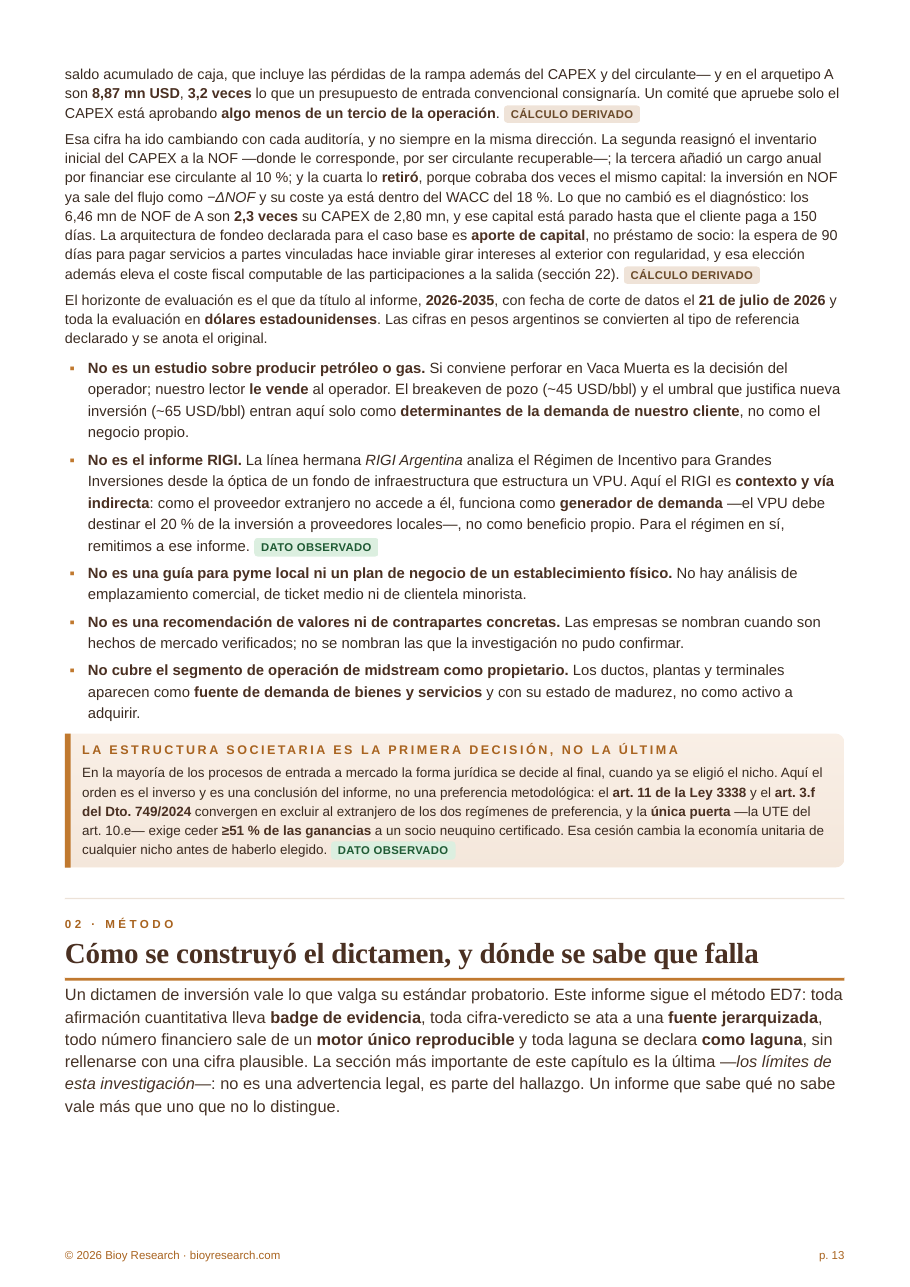
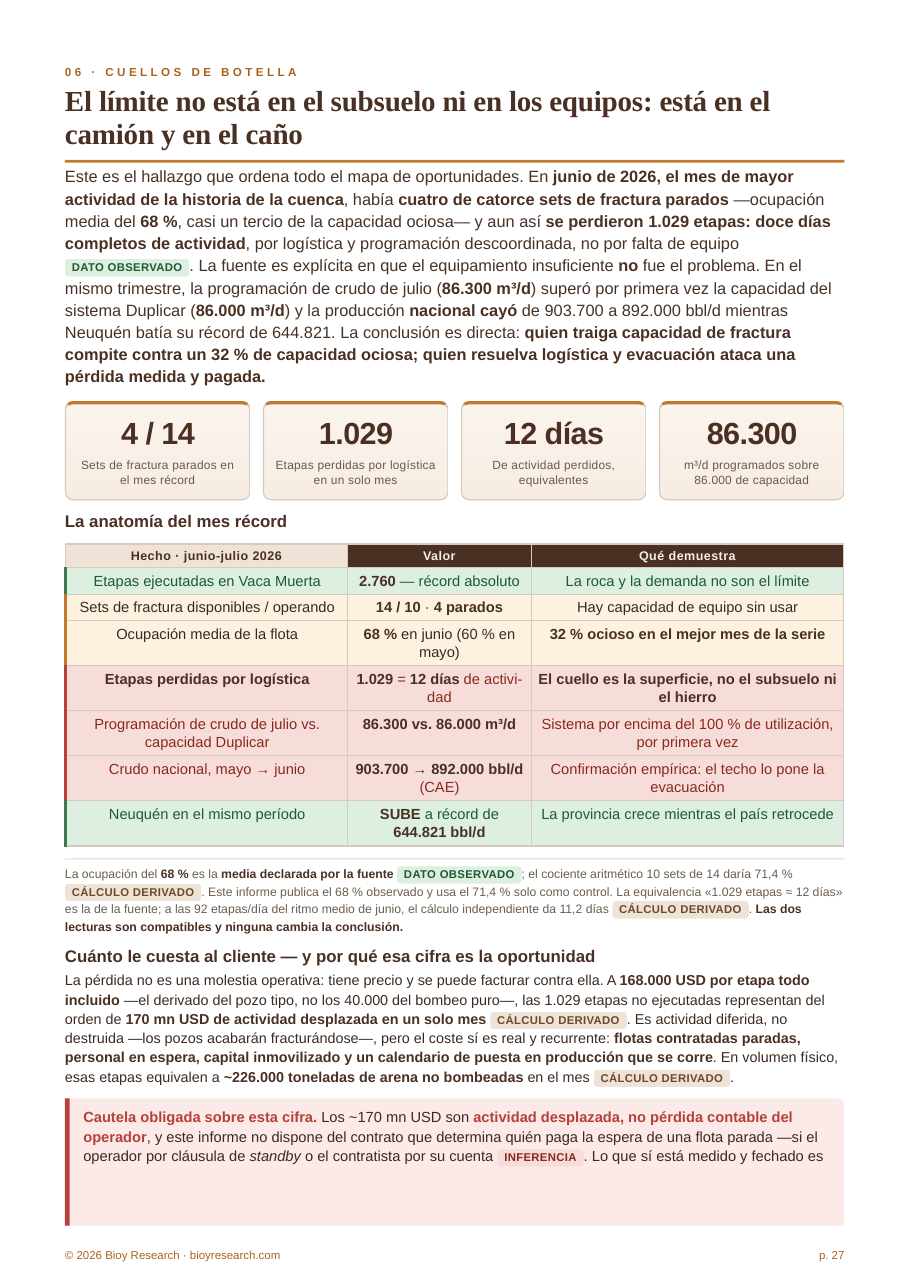
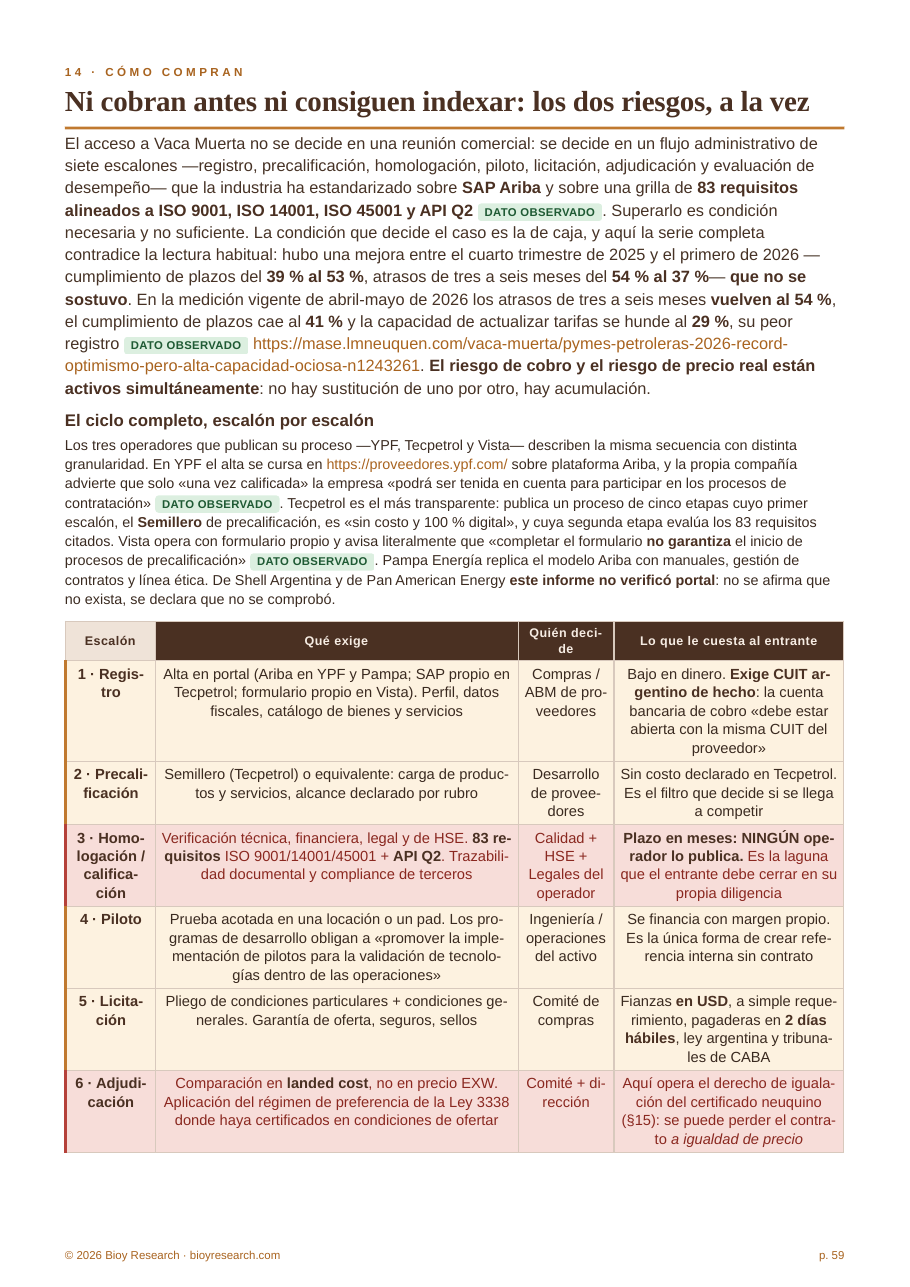
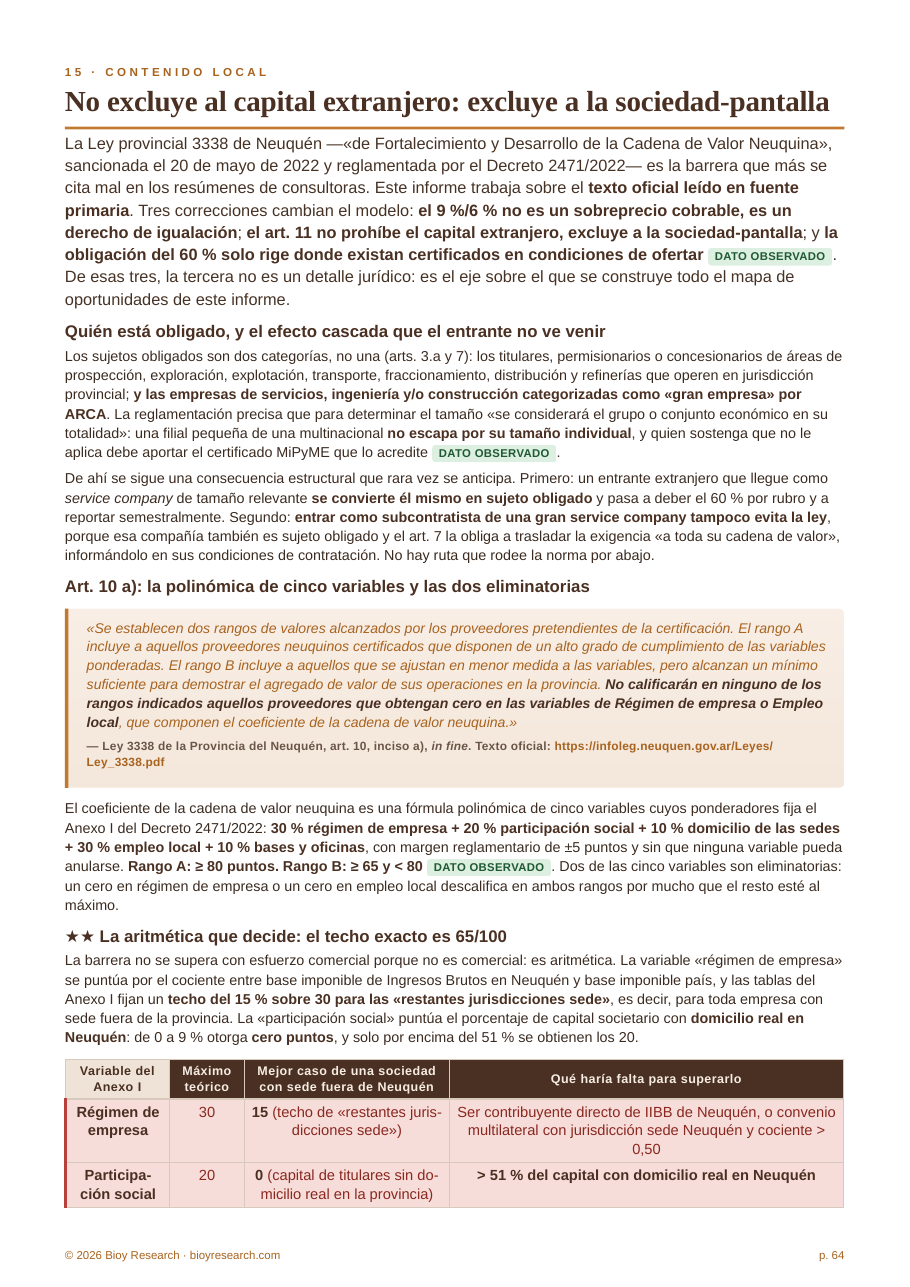
Written for the board of a foreign industrial or services company weighing entry into the Neuquén Basin as a supplier. Not a brochure about the formation, nor a study of whether producing oil pays: this is the folder on which entry is approved or rejected, with the economic engine inside and the niche map resolved on paper.
Real PDF pages: cover, executive summary, charts and competitive tables.
An entry-decision file, not a panorama of the basin. Every figure comes from a single economic engine, and every claim that moves the verdict carries its source and its date.
Intuition sells: «Vaca Muerta is growing, so there is business». The report discounts the announced-investment headline step by step —real project maturity, captive spend held by the major contractors, categories already closed and local content— down to the spend a foreign entrant can genuinely invoice. The gap between those two figures is why this report exists.
You can hold the best equipment on the market and not sell a single bolt. The file walks the real purchasing cycle —registration, vendor approval, pilot, tender— and puts numbers on what decides before the product does: payment terms, the ability to index prices, and the capital you must lock up to sustain the operation.
Not against consultancy summaries. What Law 3338 mandates, on whom, how a supplier is certified and —what almost nobody publishes— the annex arithmetic that sets the real ceiling for a foreign-owned company, with the one door it leaves open and what crossing it costs.
Equipment maker with subsidiary and workshop; asset-heavy service business; digital or environmental solution; and high-margin service. All four run through the same economic model —NPV, IRR, gross-margin threshold, working capital, utilisation break-even— so the comparison is between businesses, not between narratives.
Category by category along the value chain: who holds it today, what the demand unit is, which client pays, and whether an entrant has room. Closed niches are flagged as closed, and the bottleneck the operator is already paying for is identified and measured.
The report includes the strongest argument against each of its own theses, the explicit falsifiers that would refute it, and the full record of four external audit rounds that corrected twenty-one modelling defects. What was corrected, and what changed as a result, is published.
What the research could not verify is named, not filled in: service rates, vendor-approval timelines no operator publishes, and contradictions between sources that are not resolved by averaging. An honest gap is worth more than a plausible invented figure.
Download a free sample with the cover and the full table of contents.
The sample includes the cover and the full table of contents, so you can see the entire scope. The analysis, the economic model and the archetype verdicts are in the full version.
For the board or investment committee of an industrial or services company —typically foreign— weighing entry into the Neuquén Basin as a supplier to oil and gas operators. It is not written for those who want to produce hydrocarbons, but for those who want to sell to whoever does.
No. That is the operator's decision. Here the subject is the supplier: what gets bought, how vendor approval works, how many days until payment, what margin survives provincial taxation and how much working capital must be locked up to sustain the operation.
It includes a verdict. Each of the four entry archetypes receives a reasoned conclusion with its economic model behind it, and the report states what would have to change —and at exactly which threshold— for that conclusion to reverse.
Cut-off July 2026, with provincial and national regulation verified against official sources and basin activity taken from the most recent series available. The report also declares the consultation date for every claim that moves the verdict.
It is declared. The report publishes its evidence gaps by name —service rates, vendor-approval timelines, contradictions between sources— rather than filling them with plausible estimates. That list is, in fact, the first task of the entry plan it proposes.
A market study tells you how fast the sector is growing. This file tells you how much of that growth you can invoice, through which corporate vehicle you can do it, and what it will cost your cash before the first invoice is paid.
Instant-download PDF after purchase, with a navigable table of contents and linked sources. Single licence for internal use by the purchasing company.
Four archetypes with a verdict, the genuinely addressable spend, the local-content law read against the official text, and the economic model to defend entry —or to rule it out with arguments.
Buy the report · €3,499