PDF interior
What you will see inside
Real PDF pages: cover, executive summary, charts and competitive tables.
Permitting, grid access, tariffs, site strategy, CAPEX, partnerships and investment risks for foreign CPOs entering Spain. Eight business models run through one financial engine, each with a verdict: seven NO-GO and one GO.
Real PDF pages: cover, executive summary, charts and competitive tables.
This is not a sector trend report and it is not a case for the project: it is the file on which an investment committee approves or kills entry into Spain. Every material figure carries its source, one financial engine runs through the whole document, and the verdict holds even when it has to say no seven times.
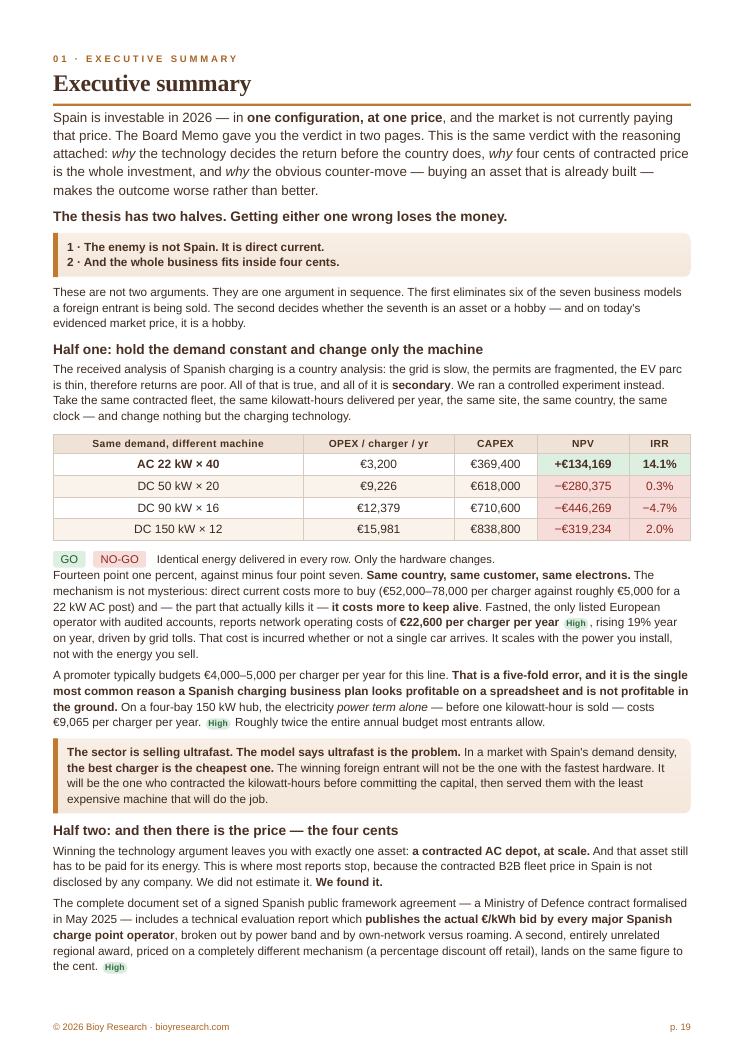
Hold demand constant — the same contracted fleet, the same kilowatt-hours — and change only the technology: AC returns 14.1% IRR, DC returns between −4.7% and +2%. DC hardware (€52–78k per charger) and its power-scaled OPEX (€16–26k per charger per year) outrun Spanish demand at every scale tested. The whole industry sells ultrafast; the model says ultrafast is the problem.
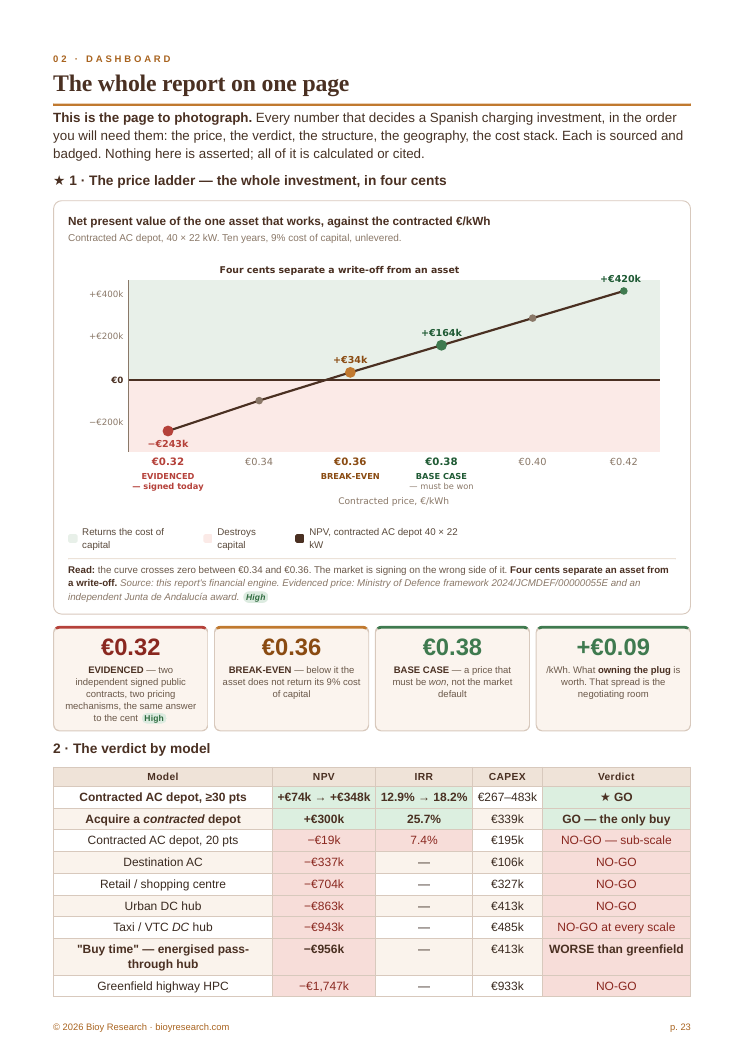
The one asset that works — a contracted AC depot of 30 points or more — needs a price above €0.36/kWh. The price Spanish fleets are actually signing is €0.32, and that was not estimated: it was extracted from the technical evaluation report of a signed Ministry of Defence framework agreement, which publishes the €/kWh bid by every major Spanish operator, then cross-validated against an unrelated regional award that lands on the same figure to the cent. At €0.32/kWh the asset returns −€241,793 and an IRR of −8.4%. And scale does not rescue it: at that price a 160-point depot loses more than a 40-point one.
Highway HPC −€1.75m · heavy-duty −€1.90m · taxi/VTC DC −€943k · urban DC −€863k · retail −€704k · destination AC −€337k. And “buying time” is a trap: acquiring an already-energised pass-through hub makes the NPV worse, because removing the delay only makes you start bleeding sooner.
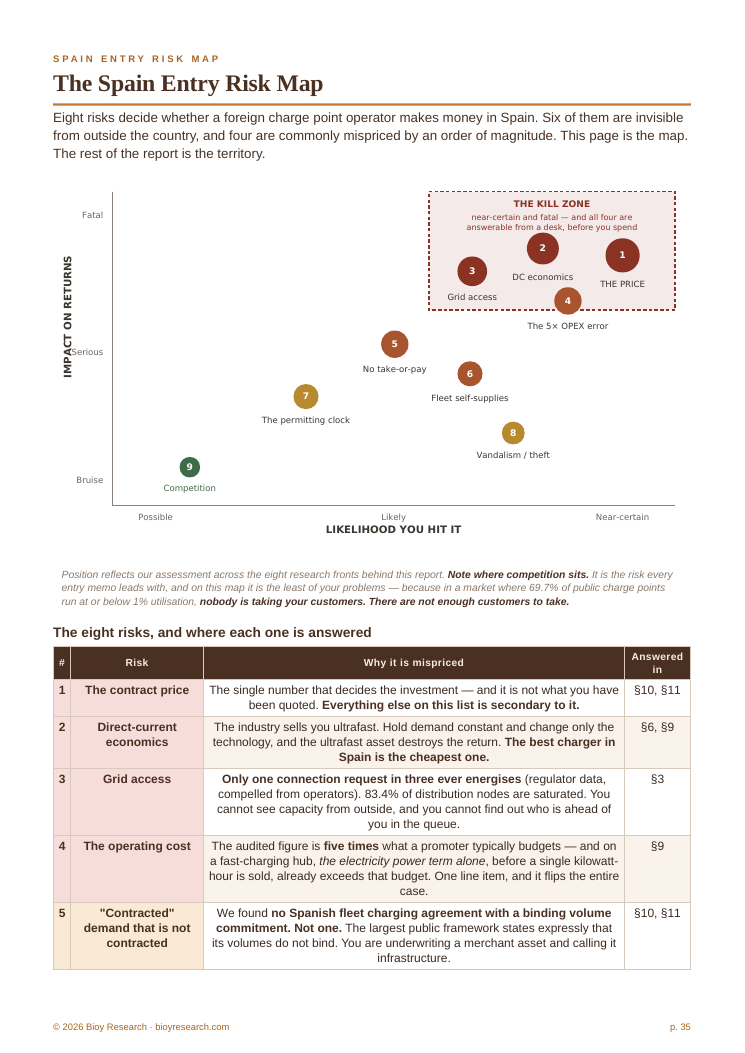
Only 1 in 3 grid connection requests ever gets connected (CNMC, data compelled from the distributors). 83.4% of distribution grid nodes are saturated, and roughly 90% of granted capacity is held by developers who never used it — stated in the preamble of the decree itself. Málaga and Bilbao: 100% of their nodes saturated. You physically cannot connect a new load in the two cities most likely to reach a foreign investor's shortlist.
69.7% of Spain's public charge points run at 1% utilisation or below; only 2.4% exceed 10%. 23.9% of installed points are not operational — and the backlog is growing. The audited operating cost is €22,600 per charger per year, where promoters typically budget €4–5k: a 5× error.
The 250 kW threshold was repealed; so was the maxímetro formula everyone still publishes; the transformer triggers at 100 kW, not 450; and the EV-specific tariff is a trap above 6–10% utilisation. Plus: no Spanish fleet charging contract is take-or-pay. Not one. Underwrite it as a merchant asset.
The verdict by business model, the grid-access bottleneck, the permitting route, tariffs and energy economics, city and corridor prioritisation (with two vetoes), the competitive landscape separating what is energised from what is merely announced, line-by-line CAPEX/OPEX benchmarks, a decision grid to run your own numbers, partnering and entry routes, and 8 due-diligence checklists plus 5 ready-to-use templates (grid access question list, landowner term sheet, fleet anchor checklist, EPC quote structure and a red-flag memo for the investment committee).
Download a free sample with the cover and the full table of contents.
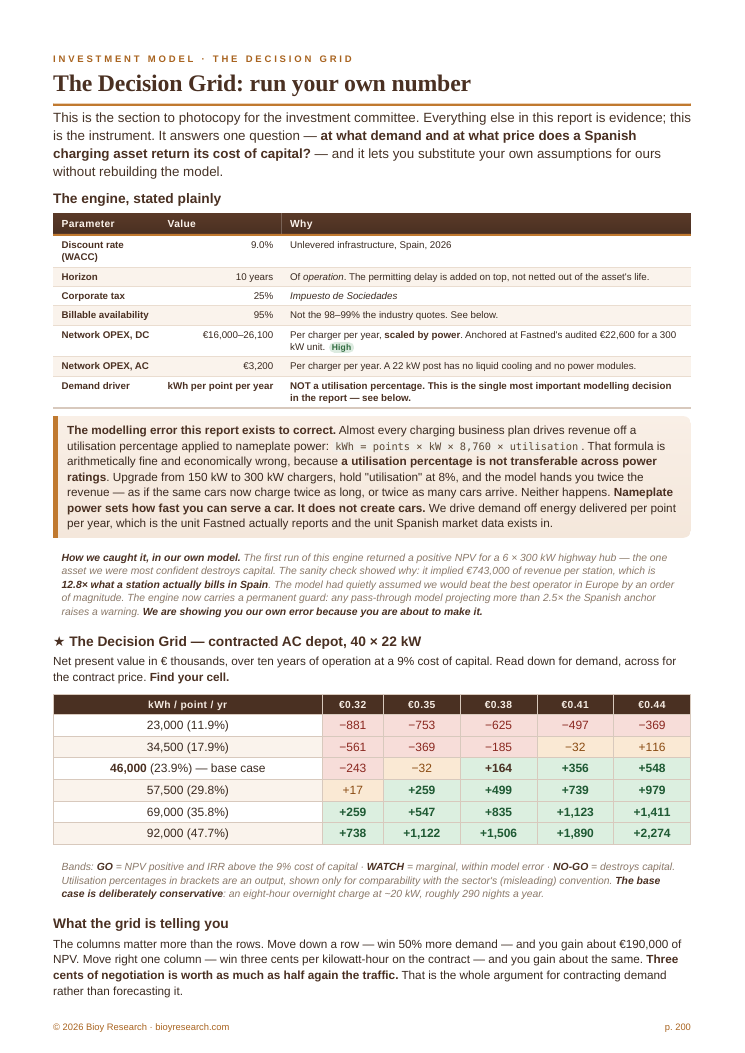
The sample includes the cover and the contents, so you can see the full scope. The analysis, the financial model and the verdict are in the full edition.
Foreign charge point operators considering entry into Spain, infrastructure funds studying an investment or an acquisition, and fleet-charging operators. It is not written for the local promoter of a single station: it is the file on which a committee decides whether to enter a market.
It says no seven times and yes once. Of the eight business models modelled, only one creates value — and only above a specific price the market is not paying today. That is precisely its value: it tells you where not to put the money, and the one place to put it.
Mostly from primary sources. The fleet price was extracted from the technical evaluation report of a signed Ministry of Defence framework agreement — which publishes the €/kWh bid by every major Spanish operator — and cross-validated against an unrelated regional award. The node saturation and the connection funnel come from CNMC data compelled from the distributors; the operating cost comes from audited accounts. Every material figure carries its source and a confidence level.
A PDF ready to read on any device or to print (266 pages). You receive it by email immediately after payment.
The analysis, the regulation, the tariffs, the grid access and the city and corridor prioritisation are Spain-specific. What travels is the method and the financial engine: the AC/DC comparison and the threshold price can be recalculated with another country's inputs.
English. This edition is available in English only.
Eight business models with a verdict, the threshold price that decides the investment, and the grid bottleneck quantified. No flattery: it tells you where not to put the money.
Buy the report · €3,499