PDF interior
What you will see inside
Real PDF pages: cover, executive summary, charts and competitive tables.
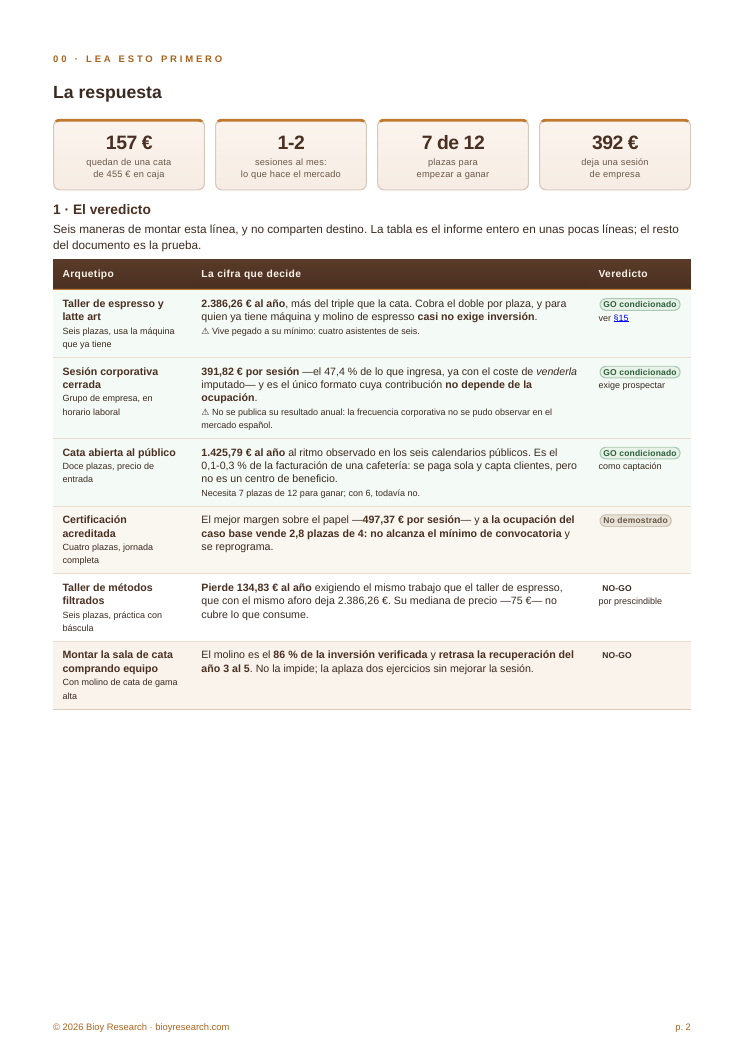
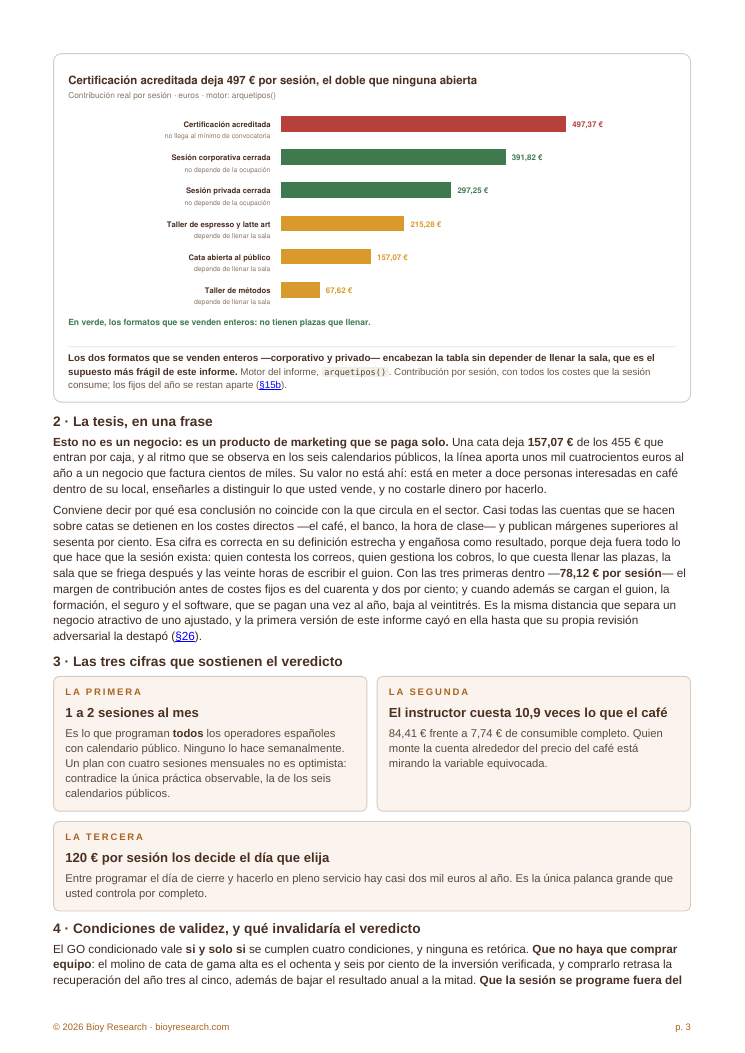
Pricing, experience families, occupancy required, legal fit and viability, with 34 prices from 16 operators verified one by one and a reproducible calculation engine.
Real PDF pages: cover, executive summary, charts and competitive tables.
A decision report for someone who already has the premises and the coffee, not an overview of gastronomic tourism. Every figure comes out of a reproducible engine whose 65 assumptions are published one by one with their evidence type, and whatever could not be verified is declared in the same table as whatever could.
The price of a tasting is not estimated: it is looked up. The report audited 34 prices from 16 Spanish operators by going to each one's website and recording what is charged, for which format, with how many seats and what is included, with fieldwork closed on 11 August 2026. The complete table goes into the annexe, not a summary: you can redo any median, drop the operator you consider an outlier and see how it moves. And what could not be verified is declared in that same table, in the same type: the VAT treatment is stated in only 13 of the 34 prices, so any comparison between prices with and without tax is made knowing what is being compared.
Introductory tasting, comparative tasting, filter brewing workshop, espresso and latte art workshop, roasting experience, corporate event and tourist experience are not variants of one product: the duration, the material consumed, the number of seats that fit and who pays all change. Averaging their prices gives a mean ticket that corresponds to no session anyone actually sells, and half the sector's business plans are built on that non-existent ticket. The report analyses each family separately, with its observed price range, its cost structure and the kind of customer that buys it, and says which ones sit well together in the same venue and which compete with each other for the same evening.
The report calculates the break-even of each format in two magnitudes that almost nobody distinguishes —the average across the year and the target for each individual session— and says which one serves which decision: one governs whether the line exists at all, the other governs whether this Saturday's session runs or is cancelled. It also publishes how each moves when price, group size, the cost of the coffee served and the hour of whoever runs it change, so you can see how far your own venue sits from the threshold before announcing a first date.
The report located 28 operators and only six publish their session calendar. Rather than filling the gap with a plausible frequency, it publishes what can be seen and calls it by its name: of those six, none programmes weekly, and the observed practice sits between one and two sessions a month. The report itself declares that this is an exploratory observation over six calendars and not a demonstrated ceiling for the market, and explains what that uncertainty means for the number of sessions you should plan with, and how to measure it against your own customer base before committing the diary.
When a session mixes teaching, tasting, product the attendee takes home and sometimes admission to a space, which rate applies stops being self-evident, and the report shows why the answer that circulates in the sector does not hold. It is the tax finding of the work: where the doubt comes from, which elements of the session tip it one way or the other, and what that means for the advertised price and for the contribution of each seat. With the warning that belongs with it: the report delivers the reasoning and the sources, not a binding ruling on your behalf.
Premises that used to serve coffee now host an activity with invited attendees, and that moves several obligations at once. The report resolves public liability insurance by citing the specific article of the regional act that imposes it, capacity and how the activity fits the licence you already hold, allergen information in a session where what is served is what is tasted, and the right of withdrawal with its exceptions —which is what decides whether a seat sold on Tuesday can be cancelled on Friday and who bears the cost—. Each point with what has to be signed or displayed before the first session, not after.
Six different ways of building the line —by type of venue, who runs the sessions, which families are programmed and how often— go through the same engine, with the same rules and the same assumptions, so the comparison between them is clean. Each archetype comes with its contribution per session, its break-even and its annual result, and the report explains which lever separates one from another. It is accompanied by a year-by-year P&L that separates accounting result from cash, and by full sensitivity to occupancy: what happens to the whole line when seats sold fall short of plan.
The traceability register does not only say where each assumption comes from: it says what CLASS of evidence it is. Six types —observed data, external estimate, model assumption, derived calculation, inference and recommendation— applied to the engine's 65 assumptions, each with its source level, its date and its confidence grade. Sixteen are declared low confidence and named as such, with the reason, rather than being allowed to blend in with the observed ones. That way you can replace the ones you can obtain yourself —your coffee cost, the wage of whoever runs the session, your rent— and redo the calculation without depending on our numbers.
The report commissioned the refutation of its own verdict before the analysis was drafted, not after it was finished. That refutation knocked down all four figures the provisional verdict rested on, and those four figures were corrected. The adversarial chapter does not summarise the episode: it documents what had been taken as sound, why it was wrong, what evidence dismantled it and what figures it ended up with. It is the chapter a buyer should read first, because it is the one that says what they would have bought had the report been published without it.
The text went through nine successive external reviews, each briefed to find what the previous one let through. And eleven automated guardians check every published numerical statement against the calculation engine that produces it, so a figure corrected in the model cannot survive intact in a paragraph. The report also declares its own perimeter without decoration: who it is written for —a speciality roaster or coffee shop already trading—, who it is NOT for, what was audited, how much, and what fell outside the scope.
Download a free sample with the cover and the full table of contents of the report.
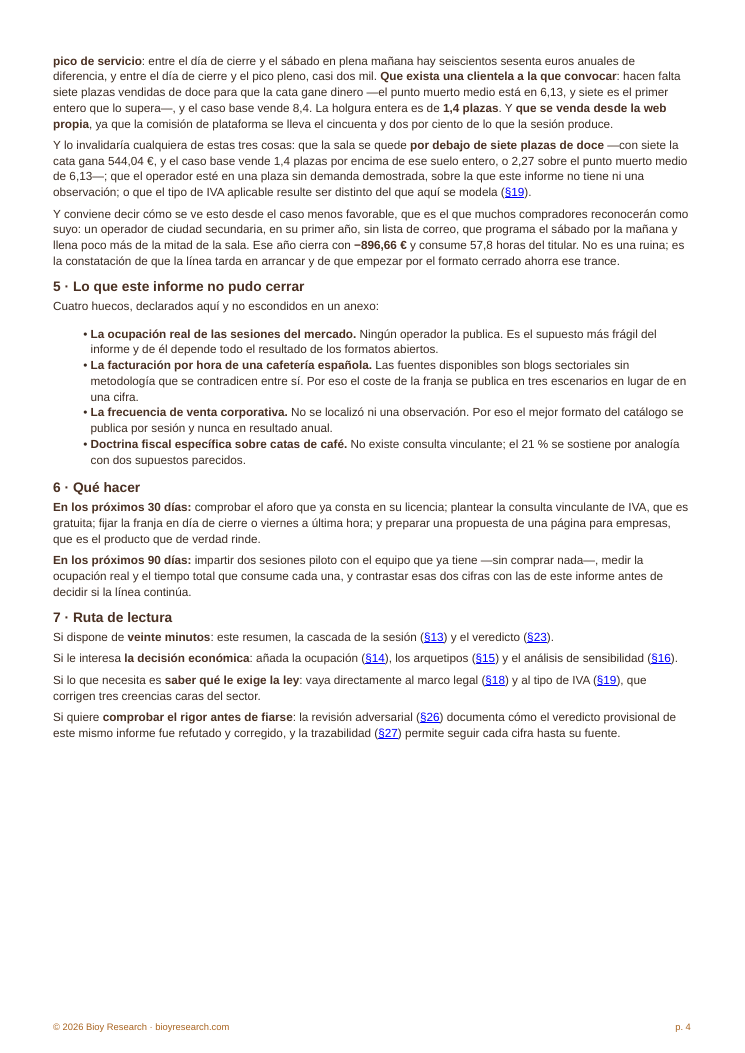
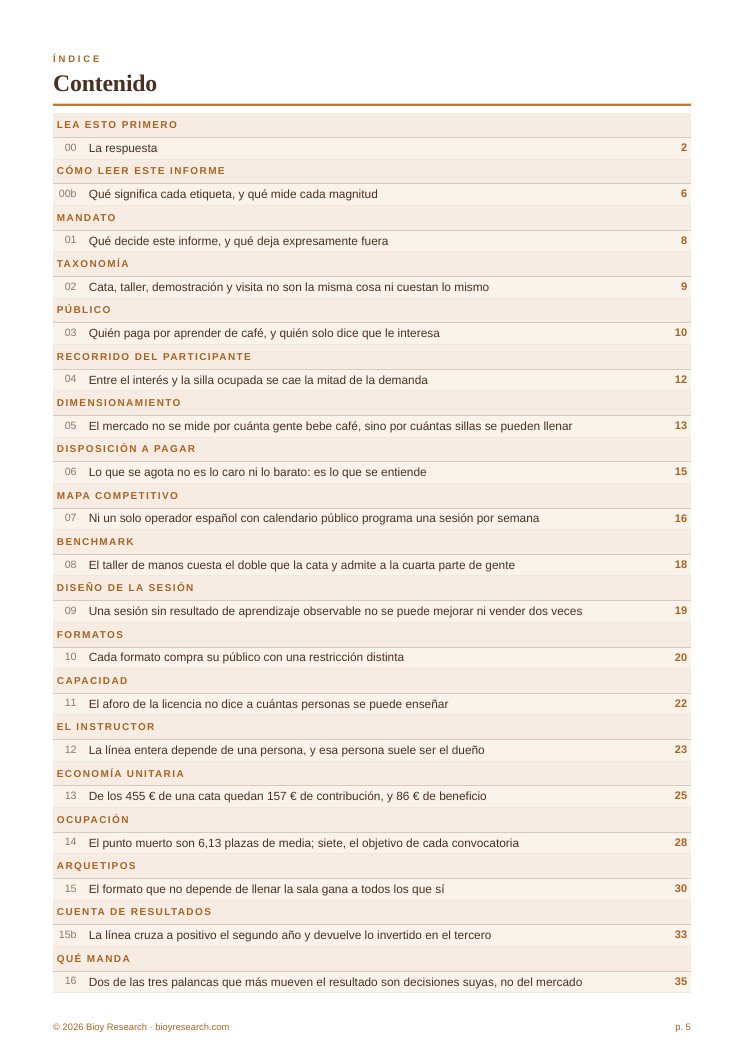
The sample includes the cover and the contents, so you can see the full scope of the report. The analysis, the financial model and the verdicts are in the complete edition.
For the speciality roaster or coffee shop ALREADY trading in Spain —with premises, coffee, machine and a customer base— considering adding a line of experiences using the asset they already have. It is not written for anyone wanting to build a coffee academy from scratch, and the report excludes that reader expressly: the economics of someone already paying the rent and of someone who has to start by paying it are nothing alike, and mixing them produces a model that serves neither.
From an audit of our own: 34 prices from 16 Spanish operators, verified one by one on each operator's website, with fieldwork closed on 11 August 2026. The complete table is published in the annexe, operator by operator, so you can redo any median, exclude the case you consider an outlier and check where every figure comes from. What could not be verified is declared in that same table: the VAT treatment is stated in only 13 of the 34 prices.
Exactly what the evidence allows it to say, and no more. Of the 28 operators located, 22 publish no calendar; of the six that do, none programmes weekly and the observed practice sits between one and two sessions a month. The report declares that this is an exploratory observation over six calendars and not a demonstrated ceiling for the market, and instead of turning it into a silent assumption it explains how to measure the frequency your own customer base will take before committing the diary.
Yes, and it is reproducible: all 65 assumptions are published one by one with their evidence type —observed data, external estimate, model assumption, derived calculation, inference or recommendation—, their source level, their date and their confidence grade, and the 16 of low confidence are identified as such. Six operator archetypes run through the same engine, with their contribution per session, their break-even and their annual result; a year-by-year P&L separating accounting result from cash; a tornado of levers moved ±20%; and full sensitivity to occupancy.
Spanish, English, German and French. All four versions come out of the same calculation engine and the same evidence base, so the figures and the verdict are identical; what changes is the language of the text. Prices and the whole economic model are in euros and refer to Spain.
Edition 8, with fieldwork closed on 11 August 2026. The report identifies which elements force a review —the audited prices, which operators move with the season; the cost of green coffee and milk; and the tax and insurance framework, which can change by legislation— and recommends a review horizon. The assumptions register indicates which ones are most sensitive to the passage of time.
34 prices from 16 operators audited one by one and published in full in the annexe, seven families of experience analysed separately rather than averaged, break-even resolved in the two magnitudes that answer different questions, six archetypes through the same engine with a year-by-year P&L and sensitivity to occupancy, the legal chapter with the article cited and the VAT rate explained, 65 assumptions with evidence type and confidence grade, and a refutation commissioned before the chapters were written that knocked down four figures of the provisional verdict.
Buy the report · €990