PDF interior
What you will see inside
Real PDF pages: cover, executive summary, charts and competitive tables.
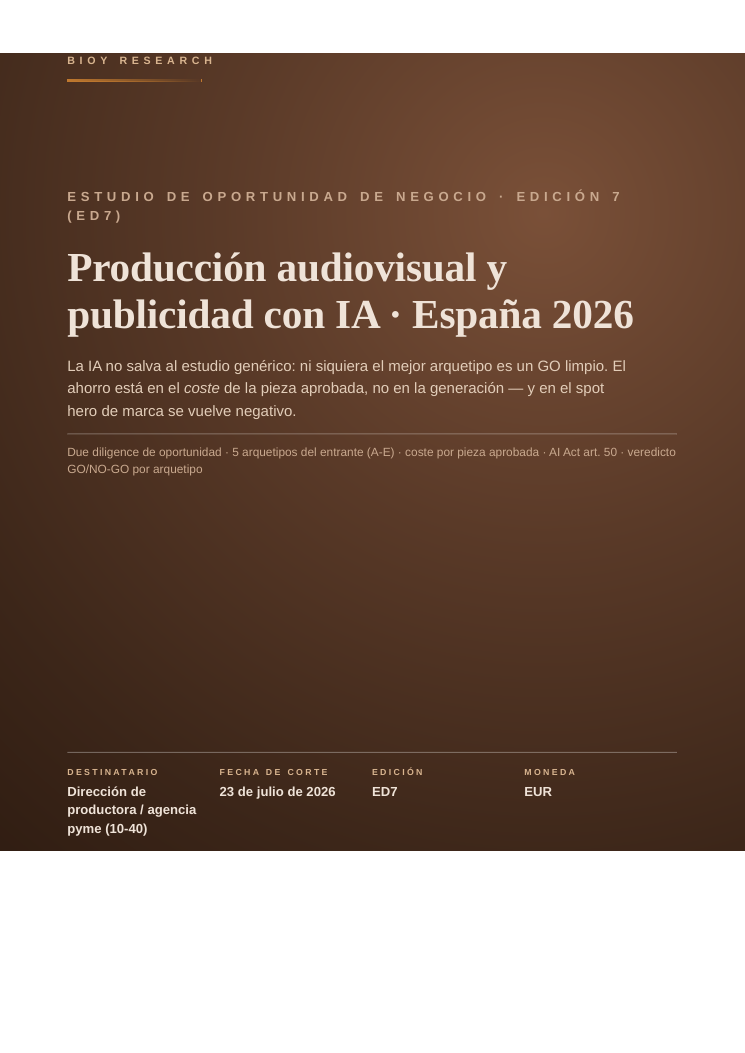
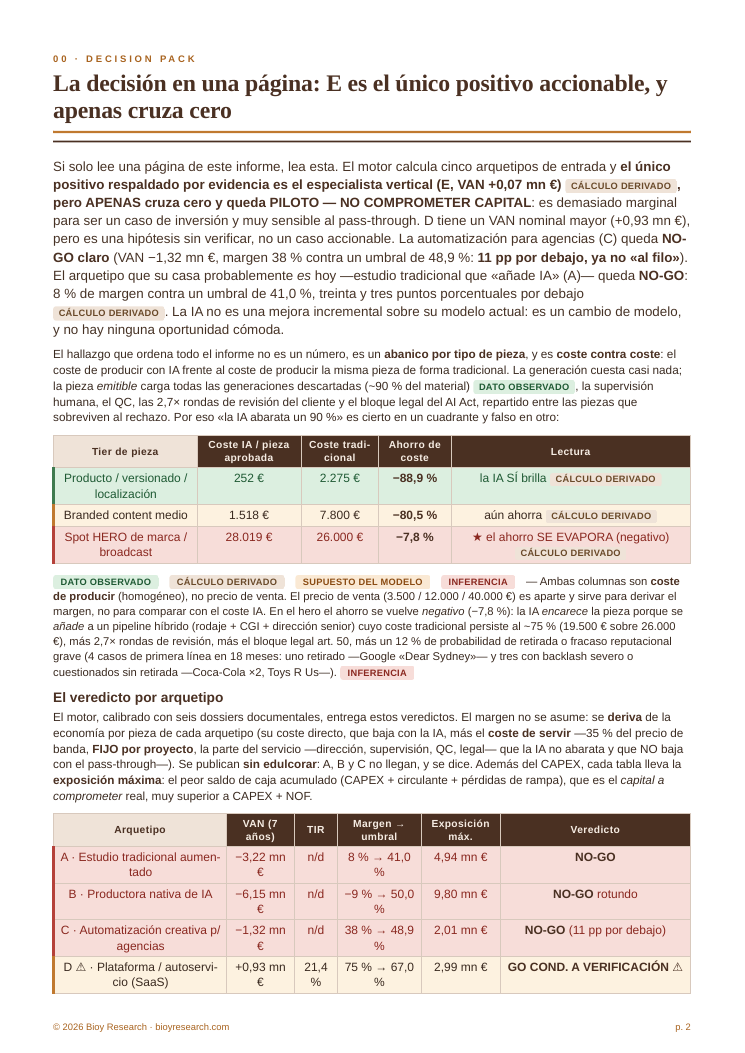
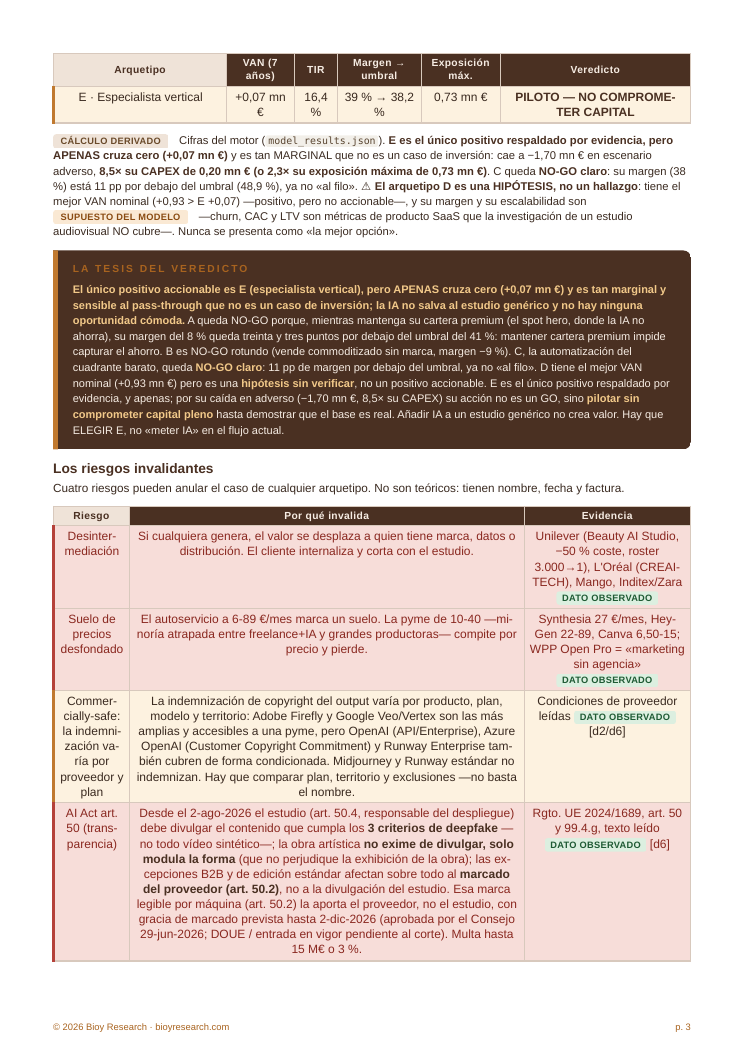
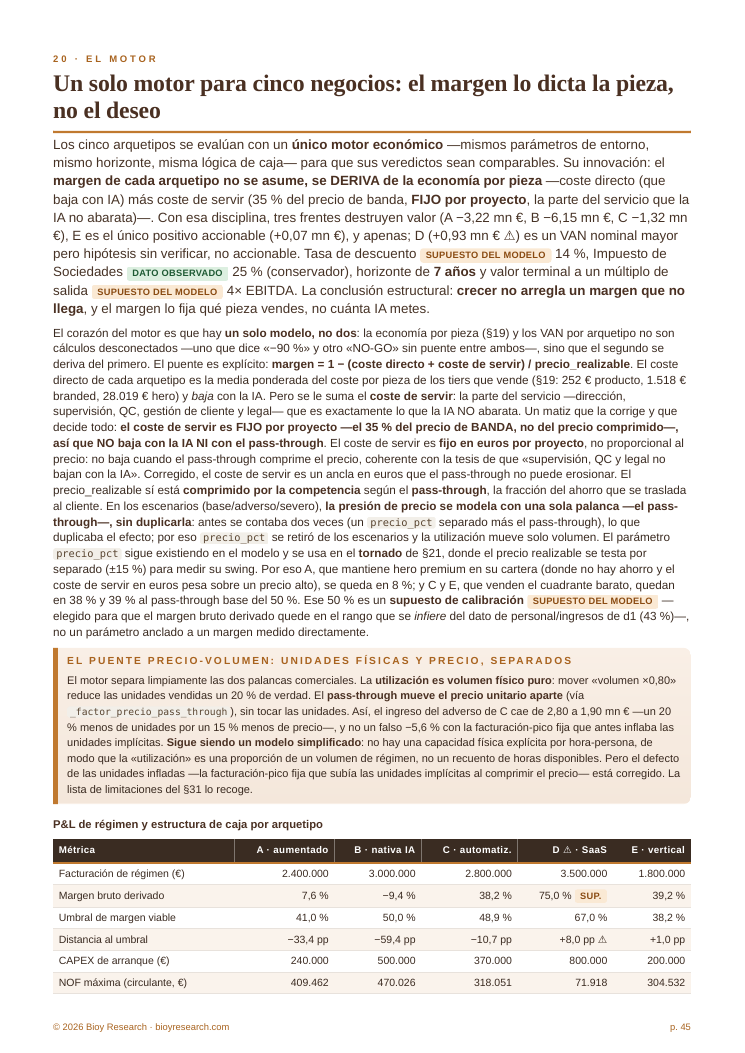
Written for the leadership of a small or mid-sized audiovisual production company or agency —ten to forty people— in Spain weighing whether to capture value with generative AI. This is not a tool round-up or a prompt list: it is the folder on which you decide which type of piece and which archetype to bet on, with the economic model inside and the question of the saving —where does the cost per approved piece actually fall?— already worked out on paper.
Real PDF pages: cover, executive summary, charts and competitive tables.
An opportunity decision file, not a catalogue of tools. Every figure comes out of an economic engine that ships with the report, and every decisive claim carries its source, its date and the confidence we place in it.
The demo sells: "AI makes the video in a minute." It does not follow. Between the clip a model generates and the piece the client approves and pays for there are iterations, human review, fixing hands and text, and discards that are never shown. The report does not count render seconds: it counts the cost per APPROVED piece —including what gets thrown away— and compares it with the traditional flow euro by euro. That is where AI wins or loses, not in the speed of the demo.
There is no single AI saving in audiovisual: there is a saving by type of piece, and the range is enormous. On product video and versioning —the fifty variants of one ad for each market, format and language— the cost per approved piece collapses. On the brand hero spot —the single, authored piece with real direction and talent— the saving evaporates and can turn negative: review, reprocessing and risk destroy the advantage. The report lays out the full spread so you know which half of your catalogue your money is in.
There is no single verdict for "getting into AI audiovisual": there are five distinct ways to capture the value and the same engine measures them all. Augmented studio —the production house you already run, with AI inside—, AI-native production house, automation for agencies, self-service SaaS platform, and vertical specialist. All five run through the same engine: full P&L, NPV, IRR, maximum cash exposure, break-even, sensitivity tornado and base, adverse and severe scenarios. So your leadership can redo the numbers, argue with them and break them.
No configuration is a comfortable investment case, and the report says so without sweetening it. Generative AI lowers the cost of producing, but it lowers everyone's cost at once: what was an advantage becomes the market's new floor, and the price per piece falls behind the cost. The studio that merely produces more cheaply the same thing everyone else produces captures no value: it gives it away. The report separates the archetypes that defend a margin —through proprietary data, client relationship or vertical specialisation— from those that only accelerate a race to the floor.
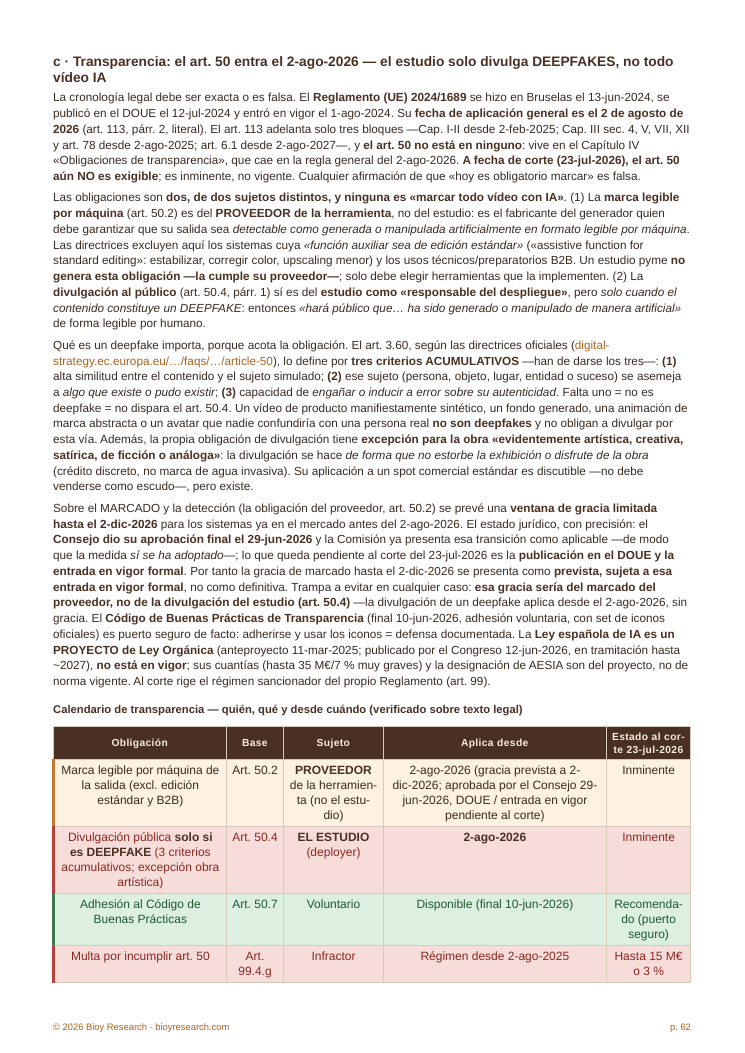
The legal framework is not a decorative annex: it changes what you can deliver and what you can charge for. The report reads the AI Act (Reg. (EU) 2024/1689) from real production —Art. 50 and the obligation to label synthetic content and deepfakes, who is liable and from when—, the uncertain intellectual property of output purely generated by AI, people's image and voice rights (Organic Law 1/1982) when a face or a voice is synthesised, the copyright indemnity each tool offers or denies in its contract, and the Spanish taxation of the operation. Everything that decides whether a piece is deliverable or a lawsuit waiting to happen.
We do not ask you to take a table on trust. The report comes with the complete economic model —the calculation script, its documentation and the results in structured form— so your team can change the assumptions they disagree with (the price per piece, the discard rate, the cost of human review), run it again and check whether the verdict survives their own numbers. And so the chain from data to conclusion is auditable: every decisive claim goes into a register with its source, the exact location within that source, the date consulted and the confidence we place in it.
Before publishing we put the thesis through an adversarial review briefed explicitly to refute it: whether the saving per approved piece holds when discards are genuinely counted, whether mass-versioning demand is as large as it looks, whether the legal framework lets you deliver the piece without risk, and whether any archetype defends its margin for more than one year. The chapter tells you which objections held, which knocked us down and what we changed —including our own mistakes. And every claim that moves the verdict says so when confidence is low. All inside the PDF.
Download a free sample with the cover and the full table of contents.
The sample includes the cover and the contents, so you can see the full scope of the report. The analysis, the economic engine and the verdicts are in the full edition.
For the leadership of a small or mid-sized audiovisual production company or agency —ten to forty people— in Spain, and the team preparing the decision, weighing whether to capture value with generative AI. It is not a tool catalogue or a prompt course: it is an opportunity due-diligence file, built on five archetypes —augmented studio, AI-native production house, automation for agencies, self-service SaaS platform, and vertical specialist— all run through the same economic engine.
It depends on the type of piece, and that is one of the report's central theses. The saving is not in generating the clip, it is in the cost per APPROVED piece —counting iterations, human review and discards— and it is an enormous spread: it collapses on product video and mass versioning, and it evaporates, when it does not turn negative, on the brand hero spot. The report lays out the full spread, so you know in which half of your catalogue AI makes you money and in which it loses it for you.
It depends on the archetype, which is why there are five. Each one runs through the same economic engine and receives a verdict —GO, conditional GO, WAIT or NO-GO— with the explicit conditions where the verdict is conditional. The report does not give a generic "yes to AI": no configuration is a comfortable investment case, and it says so without sweetening it. AI does not save the generic studio, because it lowers everyone's cost at once and drags the price down behind it. The report separates the archetypes that defend a margin from those that only accelerate a race to the floor.
The AI Act (Reg. (EU) 2024/1689) read from the production desk —Art. 50 and the obligation to disclose synthetic content and deepfakes, who is liable and from when—, the uncertain intellectual property of output purely generated by AI, people's image and voice rights (Organic Law 1/1982) when a face or a voice is synthesised, the copyright indemnity each tool offers or denies in its contract, and the Spanish taxation of the operation. It is what decides whether a piece is deliverable or a risk waiting to happen.
The economic engine reasons in euros (EUR), because the anchor of the decision is the Spanish market: it is the currency in which the piece is invoiced, the tool is paid for and the return is measured. Where a source is in dollars —an AI suite's fee, for instance— it is kept in its currency with the reference conversion alongside. The report sells for €3,499 per single licence, as an instant-download PDF.
The report is available in Spanish, English, German and French. Each version is a full edition, not a summary: the same analysis, the same economic engine and the same verdicts, adapted to the language.
Before publishing, we put the report's thesis to the explicit task of destroying it, angle by angle: whether the saving per approved piece holds when discards are genuinely counted, whether mass-versioning demand is as large as it looks, whether the legal framework lets you deliver the piece without risk, and whether any archetype defends its margin for more than one year. The review chapter tells you which objections held, which knocked us down and what we changed, including our own mistakes. It is the part that gives most confidence in the final verdict.
Five archetypes with a verdict, the saving per approved piece measured type by type, the AI Act framework with its traps, and the economic engine shipped so you can redo it with your own numbers.
Buy the report · €3,499