PDF interior
What you will see inside
Real PDF pages: cover, executive summary, charts and competitive tables.
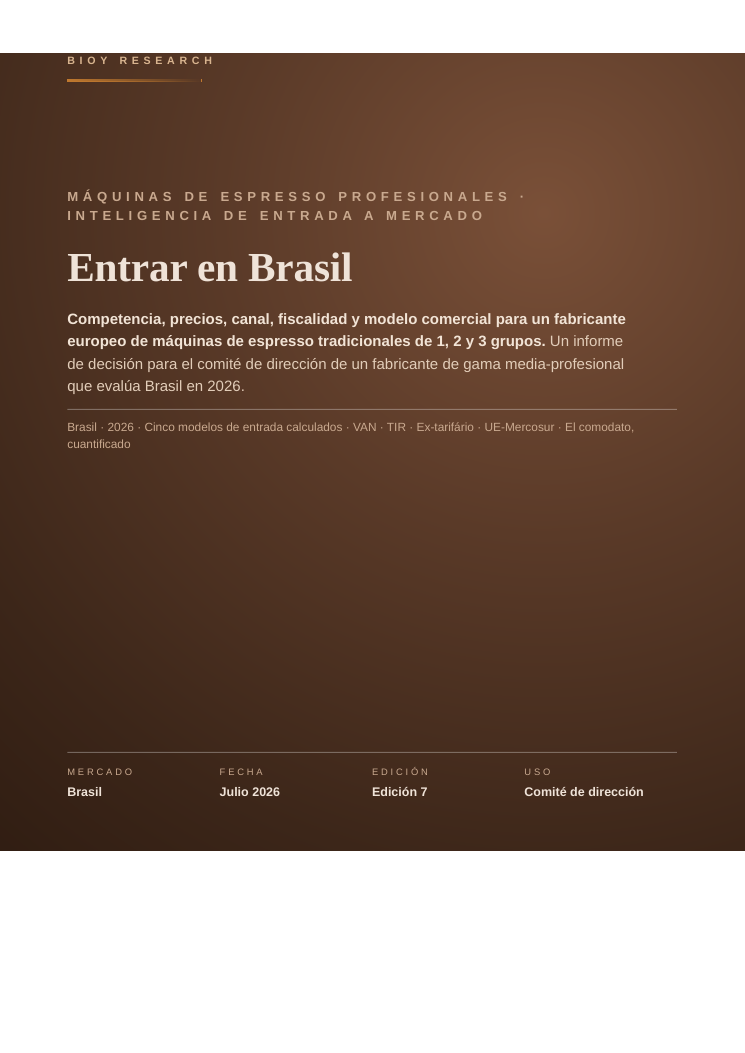
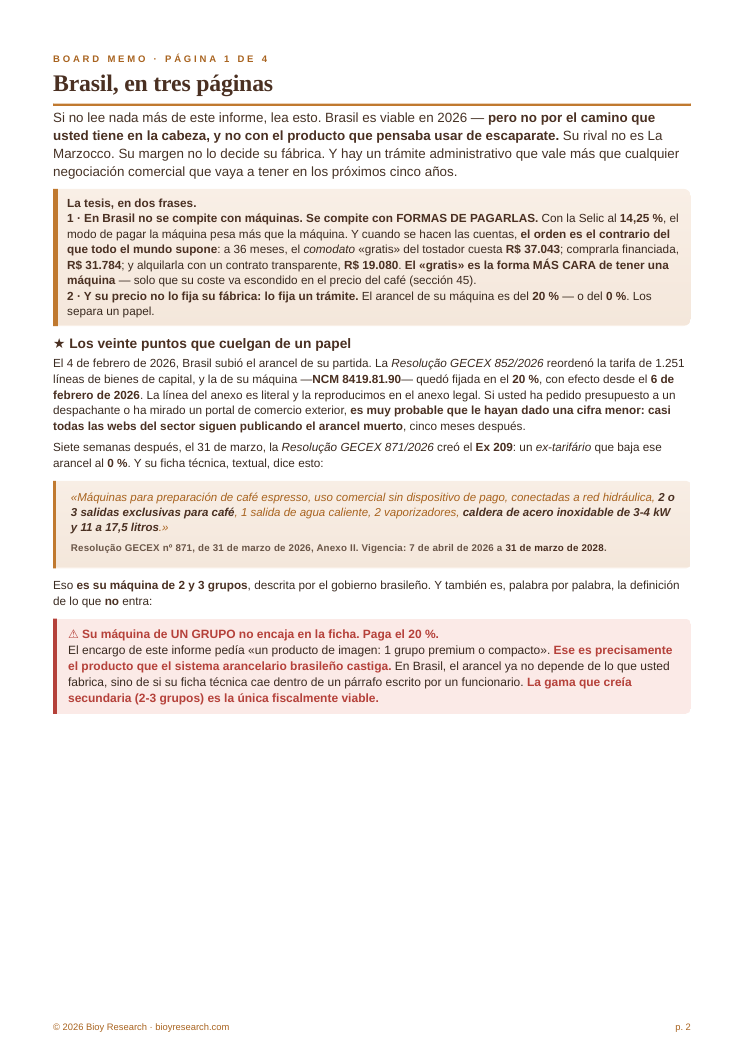
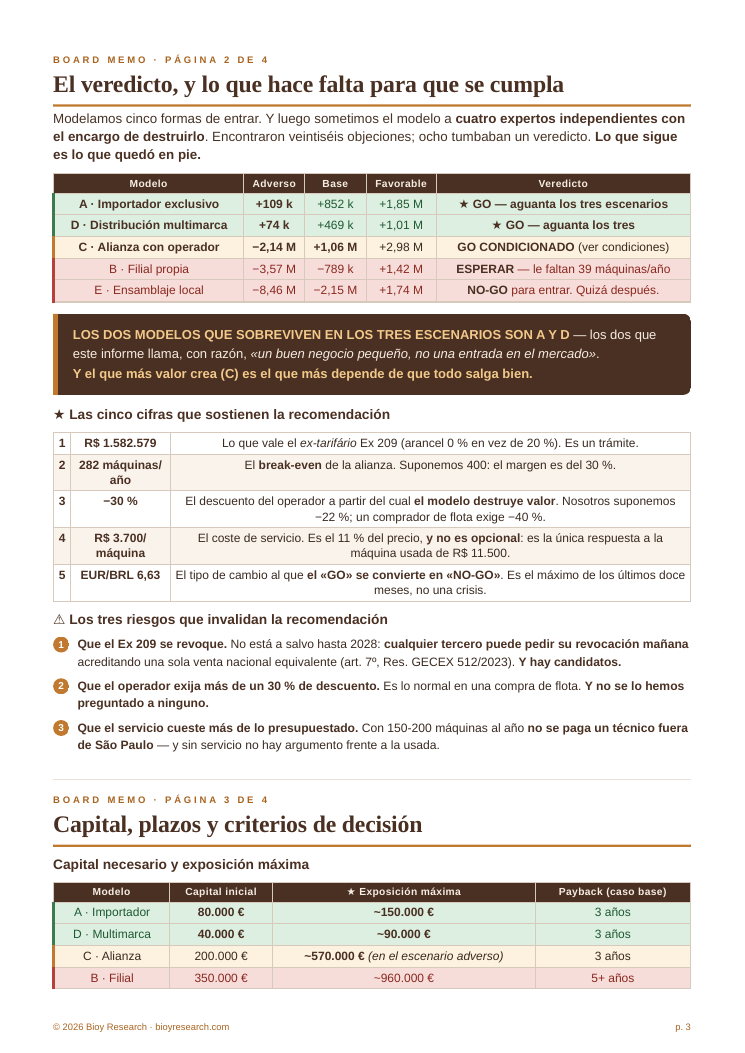
Written for the board of a European maker of mid-to-professional grade machines evaluating Brazil. This is not a trend study: it is the folder on which entry is approved or rejected, with the financial model inside and the numbers already run.
Real PDF pages: cover, executive summary, charts and competitive tables.
A decision report, not a sector overview. Every figure comes out of a financial engine that ships with the report, and every decisive claim carries its source, its date and the confidence we place in it.
In February 2026 Brazil raised its tariff line (NCM 8419.81.90) to 20%. In April it created the Ex 209, which takes it to 0% until March 2028. The difference, in present value, is R$ 1,582,579. And almost every Brazilian foreign-trade portal was still publishing the dead duty five months later: if your team has run the numbers on that figure, the plan has a hole in it.
The Ex 209 describes "2 or 3 outlets exclusively for coffee" and a 3–4 kW boiler of 11 to 17.5 litres. That is your 2- and 3-group machine, described by the Brazilian government. The image product — the premium 1-group — is precisely the one that pays the 20%. In Brazil the duty does not depend on what you manufacture, but on whether your spec sheet falls inside a paragraph written by a civil servant.
Nobody publishes what coffee "with a free machine" costs, because it is sold by the dose so that it cannot be compared. That opacity is the finding. Reconstructed backwards: over 36 months the comodato costs R$ 37,043, buying on finance costs R$ 31,784 and renting on a transparent contract costs R$ 19,080. "Free" is the most expensive way to have a machine — and it hides better the more coffee the bar buys.
Exclusive importer, own subsidiary, alliance with an operator, multi-brand distribution and local assembly: all five run through the same numbers, with NPV, IRR, a calculated break-even and three scenarios. Two hold across all three scenarios; one is a conditional GO; local assembly is a NO-GO — and the report explains why four tax incentives that push you to manufacture in Brazil are not enough.
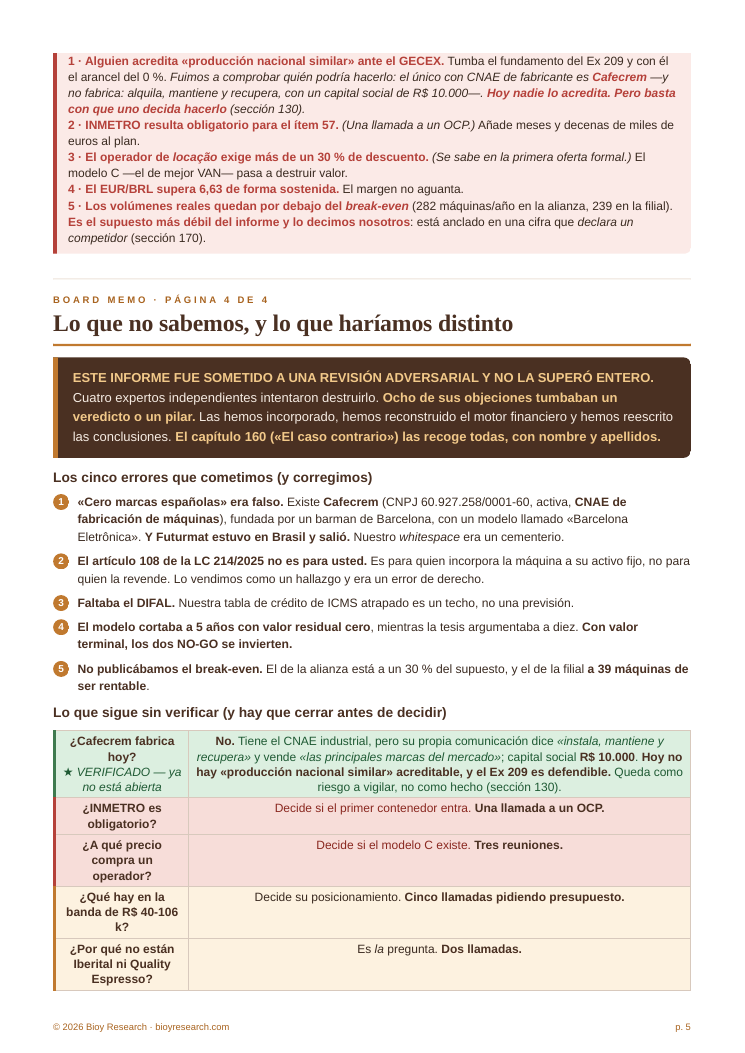
Before publishing, we put the thesis through an adversarial review: a Brazilian tax specialist, an Italian competitor, a local operator and a sceptic with access to the engine. They found twenty-six objections and eight of them knocked down a verdict. The report was rewritten. The chapter "The case against" tells you what they took down, what held and what we changed — including our own mistakes.
CSV and JSON with the assumptions, the year-by-year P&L and the verdicts. Of the eleven numbers that decide a verdict, eight are low-confidence — and we say so in a table, with the source and the date. If you do not believe our volumes, put in your own and run the model again. The conclusion that survives that change is the only one worth anything.
The three rules that hold up the verdict, reproduced exactly as the source serves them, unedited: the line from the annex to GECEX 852, the full Ex 209 spec sheet in Portuguese, and the EU–Mercosur notice from the Official Journal. You hand it to your customs broker and ask him one thing only: to confirm in writing that your machine qualifies under the Ex 209.
Download a free sample with the cover and the full table of contents.
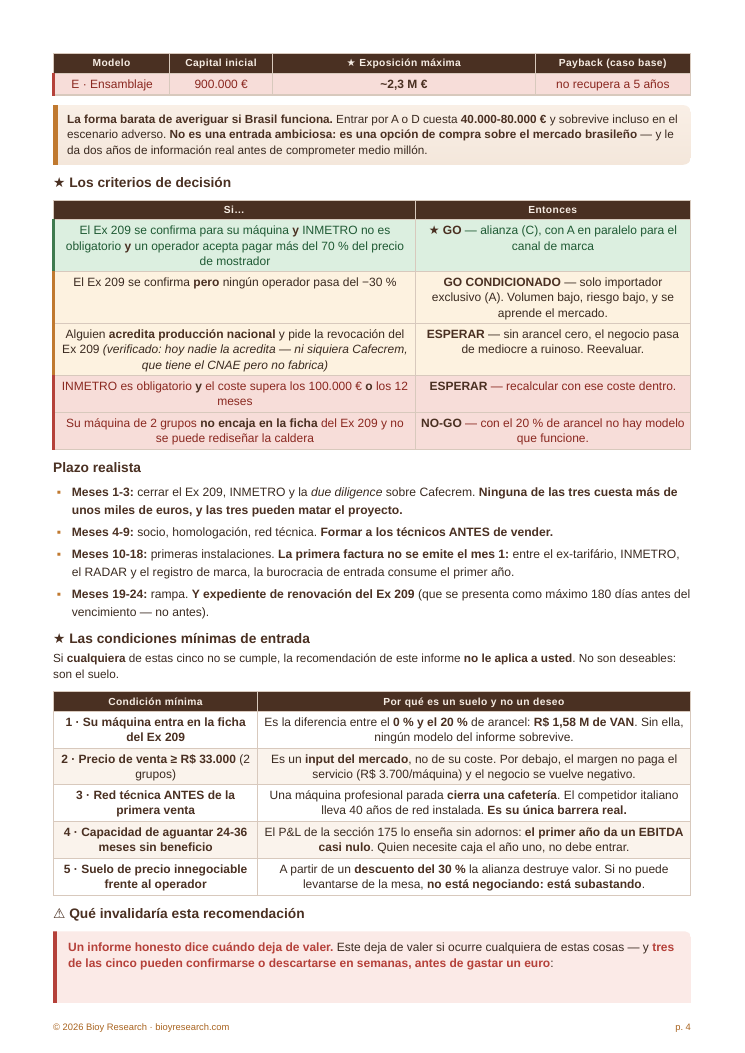
The sample includes the cover and the contents, so you can see the full scope of the report. The analysis, the financial model and the verdicts are in the full edition.
For the board of a European maker of traditional espresso machines in the mid-to-professional range (1, 2 and 3 groups) considering entry into Brazil. If you manufacture super-automatics or capsules, much of the tax analysis still serves you, but the competitive map and the commercial model are built for the group machine.
It is an ex-tarifário: a resolution that takes the import duty on a specific tariff line down to 0% for a set period. The Ex 209 covers exactly the commercial 2- or 3-group espresso machine, and it runs until 31 March 2028. In present value it is worth R$ 1,582,579, and you do not get it by default: you have to ask for it. It is the first question of the entire Brazilian project, and that is why the report treats it as a control gate, not as a data point.
It recommends entering, but not by the route almost everyone chooses. Two of the five models hold across all three scenarios (including the adverse one) and they are the cheap, reversible ones. The model that creates the most value — the alliance with an operator — is a conditional GO, and the report publishes the three exact conditions that make it viable. Local assembly is a NO-GO as an entry route, even though four tax incentives point the other way.
Yes, and that is the point. The report ships with the year-by-year P&L, the assumptions and the verdicts in CSV, plus the full model in JSON. The report itself states that, of the eleven numbers that decide a verdict, eight are low-confidence — and it tells you which. If your volumes are different, put them in and run the model again.
Before publishing, four independent specialists were explicitly briefed to destroy the report's thesis, each from a different angle: Brazilian taxation, Italian competition, the local operator and the financial model. They found twenty-six objections, eight of them capable of knocking down a verdict. The report was rewritten, and the chapter "The case against" tells you exactly what failed, including our own mistakes.
Yes, and the evidence ships with it. The 20% duty and the Ex 209 at 0% are verified in the Diário Oficial da União, and the report reproduces the literal line from the annex to each resolution. We also checked that a later resolution (GECEX 868, of March 2026) did not reverse the increase for our tariff line: it does not. The evidence annex is separate, with the text unedited.
Five entry models with a verdict, the filing worth R$ 1.58 million, the comodato quantified, and the financial model so you can redo it with your own numbers.
Buy the report · €3,499