PDF interior
What you will see inside
Real PDF pages: cover, executive summary, charts and competitive tables.
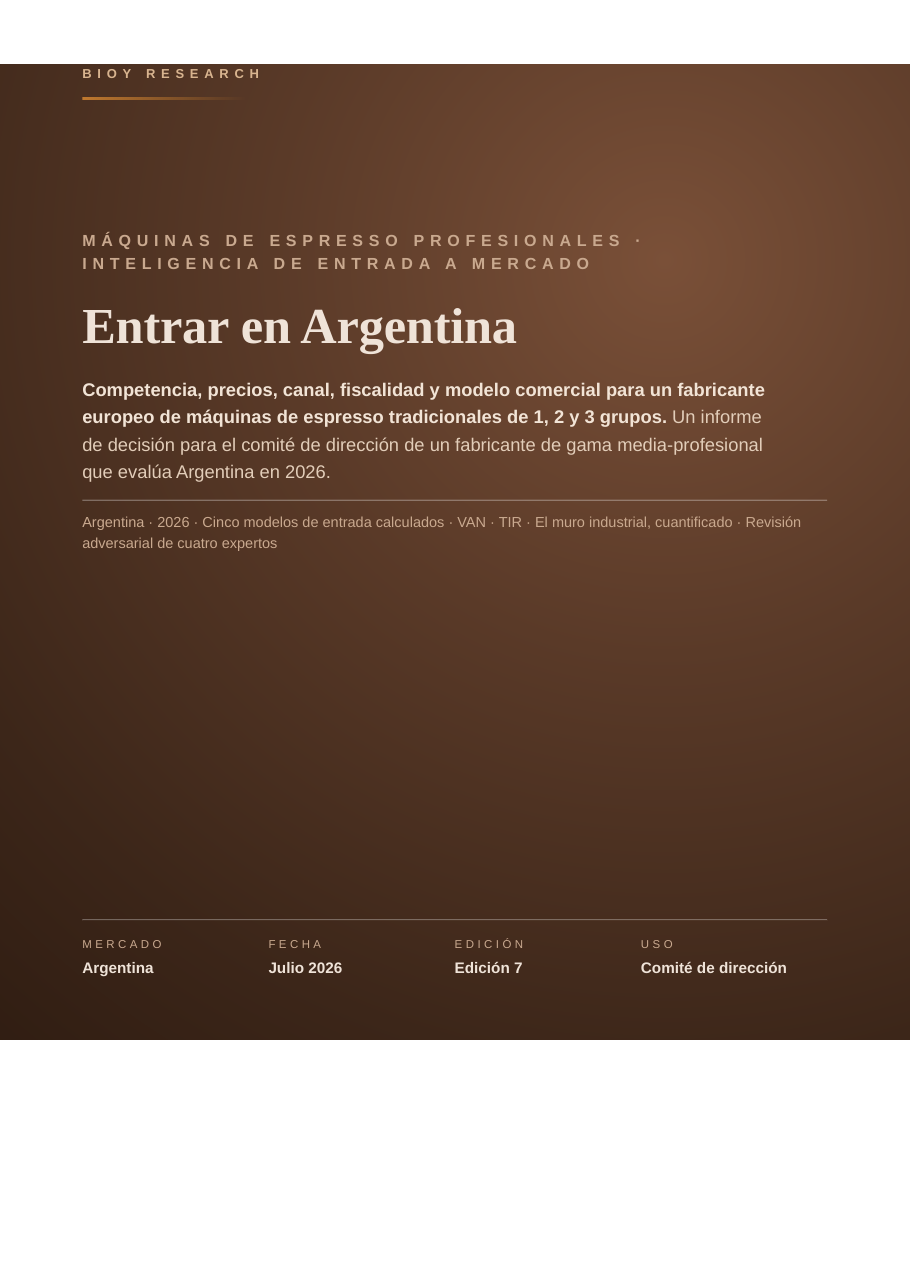
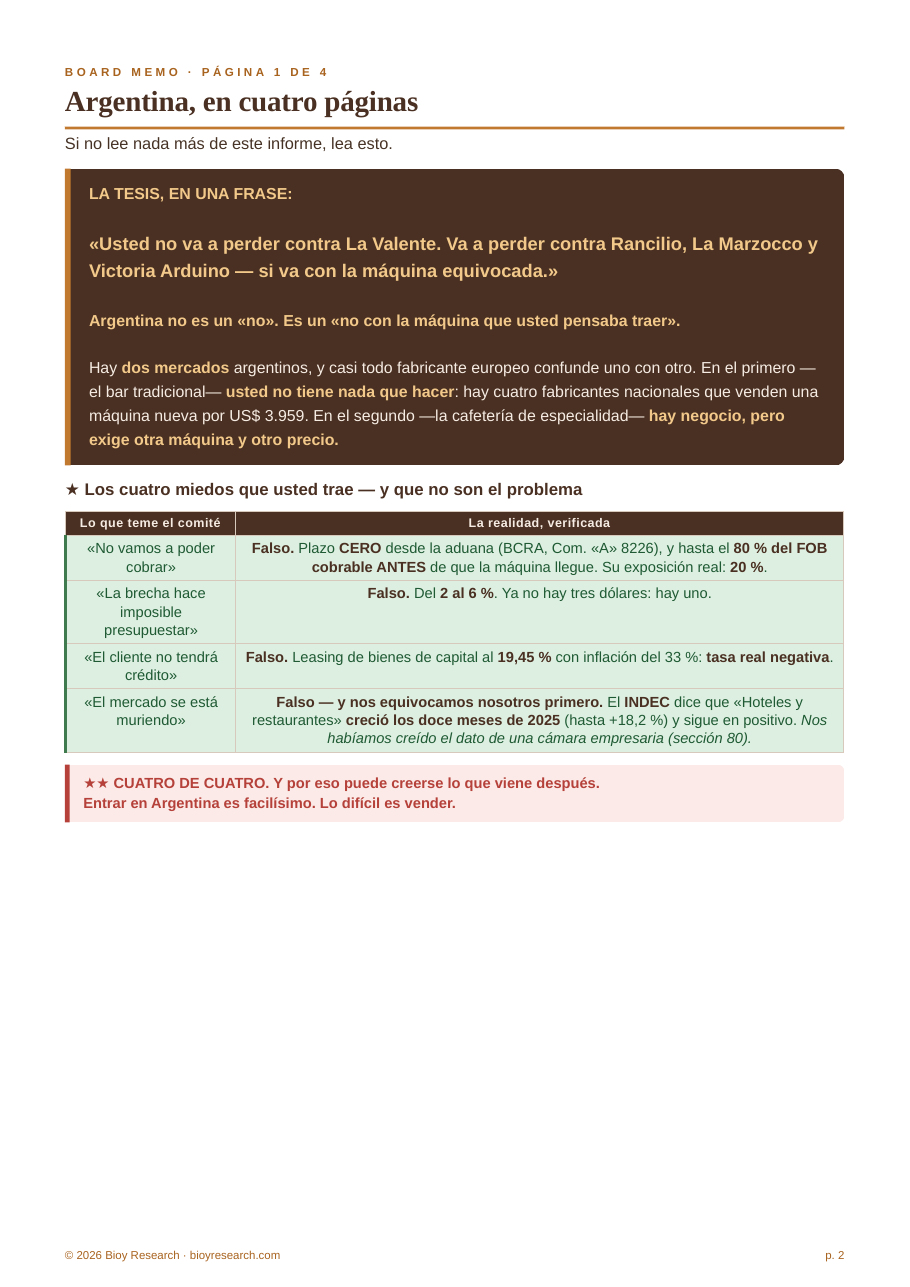
Written for the board of a European maker of mid-to-professional grade machines evaluating Argentina. This is not a trend study: it is the folder on which entry is approved or rejected, with the financial model inside and the numbers already run. The verdict is not "don't enter": it is "don't enter with that machine".
Real PDF pages: cover, executive summary, charts and competitive tables.
A decision report, not a sector overview. Every figure comes out of a financial engine, and every decisive claim carries its source, its date and the confidence we place in it.
Argentina's border isn't price: it's the product. There are two markets that don't touch —the traditional bar, locked up by four national factories with spare parts and service around the corner, and the specialty café, which pays for European performance and where no local machine competes—. The report tells you which one you can win in and which you can't, and why.
There's a single product condition that separates GO from NO-GO, and it's answered before you spend a euro: in your own engineering department, today. The report frames it, explains why it's that one and no other, and what happens to your entry if the answer is «no».
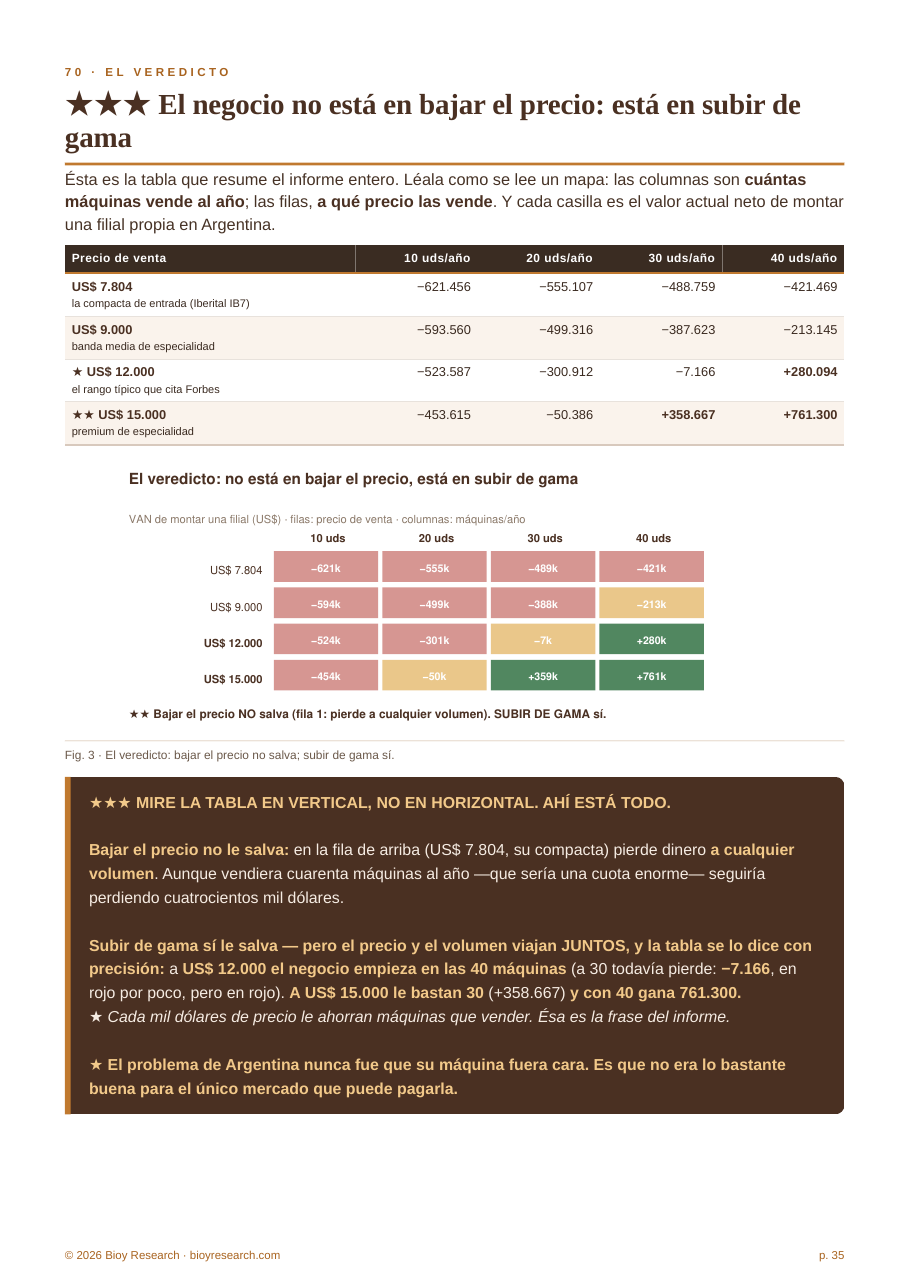
A price×volume matrix that pins down exactly where the business stops losing and starts making money, with the NPV of each combination. You'll see the point where the sign flips —and why price and volume close together, not separately— without having to estimate the size of the market.
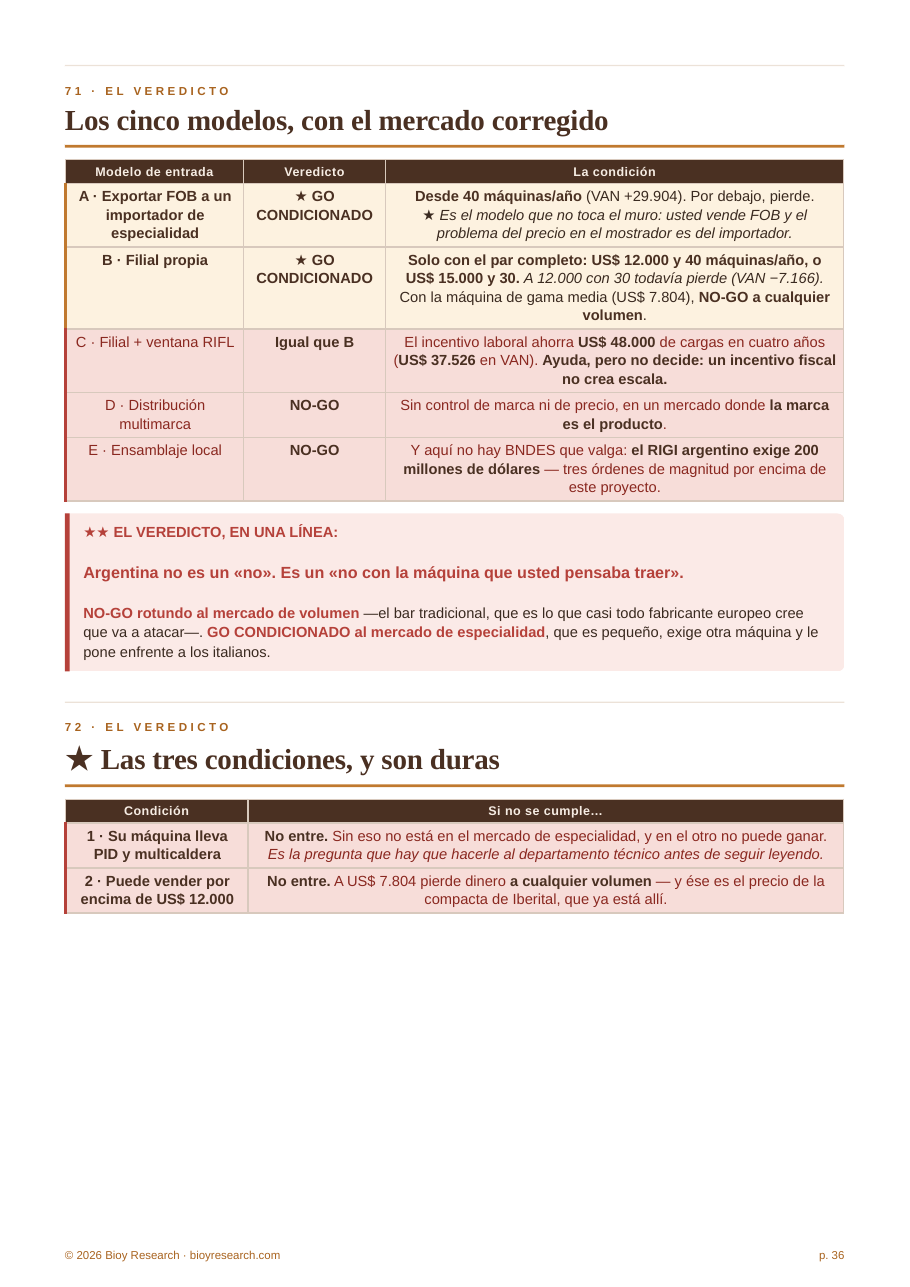
Exclusive importer, own subsidiary, alliance with a distributor, multi-brand distribution and the comodato as the premium channel: all five run through the same accounts, with NPV, break-even, scenarios and a tornado that tells you which variable really decides. It includes the arithmetic that makes the specialty comodato work, reconstructed for the first time.
Before publishing, we put the thesis through an adversarial review tasked with tearing it down. They knocked out the flagship finding —an advantage we thought we had and turned out to be false— and found two errors in our own engine. The chapter recounts each objection, what changed and what held: the verdict survived, but for a different reason than we thought.
Tariff, VAT, the real state of the cepo and your effective FX exposure, certification (or the lack of it) and the labour-incentive window that is closing. Every number with its rule and its date, verified against the official source —not against foreign-trade portals, which here publish stale figures—.
Every number that supports a verdict comes with its source, its date and how much we trust it. The weak assumptions are flagged as such: if you don't believe our volumes, plug in your own and re-run the matrix. And we say out loud what we couldn't verify, instead of dressing it up as a finding.
Download a free sample with the cover and the full table of contents.
The sample includes the cover and the contents, so you can see the full scope of the report. The analysis, the financial model and the verdicts are in the full edition.
For the board of a European maker of traditional espresso machines in the mid-to-professional range (1, 2 and 3 groups) considering entry into Argentina. If you manufacture super-automatics or capsules, much of the tax analysis still serves you, but the competitive map and the product verdict are built for the group machine with PID and a multi-boiler.
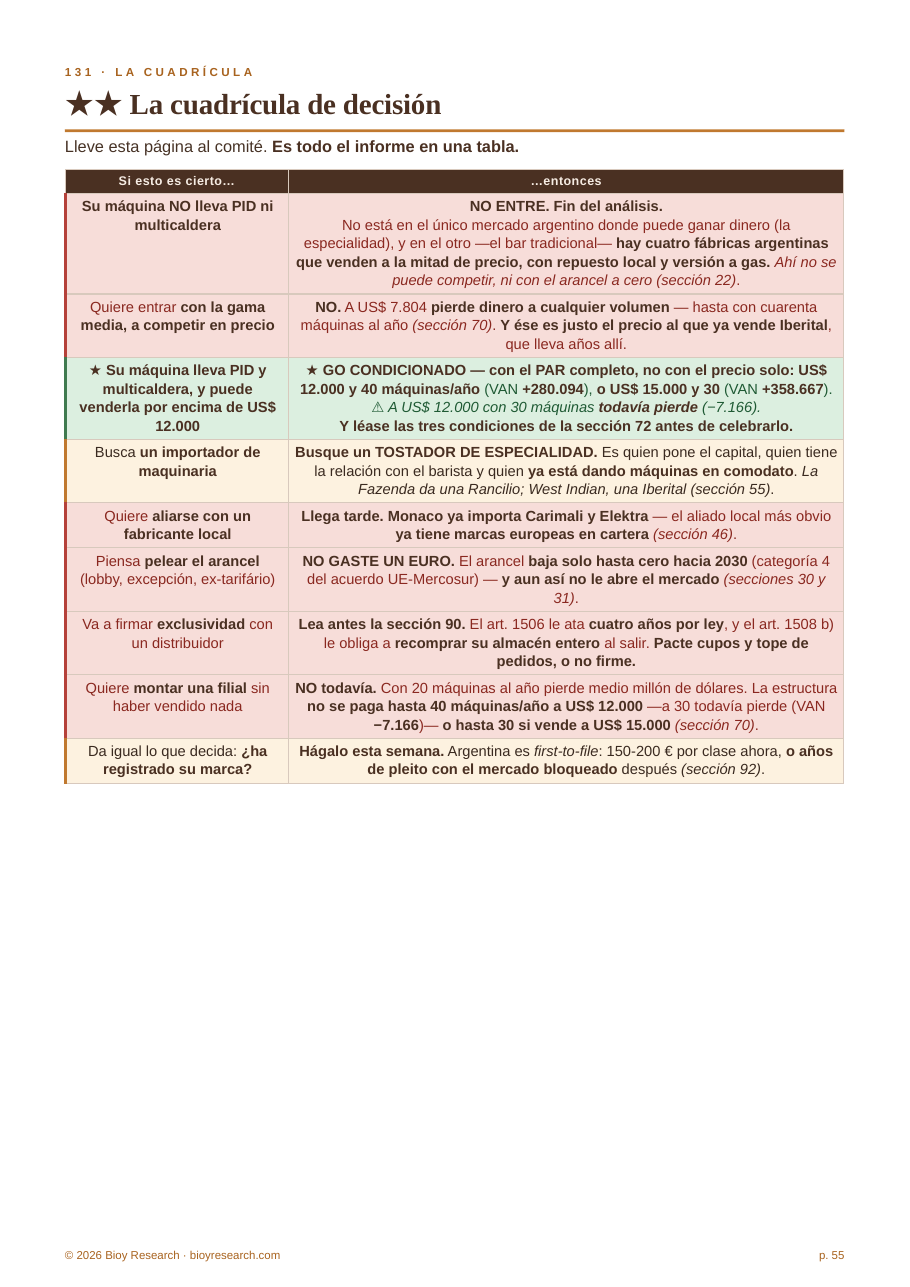
Neither in the abstract. The verdict is one of product: do NOT enter the traditional bar, where four Argentine factories sell at US$ 3,959 with local service; you CAN enter the specialty café, which pays US$ 6,000-30,000 and fits no domestic machine — but only if your machine has PID and a multi-boiler, and only if price and volume close together as the report's matrix shows.
Because cutting the price does not open the traditional bar to you: even if you matched the Argentine factory, you would still lose to its parts and its service on the corner. And moving up-market does not close the specialty on price but on capability: that customer pays more than enough, but demands PID and a multi-boiler. The axis that decides is not how much you charge, but which machine you bring. The report shows that not even a zero duty would change the verdict.
Yes, and that's the point. The report publishes the price×volume matrix and the scenarios: you'll see in which cell the NPV changes sign. If your volumes or your price differ, place yourself in the matrix and check whether your combination lands in positive territory. The conclusion that survives that change is the only one that counts.
Four independent specialists were briefed to destroy the thesis. And they succeeded with the flagship finding: the original report claimed that a "category E" of the EU-Mercosur deal left your machine out. It is false — it is category 4, with zero duty by 2030. They also caught two bugs in our financial engine. The remarkable part: the verdict did not change, because the machine does not fit on product, not on duty. The chapter tells it without make-up.
Yes. Tariffs, VAT, the real state of the cepo and your effective FX exposure, certification (or its absence) and the closing labour-incentive window: every figure with its rule and its date, verified against the official source. The report separates what is recoverable from what is a real cost, which is where most customs brokers get it wrong.
The product verdict, the two markets pulled apart, the four Argentine factories, five entry models with NPV and a tornado, and the price×volume matrix so you can redo it with your own numbers.
Buy the report · €3,499