PDF interior
What you will see inside
Real PDF pages: cover, executive summary, charts and competitive tables.
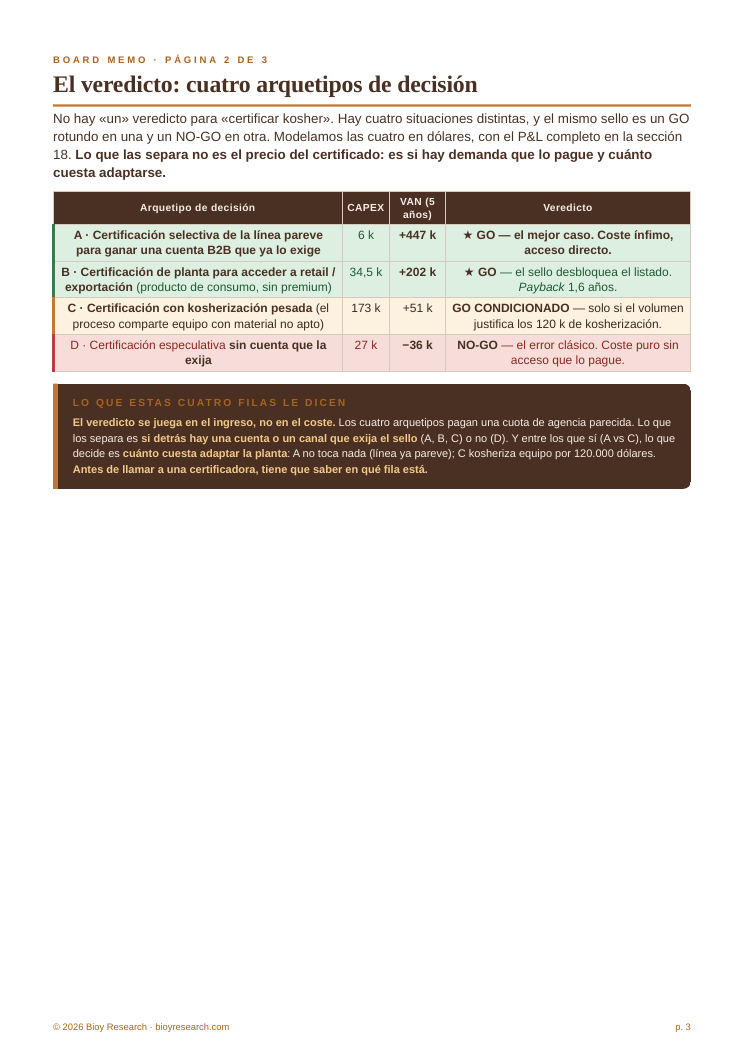
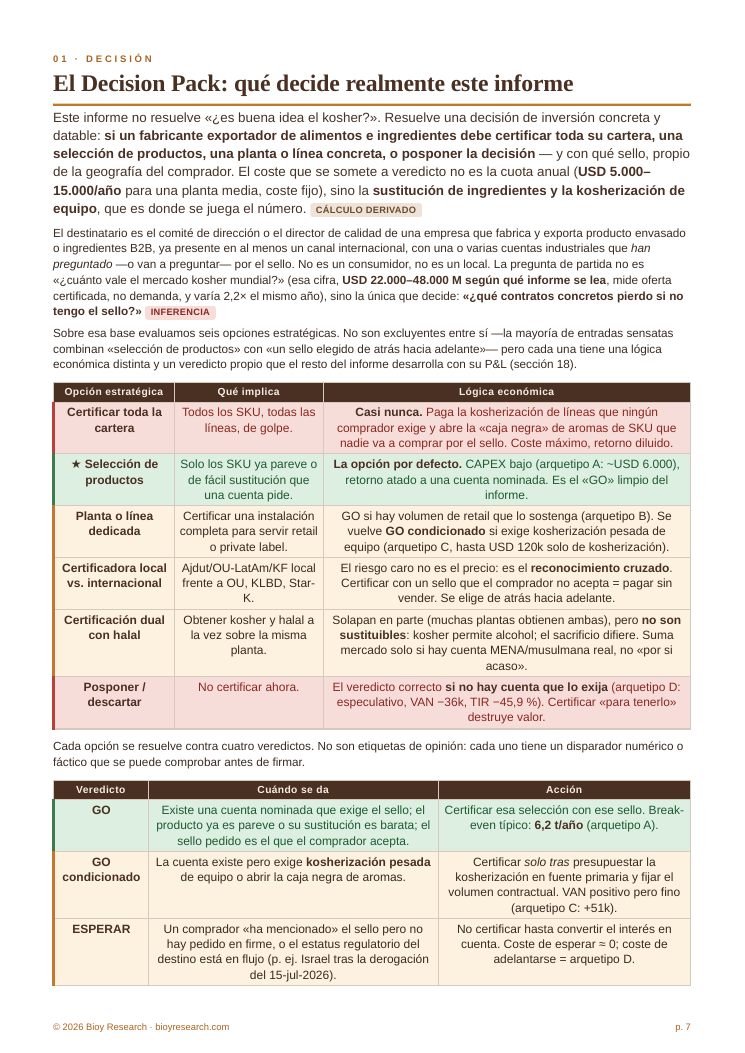
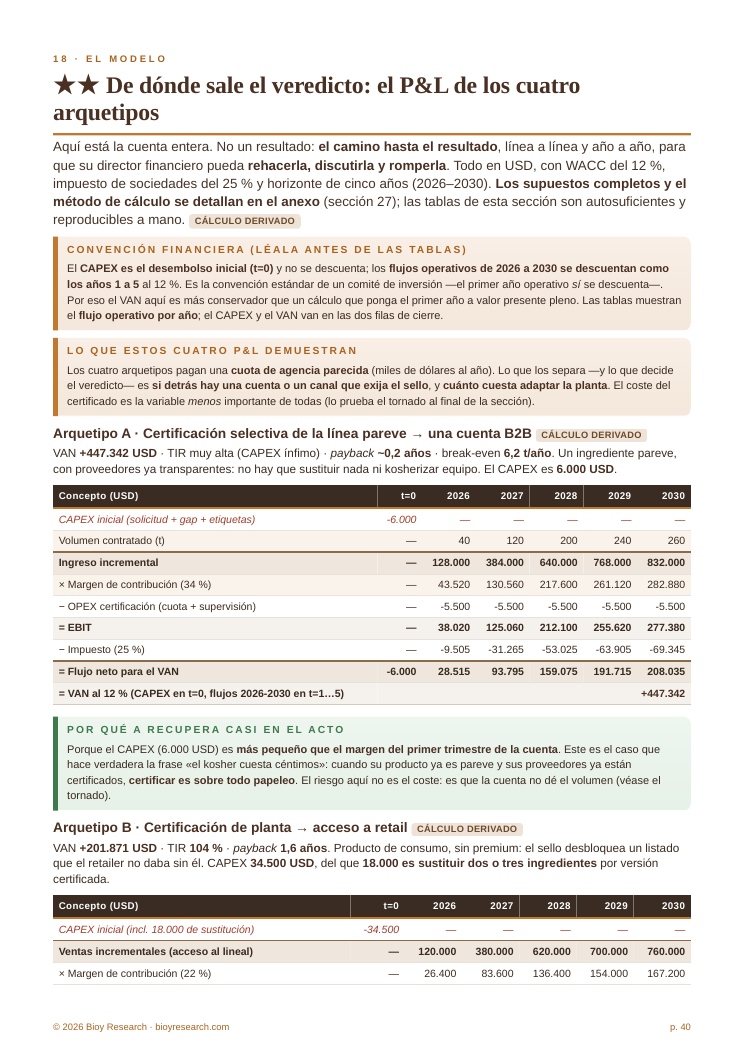
Written for the board of a food-and-ingredient manufacturer weighing kosher certification for export. This is not a kashrut guide: it is the folder on which certification is approved or rejected, with the financial model inside and the numbers already run for your own plant.
Real PDF pages: cover, executive summary, charts and competitive tables.
A decision report, not an overview of the kosher market. Every figure comes out of a financial engine, and every decisive claim carries its source, its date and the confidence we place in it.
The intuition sells: "I certify kosher and charge more." It is almost never true in the mainstream channel. The symbol does not lift the price: it stops an account or a channel that requires it as a listing condition from shutting you out. So the right question is not "how much more will I sell?" but "which specific buyer asks me for the symbol, and what does it cost me to give it to them?". If no account requires it, almost all the spend is speculative — and this report exists so you do not make that mistake.
The certifier's fee is the small line item and the one everyone looks at first. The one that sinks or saves the project is another: substituting a non-kosher ingredient for one that is, and kosherising equipment that shares lines with non-kosher product. The sensitivity tornado shows it without ambiguity: the dominant variable is the volume of the account that requires the symbol; the least important, by a wide margin, is what the agency charges.
Pareve — neither meat nor dairy — is the commercial key: a pareve product enters meat kitchens and dairy kitchens alike, and that doubles the market it can sell into. The real difficulty is not theological, it is supply chain: the flavour supplier who will not disclose its carriers can kill an entire SKU. The report separates the cheap (already pareve, with transparent suppliers) from the expensive (equipment must be kosherised, or the black box of additives opened) and from what is another business entirely (entering meat or wine).
You do not choose the certifier you like most, but the one your buyer accepts. OU opens the US door; KLBD, much of the EU and the UK; the Chief Rabbinate, Israel. The expensive risk is certifying with a symbol your customer does not recognise and finding out afterwards. The report brings the map of certifiers and the weight each carries in each destination, so you choose starting from the buyer, not from the agency.
Before publishing, we put the thesis through an adversarial review briefed explicitly to refute it from every angle: the size of the market, the logic of the premium, the tax treatment of the symbol and the legal reading. The review chapter tells you which objections held, which knocked us down and what we changed — including our own mistakes. One lesson was methodological: the "global kosher market" figure measures certified supply, not demand.
The State cannot define "kosher" (Commack v. Weiss, 2nd Circuit, 2002): the only duty it can impose is transparency, identifying the certifier. In the EU, kosher is not regulated as such, and the only sensitive front is ritual slaughter, with the CJEU case law behind it. And one fresh, precisely dated fact: Israel repealed its kashrut reform in July 2026, restoring the Chief Rabbinate's monopoly. The report explains what each of these moves for your decision.
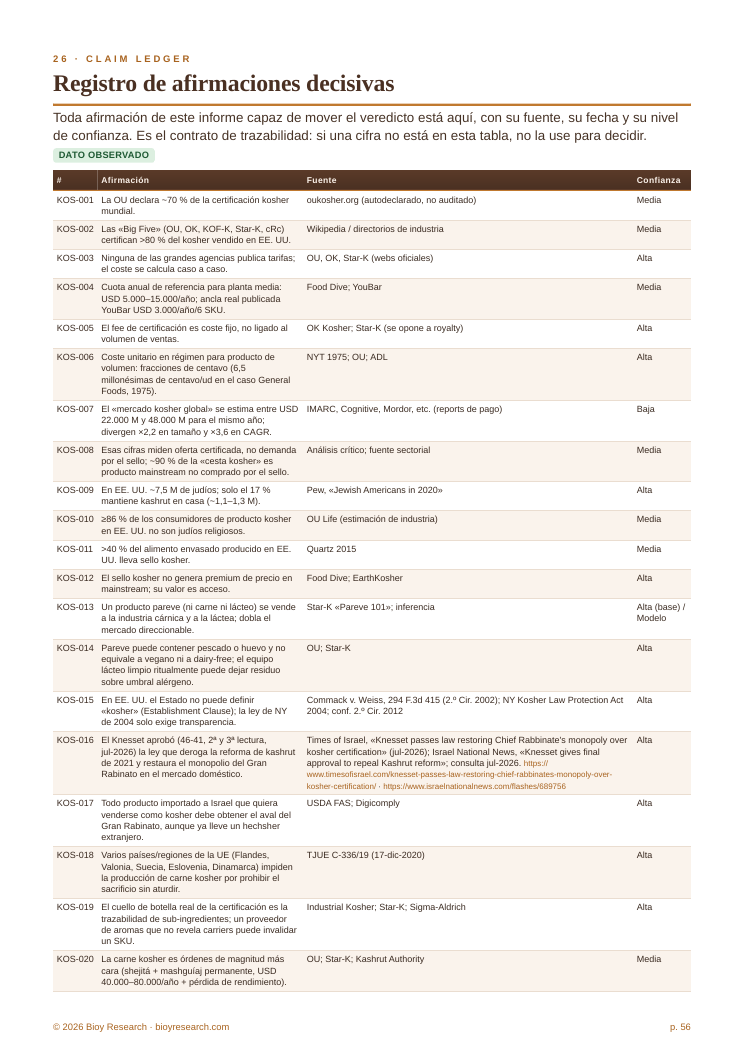
The claims register collects the numbers that move a verdict, each with its source, its date and the confidence we place in it — and we say so when the confidence is low. Alongside the register runs a table of direct links to the claims that decide, so you can verify them yourself. The report is self-contained: everything you need to judge the verdict is inside the PDF.
Download a free sample with the cover and the full table of contents.
The sample includes the cover and the contents, so you can see the full scope of the report. The analysis, the financial model and the verdicts are in the full edition.
For the board of a food or ingredient manufacturer that exports, or wants to export, and is weighing whether kosher certification is worth it. It is not a religious guide or a manual for the plant: it is a business decision report. The analysis is built for the US, Israel and the EU, the three destinations where the symbol really moves channel access.
Almost never in the mainstream channel, and that is one of the report's central theses. The symbol is an access requirement: without it, there are accounts and channels that will not even list you. A real premium exists only in specific niches (Passover, kosher wine, the strictly observant consumer). If your business plan assumes a general uplift just for carrying the symbol, that plan has a hole in it, and the report shows you where.
It depends on the archetype, which is why there are four. Where there is a specific B2B account that requires the symbol and you are already pareve, the decision is clear and the return comfortable. Where heavy equipment must be kosherised, the verdict is conditional and the report publishes the conditions. And there is a speculative archetype — certifying with no account asking for it — that is a NO-GO: it is the classic mistake this report exists to prevent.
Pareve is the kosher status of a product that is neither meat nor dairy. It matters because a pareve product can be sold to meat-line and dairy-line buyers alike, and that doubles the addressable market. The difficulty is not theological: it is supply chain. A single additive or flavour whose supplier will not disclose its carriers can block the certification of an entire product.
The financial model reasons in US dollars (USD), because that is the currency in which certification and export accounts to the US and Israel are in fact negotiated. The report sells for €3,499 per single licence, as an instant-download PDF.
The report is available in Spanish, English, German and French. Each version is a full edition, not a summary: the same analysis, the same financial model and the same verdicts, adapted to the language.
Before publishing, we put the report's thesis to the explicit task of destroying it, angle by angle: the real size of the market, the logic of the premium, the tax treatment of the symbol and the legal reading. The review chapter tells you which objections held, which knocked us down and what we changed, including our own mistakes. It is the part that gives most confidence in the final verdict.
Four archetypes with a verdict, the real cost that decides, the map of certifiers by destination, and the financial model so you can redo it with your own numbers.
Buy the report · €3,499