PDF interior
What you will see inside
Real PDF pages: cover, executive summary, charts and competitive tables.
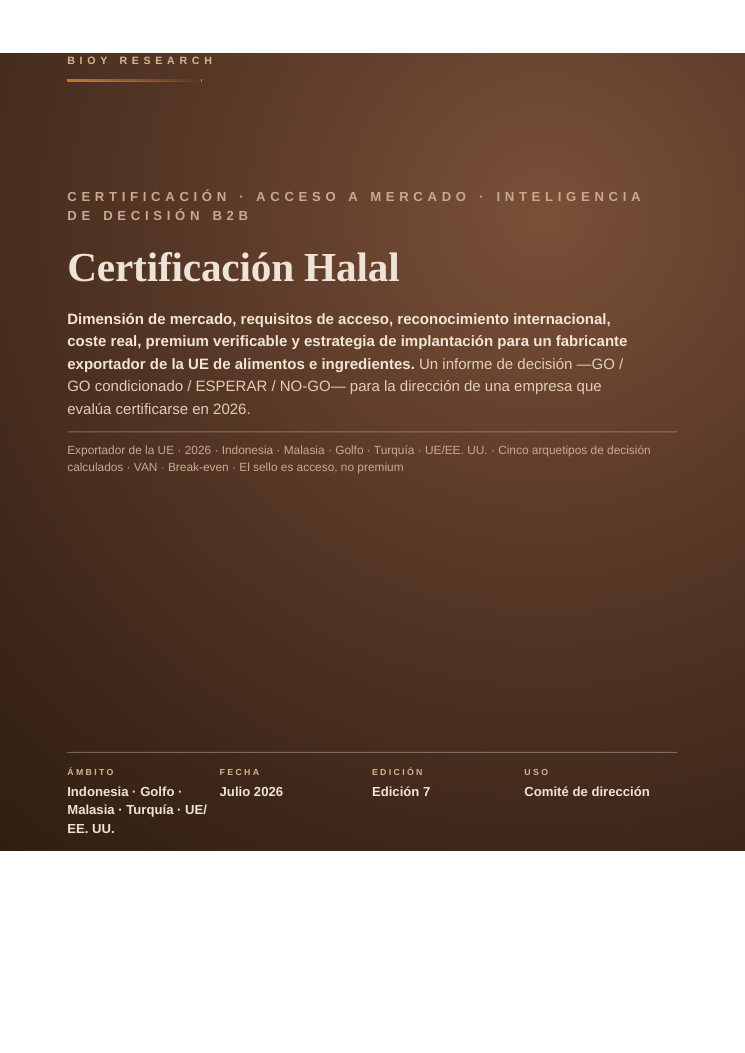
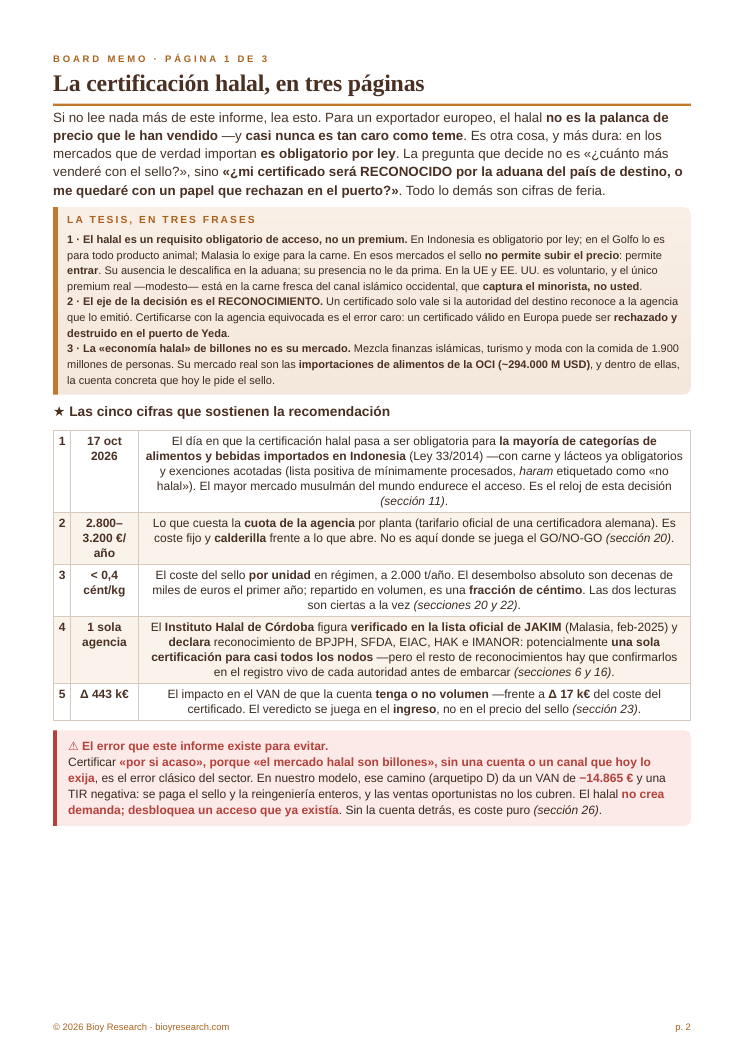
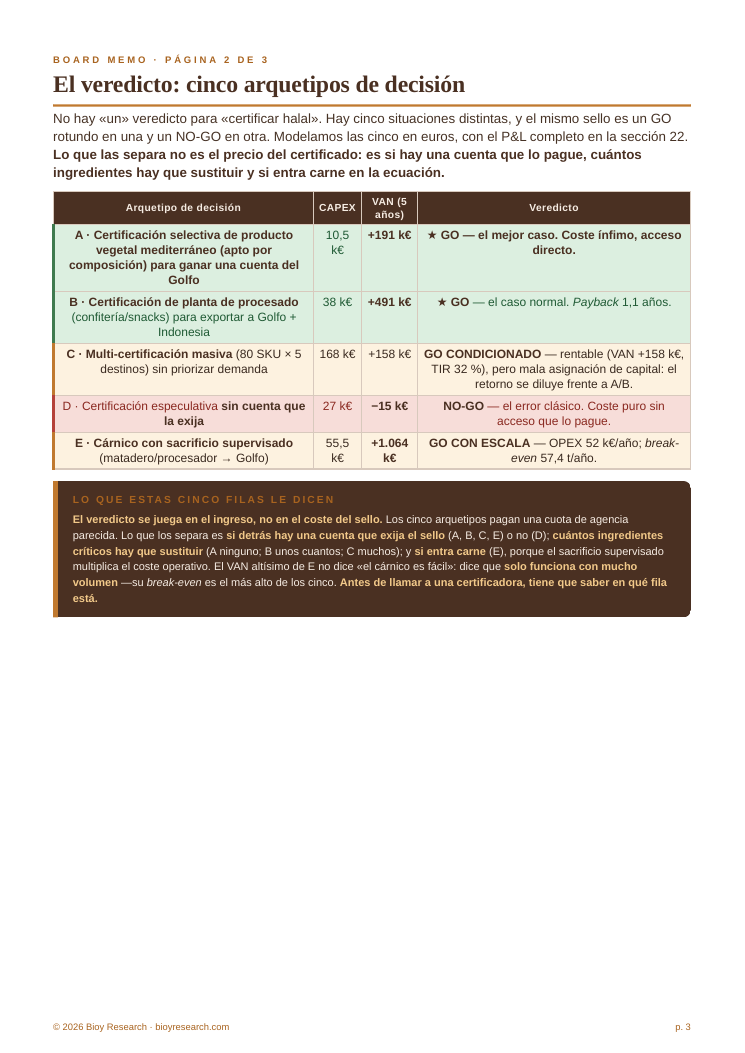
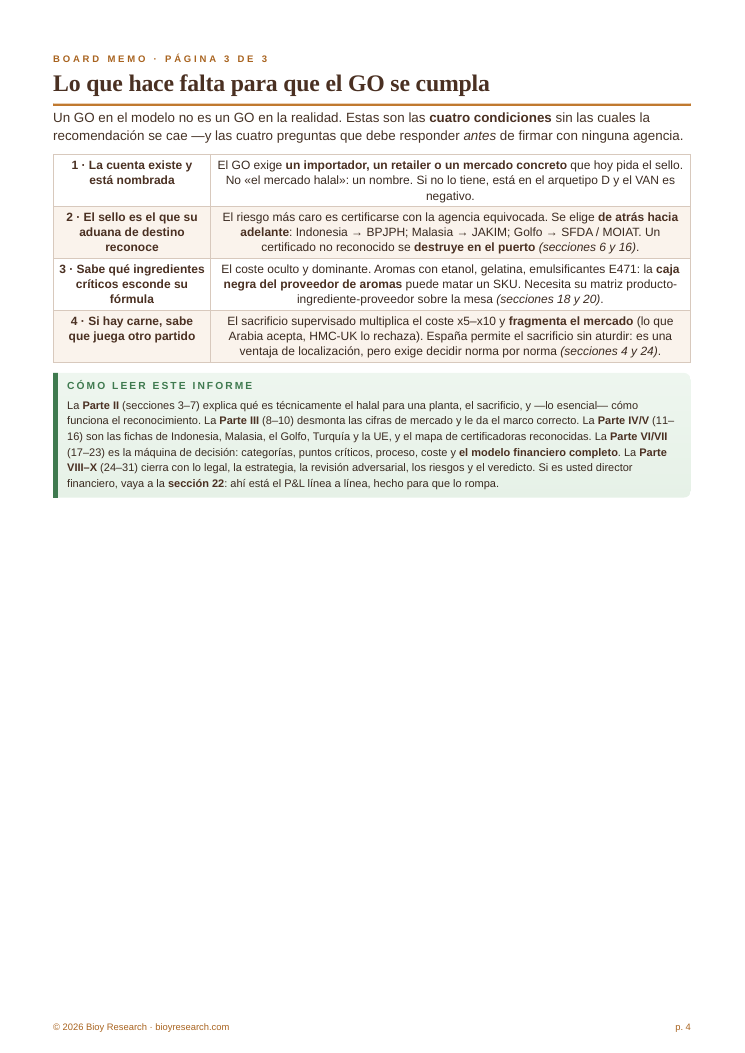
Written for the board of an EU food-and-ingredient manufacturer (based in Spain) weighing halal certification for export. This is not a religious guide: it is the folder on which certification is approved or rejected, with the financial model inside and the numbers already run for your own plant.
Real PDF pages: cover, executive summary, charts and competitive tables.
A decision report, not an overview of the halal economy. Every figure comes out of a financial engine, and every decisive claim carries its source, its date and the confidence we place in it.
The intuition sells: "I certify halal and charge more." It is almost never true. In the markets that really matter the mark does not lift the price: it decides whether your product enters or stays in the port —in Indonesia it is mandatory by law, and in the Gulf it is mandatory for any animal product. In the EU and the US, by contrast, it is voluntary, and the only verifiable premium lives in a very specific niche… which the manufacturer does not capture anyway. The report tells you which of the two worlds your SKU is in before you spend a euro.
A certificate is only worth something if the authority of the destination country recognises the agency that issued it. A paper that is valid in Europe can end with the container rejected —or destroyed— at the destination port. And recognition expires and is withdrawn: a European agency was struck off the Malaysian list in 2023. The report brings the map of who recognises whom, the rule of choosing the mark back-to-front (starting from your buyer, not from the agency) and —key for a Spanish exporter— what is verified in an official source and what is merely the certifier's self-declaration.
The figures in circulation mix Islamic finance, tourism and fashion with the food of 1.9 billion people, certified or not. The proof is in the data itself: the same magnitude, "halal food market", varies twenty-five-fold depending on which consultancy publishes it, and one of the big names contradicts itself when it narrows its own definition. The report rebuilds the market a European exporter can actually capture from real trade, not from the headline —and explains why "five sources agree" usually means one source copied five times.
The certifier's fee is the small line item, and it is the first one everybody looks at. The one that sinks or saves the project is another: opening the black box of your ingredients. The flavour whose supplier will not declare the ethanol carrier, the gelatine, the emulsifier of undetermined origin —that is where the real cost lives, and it is a procurement problem, not an R&D one. The sensitivity tornado shows it without ambiguity: the dominant variable of the verdict is the volume of the account that requires the mark; the least important, by a wide margin, is what the agency charges.
There is no single verdict for "getting halal certified": there are five situations, and the same mark is an emphatic yes in one and a no in another. A Mediterranean product compliant by composition, a processing plant with ingredients to substitute, the whole catalogue at once, certifying with no customer asking for it, and the meat case with supervised slaughter. All five run through the same engine —year-by-year P&L, NPV, IRR, payback, break-even and tornado— so your CFO can redo the numbers, argue with them and break them. Including the scenario that exists so that you do not repeat it.
Ritual slaughter multiplies the operating cost and, above all, fragments the market: what one authority accepts, another rejects —reversible stunning splits the map in two, and there is no such thing as "a universal halal product". On top of that, the EU has its own open front: the Court of Justice has ruled that Member States may impose stunning, and has closed off the route of combining the European organic logo with slaughter without stunning. The report explains where that leaves a Spanish plant, and what has to be validated with a lawyer before investing in a dedicated line.
Before publishing we put the thesis through an adversarial review briefed explicitly to refute it: the size of the market, the logic of the premium, the omitted cost, the regulatory calendar. The chapter tells you which objections held, which knocked us down and what we changed —including our own mistakes. And every claim that moves the verdict goes into a register with its source, its date and the confidence we place in it, saying so when the confidence is low or when a figure is merely a self-declaration. With direct links so you can verify it yourself. All inside the PDF.
Download a free sample with the cover and the full table of contents.
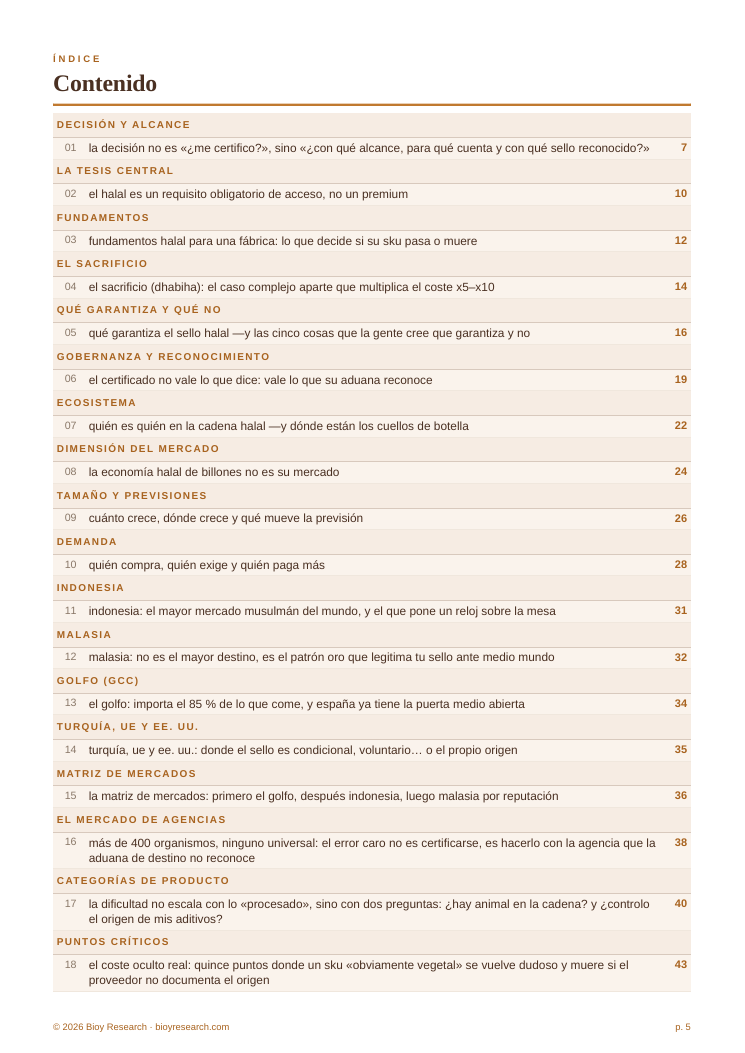
The sample includes the cover and the contents, so you can see the full scope of the report. The analysis, the financial model and the verdicts are in the full edition.
For the board of an EU food or ingredient manufacturer —the base case is a Spanish company— that exports, or wants to export, and is weighing whether halal certification is worth it. It is not a religious guide or a manual for the plant: it is a business decision report. The analysis is built for Indonesia, the Gulf (GCC), Malaysia, Türkiye and the EU/US, the destinations where the mark really decides access.
Almost never, and that is one of the report's central theses. In the markets that matter the mark is not a premium: it is customs. In Indonesia it is mandatory by law and in the Gulf it is mandatory for any animal product; without it, your product does not enter. In the EU and the US it is voluntary, and the only verifiable premium lives in a very specific niche that the manufacturer does not capture anyway. If your business plan assumes a general uplift just for carrying the mark, that plan has a hole in it, and the report shows you where.
It depends on the archetype, which is why there are five. Where there is a specific account in a destination that requires the mark and your product is already compliant by composition, the decision is clear. Where ingredients must be substituted or processes reworked, the verdict is conditional and the report publishes the conditions. There is a speculative archetype —certifying with no customer asking for it— that is a NO-GO: the classic mistake this report exists to prevent. And the meat case, with supervised slaughter, is a different game.
Because a certificate is only worth something if the authority of the destination country recognises the agency that issued it. There are more than 400 certification bodies and none is universal: a paper that is valid in Europe can end with the container rejected at the destination port. Recognition also expires and is withdrawn —a European agency was struck off the Malaysian list in 2023. That is why the mark is chosen back-to-front, starting from your buyer and from customs, not from the agency.
The financial model reasons in euros (€), because the base case is an EU exporting manufacturer based in Spain, and that is the currency in which it bears its costs and negotiates its accounts. The report sells for €3,499 per single licence, as an instant-download PDF.
The report is available in Spanish, English, German and French. Each version is a full edition, not a summary: the same analysis, the same financial model and the same verdicts, adapted to the language.
Before publishing, we put the report's thesis to the explicit task of destroying it, angle by angle: the real size of the market, the logic of the premium, the omitted cost and the regulatory calendar. The review chapter tells you which objections held, which knocked us down and what we changed, including our own mistakes. It is the part that gives most confidence in the final verdict.
Five archetypes with a verdict, the real cost that decides, the recognition map by customs authority, and the financial model so you can redo it with your own numbers.
Buy the report · €3,499