PDF interior
What you will see inside
Real PDF pages: cover, executive summary, charts and competitive tables.
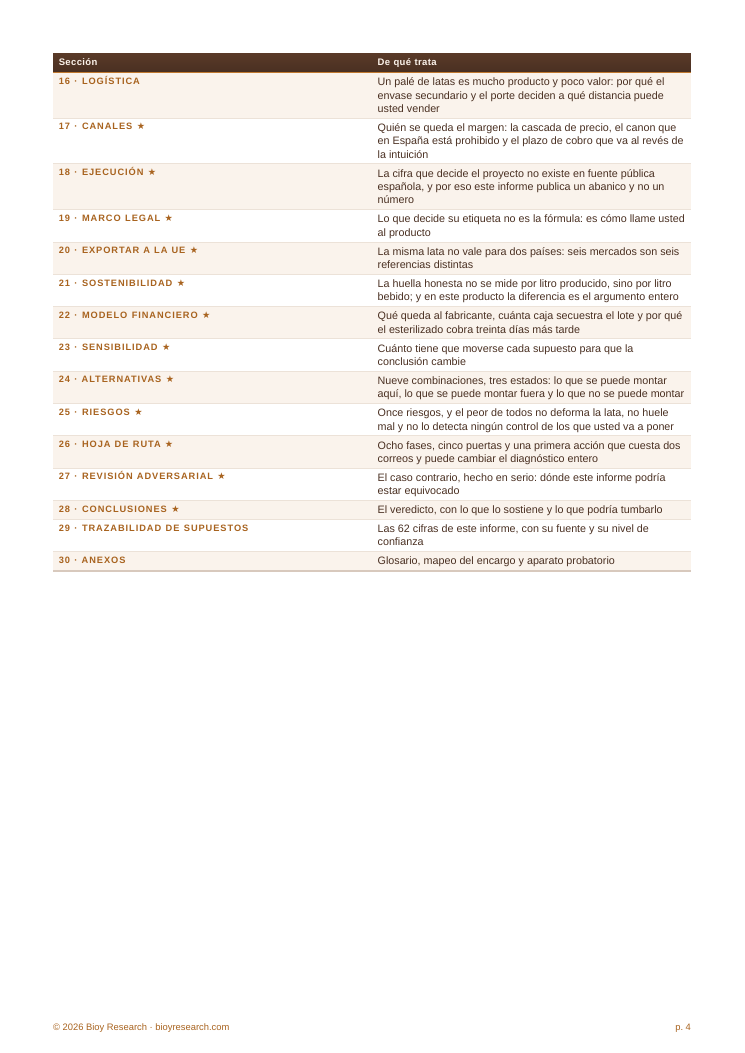
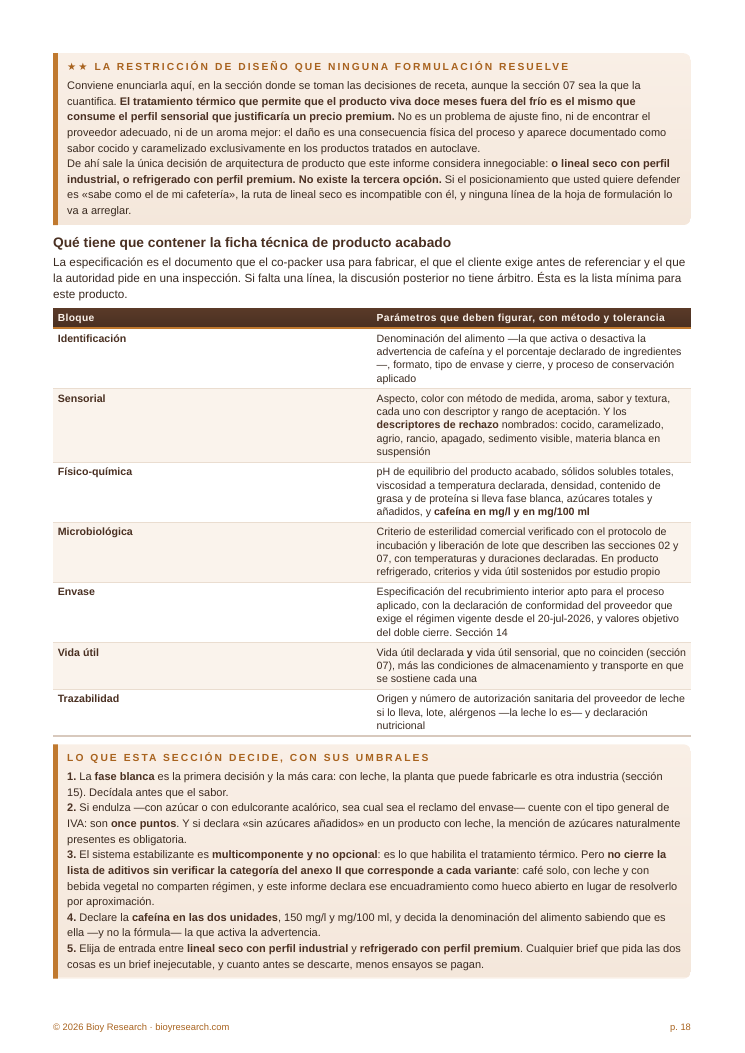
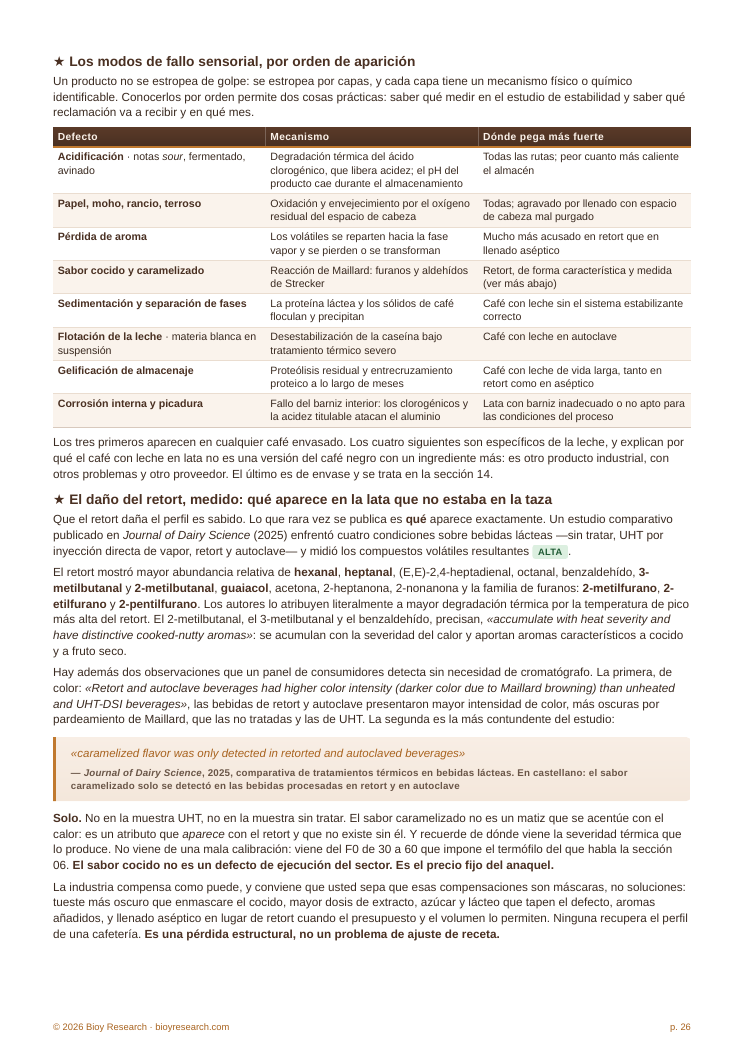
Categories, formulation, industrial process, packaging, distribution, rotation and viability, with an original shelf audit and a reproducible calculation engine.
Real PDF pages: cover, executive summary, charts and competitive tables.
A decision report, not an overview of the cold coffee category. Every figure comes out of a financial engine whose assumptions are published one by one, and every decisive statement carries its source, its date and the confidence grade we give it, including the gaps that could not be closed.
Ready-to-drink coffee has high perceived acidity and a pH well above the 4.6 threshold that separates two regulatory worlds. Inside a sealed can, moreover, the environment is anaerobic. The report works through what that means for the process, for the equipment and for the minimum scale, with the pH value measured and published, the legal threshold cited in its own article, and the preservation routes the rule admits —and the one the sector proposes that does not work, with the written denial from its own equipment manufacturer.
The heat treatment for this category is not set by food safety but by commercial stability: a thermophile far more heat-resistant than the classic hazard. The report quantifies that difference, explains what it does to the sensory profile, and describes the defect characteristic of the format — one that does not deform the pack and therefore escapes conventional quality control.
The identification mark printed on the label makes it possible to establish the plant where each reference is filled. The report reads it across nine brands of Spanish cold coffee —private label included— and publishes the complete table of brand, owner, plant and country. The pattern that emerges explains, better than any market estimate, what kind of industry manufactures this product and for whom.
The expiry date is not your selling time. Between the residual shelf life the trade demands and the days in transit there is an effective window that the report calculates for each process route, and from which it derives waste —rather than assuming it. With sensitivity on the two variables that govern it: rotation at the point of sale and the size of each drop, which is a replenishment decision and not a given of the channel.
Slim versus sleek format —not the same body, not the same end, and confusing them means ordering something that is not in the catalogue—, published prices for body and end separately, verified palletisation, and the decoration decision that sets a volume floor independent of the filling one. Plus the bisphenol A-free lacquer requirement, with its application date read in the article of the regulation and not in the press summary.
The full cascade by channel —grocery multiples, convenience, vending and direct sales— with VAT, retail margin, trade investment, promotion and bad debt applied in the right order and on the right base. It includes how listing fees sit within the Spanish food supply chain act, the real payment terms by product type, and the cash mechanism that suffocates drinks projects.
The caffeine warning depends on the product's commercial name, not on its formula: the report cites the two cumulative requirements of the regulation and works through what that means for branding. Plus the food-safety regime that applies to a coffee with milk —which is not the one the sector assumes—, the VAT rate that decides the recipe, and the claims that cannot be used because they were refused.
A country-by-country matrix of packaging deposits, extended producer responsibility schemes and mandatory prior registrations, with their amounts, their rules and their penalties. It includes the trap that catches exporters out: registration is a condition precedent to the first sale, not a formality afterwards, and stock is not fungible between markets.
Every economic figure comes out of a reproducible engine whose assumptions are published in full with their source, their consultation date and their confidence level. The data the research could not close are published as declared gaps, with instructions for closing them: the engine throws an error if any section tries to read them as a figure. The report also explains what that decision does to what it publishes and what it does not.
Download a free sample with the cover and the full table of contents of the report.
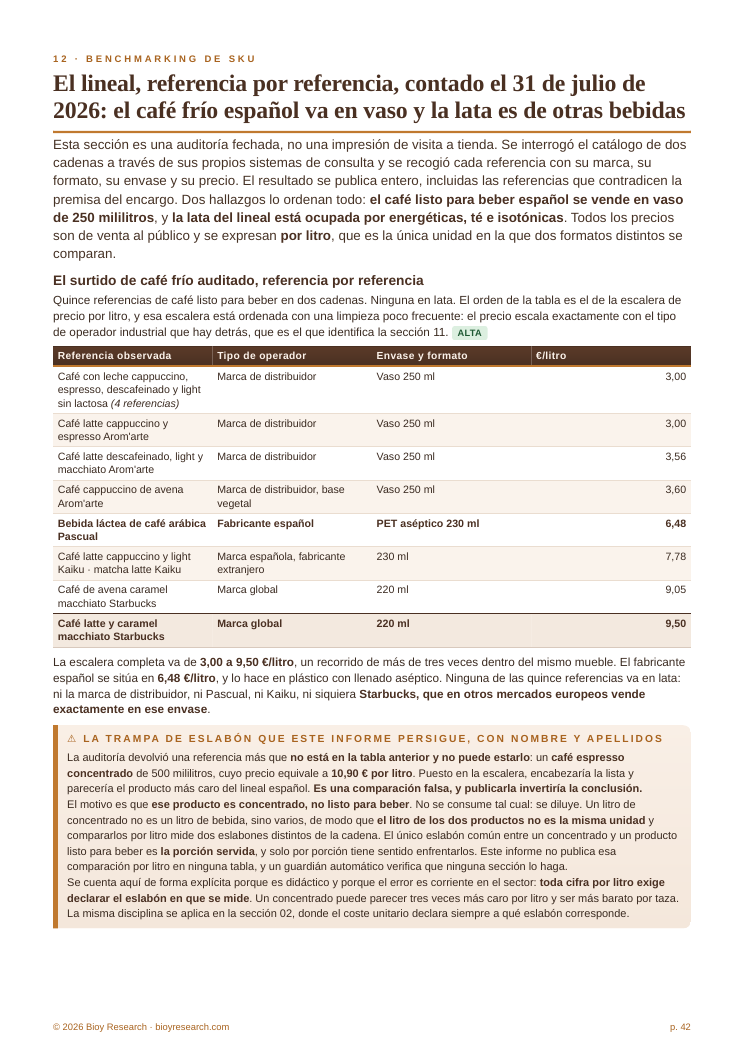
The sample includes the cover and the contents, so you can see the full scope of the report. The analysis, the financial model and the verdicts are in the complete edition.
For a small business about to risk its own money, in three profiles: the roaster or coffee brand that wants its own can and has no beverage plant, the drinks brand or functional startup born as a ready-to-drink product, and anyone weighing whether to manufacture private label for a retail chain. It is not a report for a committee with the means to buy a plant: the premise is that you decide alone.
That it does not start from a consultancy's projection but from the shelf counted product by product with a method anyone can repeat, and that it establishes the plant that actually manufactures each brand by reading the identification mark on its label. And that it publishes its own limits: whatever could not be verified appears as a declared gap, not as an estimate dressed up as data.
Yes, and it is reproducible: the assumptions are published in full with source, date and confidence level, so that you can replace the ones you obtain yourself and redo the calculation. It includes the price cascade by channel, the selling window, the waste derived from it, working capital and the behaviour of the minimum order quantity, with sensitivity on the variables that move the result most.
Yes, in a dedicated chapter. A country-by-country matrix of packaging deposits, extended producer responsibility schemes, mandatory prior registrations with their deadlines and their penalties, and labelling language. It includes which obligations carry a date and which ones change in the coming months.
Edition 7, with a cut-off date of 31 July 2026. The report explicitly identifies the dated regulatory obligations that force a review and recommends a review horizon.
Three archetypes with a verdict, the three preservation routes with their real availability in Spain, the selling window against the expiry date, the physical compatibility between pack and process, the legal framework verified article by article, and the model delivered in CSV and JSON so you can redo the arithmetic with your own assumptions.
Buy the report · €3,499