PDF interior
What you will see inside
Real PDF pages: cover, executive summary, charts and competitive tables.
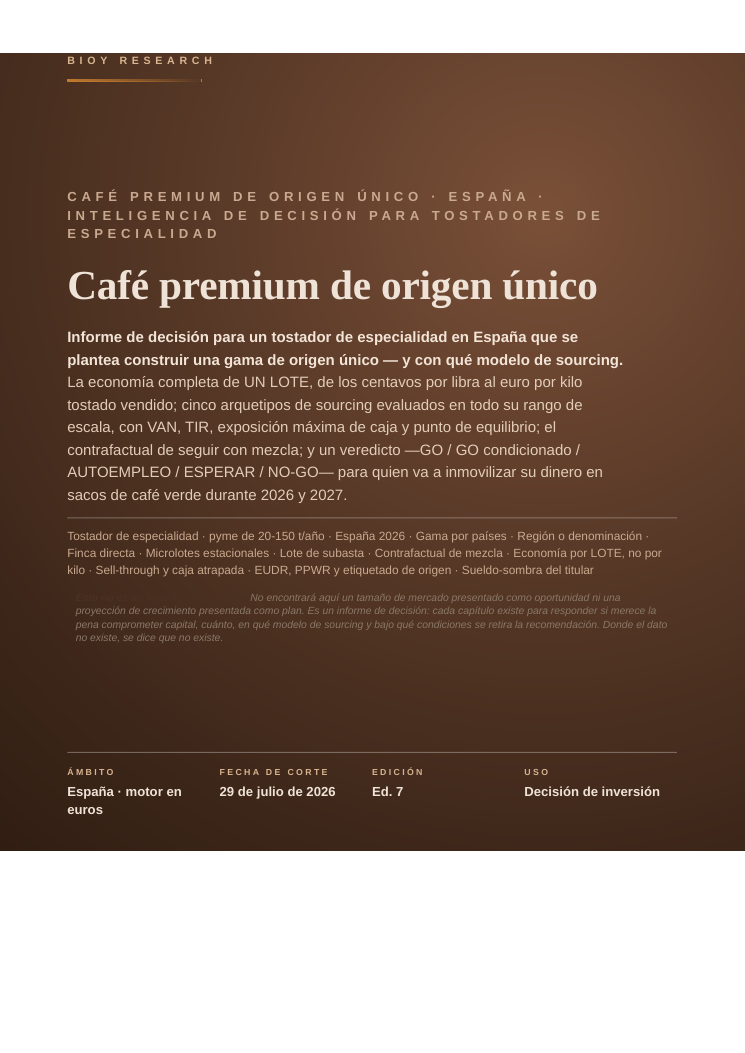
Written for the owner of a Spanish specialty roasting SME — 20 to 150 tonnes a year, deciding alone — weighing whether to build a single-origin range and with which sourcing model. Not a survey of the specialty scene: it is the file on which green coffee purchasing is committed or refused, with five sourcing archetypes settled through one engine and the counterfactual of staying with blends held throughout.
Real PDF pages: cover, executive summary, charts and competitive tables.
A decision report, not a tour of the specialty scene. Every figure comes out of a single financial engine, the unit of analysis is the lot rather than the kilo, and every claim capable of moving the verdict carries its source, its date and the confidence we place in it.
The brief that starts this kind of project almost always reads "we want to enter the premium single-origin niche". That niche does not exist as a niche. We audited the Spanish specialty channel and 71.6 % of the SKUs already declare an origin — country, region, farm or washing station — while blends sit in the entry price band. Declaring origin is the entry ticket to the category, not the advantage inside it. So the report answers the question left standing once the false premise is withdrawn: if origin no longer differentiates, what does, and exactly how much does it cost to buy it?
This is the methodological decision that separates this report from a spreadsheet of margins per kilo. A lot arrives whole, it is paid for in advance, and what does not sell is not "less margin": it is sunk cost plus whatever the clearance recovers. So the engine builds every archetype lot by lot — outlay, sell-through, turnover months, trapped working capital, clearance recovery on the remainder — and only then aggregates to the portfolio, never the other way round. It is also why the report publishes peak cash exposure separately from the initial investment: in some archetypes they are the same number and in others they are not remotely the same, and it is the second one you take to the bank.
The single most expensive gap between a plan and a bank balance. A range can declare a sell-through it is physically unable to realise, because its own channel cannot absorb the volume its number of references generates — and the kilos that go unplaced are real kilos of roasted coffee. The engine applies a ceiling and reports the realised figure, not the declared one, so the returns you read are already calculated on what actually leaves the warehouse. The report shows where the two diverge, by how much, and what it does to the verdict of the archetype concerned.
Category anecdotes confuse the origin with the roaster, the pack size and the variety, so the report does not run on anecdotes. We audited 797 SKUs — 444 distinct products across 8 Spanish specialty roasters — with price, format, origin level, variety, process and published score where one exists. Every headline figure is regenerated from that file by script rather than quoted from memory, and the report declares its unit each time: the row (product × pack size) or the product. The premium the market actually pays is varietal, not geographic: scarce varieties such as geisha carry +42 % per product in this sample. And the CSV is delivered with the report so you can redo every median yourself.
Origin on a pack is not a marketing choice, it is a regulated statement. If the origin appears in words on the principal face, Art. 3.2 of Implementing Reg. (EU) 2018/775 obliges the primary ingredient indication into the same field of vision at a set minimum size — an obligation a single-origin range triggers by design, across the whole range. On top of that sit the EUDR, whose application date depends on whether you buy from an EU importer or import yourself, the PPWR, the Spanish tax on non-recycled plastic, and the environmental-claims regime. The report dates each one and says which archetypes turn you into an operator with due-diligence obligations of your own.
Five archetypes, one engine: a five-year P&L, NPV, IRR, payback, peak cash exposure and a break-even sell-through, all measured against the counterfactual of staying with blends without declared origin — because without that comparison you cannot assert that single origin contributes anything at all. On top sits the sensitivity work: a tornado of levers ranked by NPV swing, a full scale sweep from small lots up (each archetype is judged across its range, not at a point), a matrix crossing realised price against sell-through, and three discount rates. And an adverse scenario the report puts on the cover rather than in an annex.
The reference operator is an SME that decides alone: no purchasing department, no buyer at origin, and no capacity to absorb a lot that sticks in the warehouse. The owner travels, cups, roasts, writes the tasting note and sells. So the owner's full working year is valued at the gross rate of the Catalan coffee-roasting collective agreement and deducted before any figure is called profit. It is not a rounding line: in at least one archetype the shadow wage on its own reverses the sign of the decision, and the report names the technical category — a job, not an investment — rather than hiding it inside EBITDA.
This is desk research and it says so on the front of the methodology chapter: no field interviews of our own. Of the engine's 181 assumptions, 45 are Low confidence and 40 of those move the result — all of them listed with key, value, unit and reasoning. Four gaps no desk work can close are declared outright: there is no census of Spanish specialty roasters, no published split of single origin against blends by volume, no shop-window price for specialty green, and no published sell-through for specialty lots. None of the four has been filled with a plausible-looking number, and the pilot chapter tells you exactly how to measure them yourself.
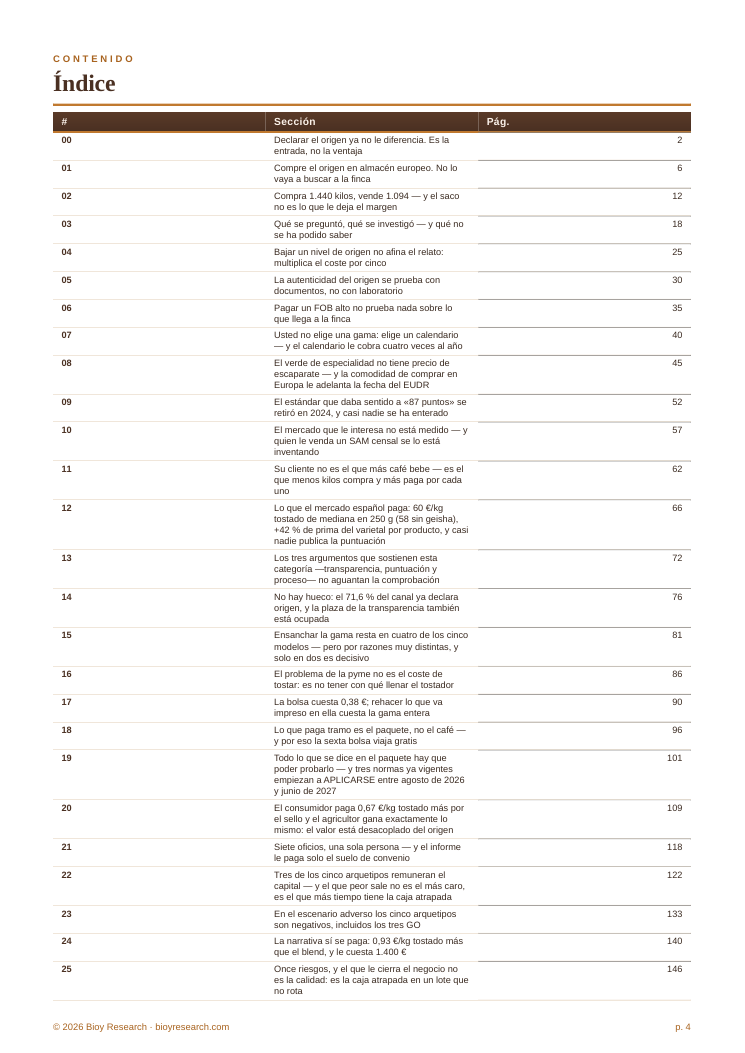
Download a free sample with the cover and the full table of contents.
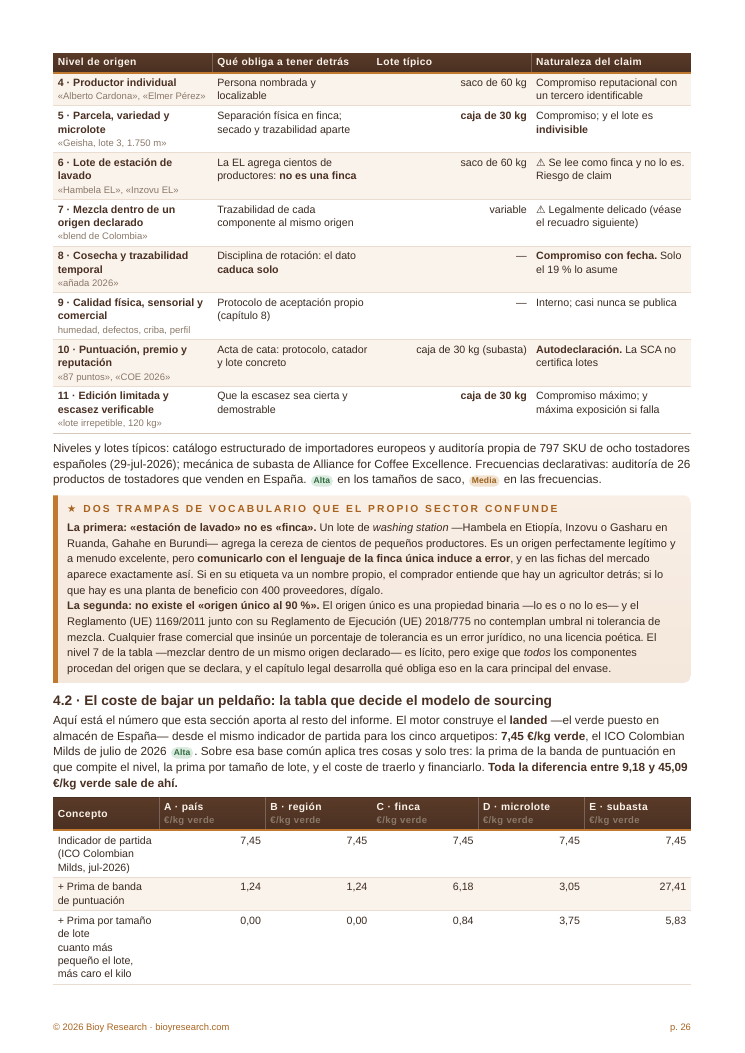
The sample includes the cover and the contents, so you can see the full scope of the report. The analysis, the financial engine and the verdicts by archetype are in the full edition.
For the owner of a Spanish specialty roasting SME — between 20 and 150 tonnes a year — that buys green coffee, roasts it and sells it under its own brand through its own channel and to hospitality accounts. It is an operator that decides alone: no purchasing department, no buyer at origin, and no capacity to carry a lot that sticks in the warehouse. It is not a farm, not an origin cooperative, not an importer and not a coffee shop. That distinction has immediate consequences for which costs land on you and which obligations you inherit.
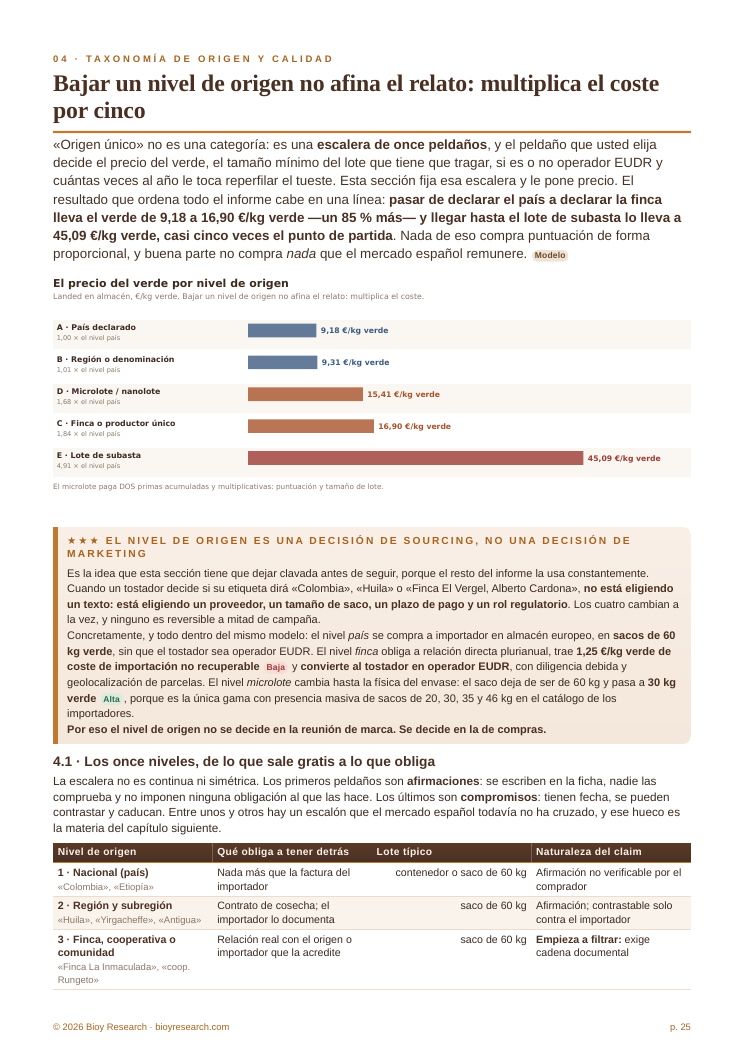
That is precisely the axis of the report. Five archetypes — a permanent country range, a regional or denomination coffee, a single farm or producer bought direct, seasonal micro- and nanolots, and an auction lot — are appraised one by one with the same engine and against the same counterfactual, which is staying with blends without declared origin. Each one carries its own verdict, its own minimum scale and its own withdrawal threshold. Two of the five do not fix themselves by growing: they were swept across the full range of scale and never cross into positive value.
Because a lot arrives whole and is paid for in advance, so the kilos you do not sell are not "less margin": they are sunk cost plus whatever the clearance recovers. Reasoning per kilo hides three things that decide the case — how much cash the lot traps and for how long, what fraction actually sells before the coffee ages, and what the remainder is worth when it is cleared. The engine models all three lot by lot, and reports peak cash exposure separately from the initial investment.
Not for the origin itself, in the sample we audited: 71.6 % of the SKUs in the Spanish specialty channel already declare one, which makes it the category standard rather than a differentiator. What the market does pay for is scarcity of variety — geisha and comparable varieties carry +42 % per product in this audit, as an association of medians without controlling for roaster, process or lot size, and the report says so. Published cupping scores are another matter: barely any SKU publishes one, and where they do the relationship with price is not monotonic.
Both are treated as calendar risks rather than sensitivities, because they arrive on their date whatever your model says. The EUDR application date depends on whether you buy from an EU importer or import directly — the two routes carry different dates and very different due-diligence burdens, and only some of the archetypes make you an operator in your own right. Origin labelling is the quieter and more expensive one: putting the origin in words on the principal face triggers Art. 3.2 of Implementing Reg. (EU) 2018/775 across the whole range, which is a packaging redesign, not a line item.
It is an audit of 797 SKUs — 444 distinct products across 8 Spanish specialty roasters — capturing price, format, origin level, variety, process and published score. Every headline figure drawn from it is regenerated from the file by script, with the unit declared each time (the row, meaning product × pack size, or the product). The CSV is delivered alongside the report, so you can reproduce every median and cut the sample your own way. It is a non-random sample and the report grades it accordingly.
The engine reasons in euros, with a single declared exchange rate for converting the green coffee quotations published in cents per pound. The horizon is five years, with an explicit required return verified at three discount rates, and IVA is excluded from every table because it is deductible — treasury, not cost. The cut-off date is 29 July 2026. The report sells for €3,499 per single licence, as an instant-download PDF.
Yes: you can download a free sample with the cover and the full table of contents before buying. The report is delivered as an instant-download PDF, with the audit CSV alongside it; the analysis, the financial engine and the verdicts by archetype are in the full edition. The model is reproducible from the assumptions declared inside the PDF itself — all 181 of them, each with its key, its value, its source and its confidence grade.
The five sourcing routes compared through a single engine, the economics of a lot from cents per pound to euros per kilo sold, a 797-SKU field audit delivered as a CSV, and every assumption declared so you can redo the sums with your own books.
Buy the report · €3,499