PDF interior
What you will see inside
Real PDF pages: cover, executive summary, charts and competitive tables.
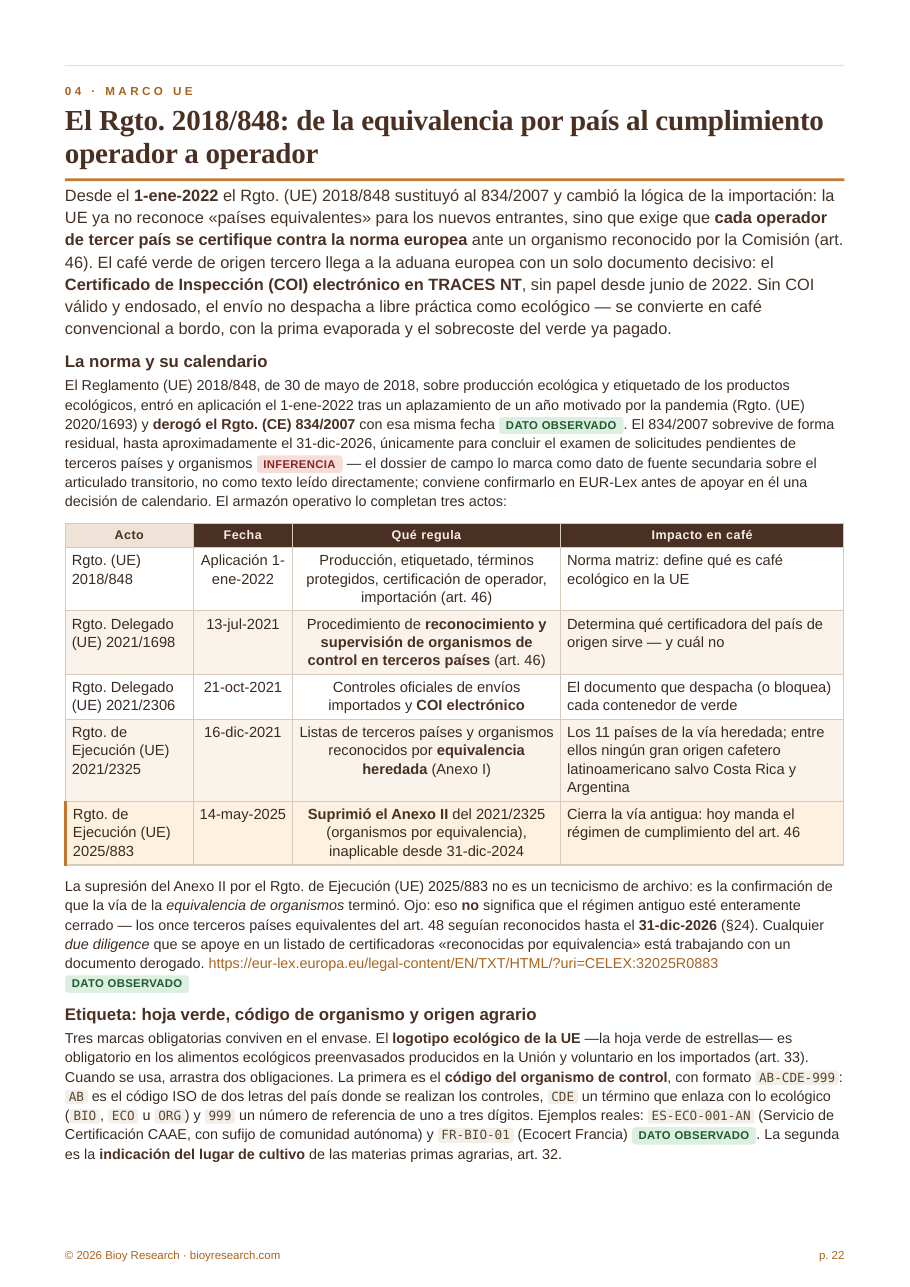
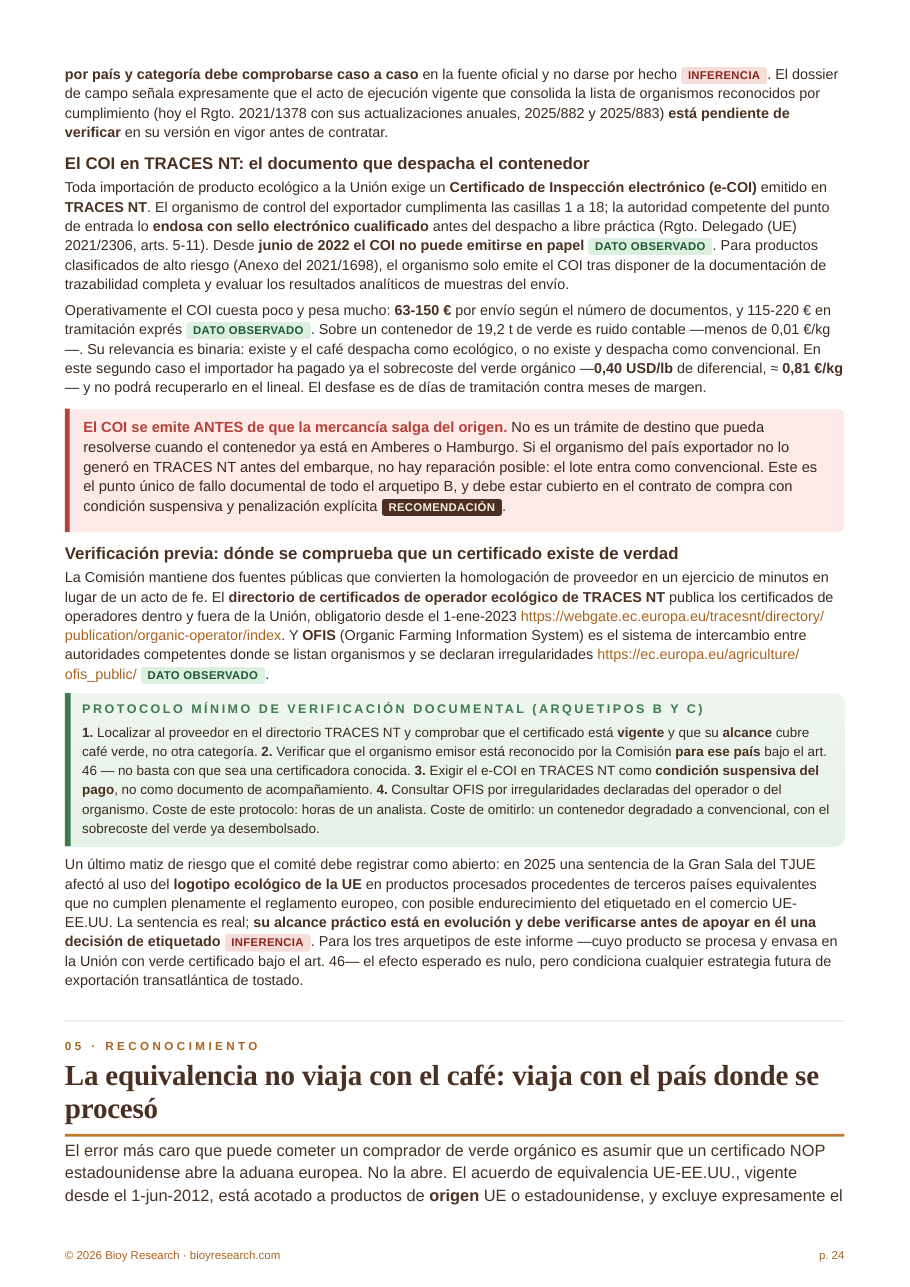
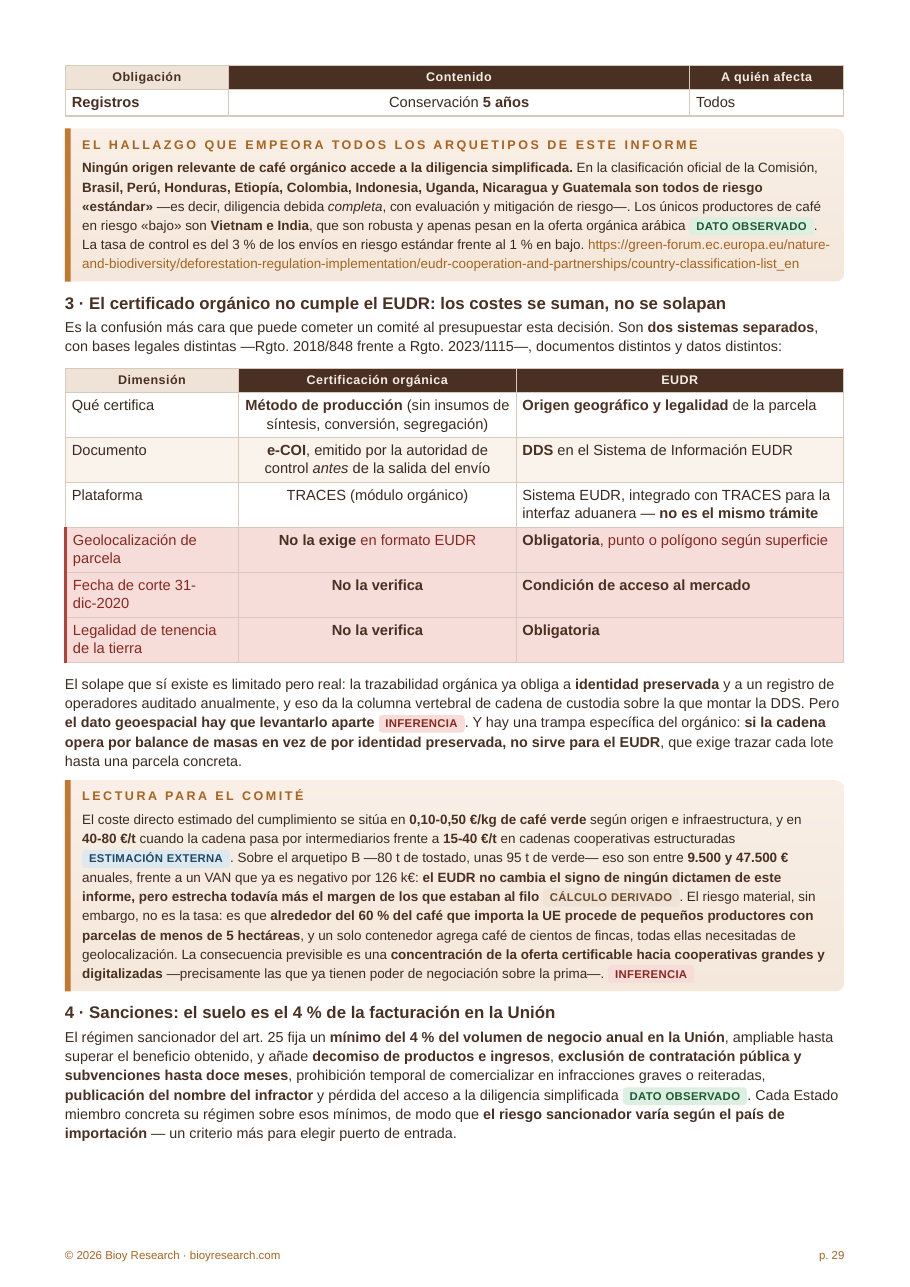
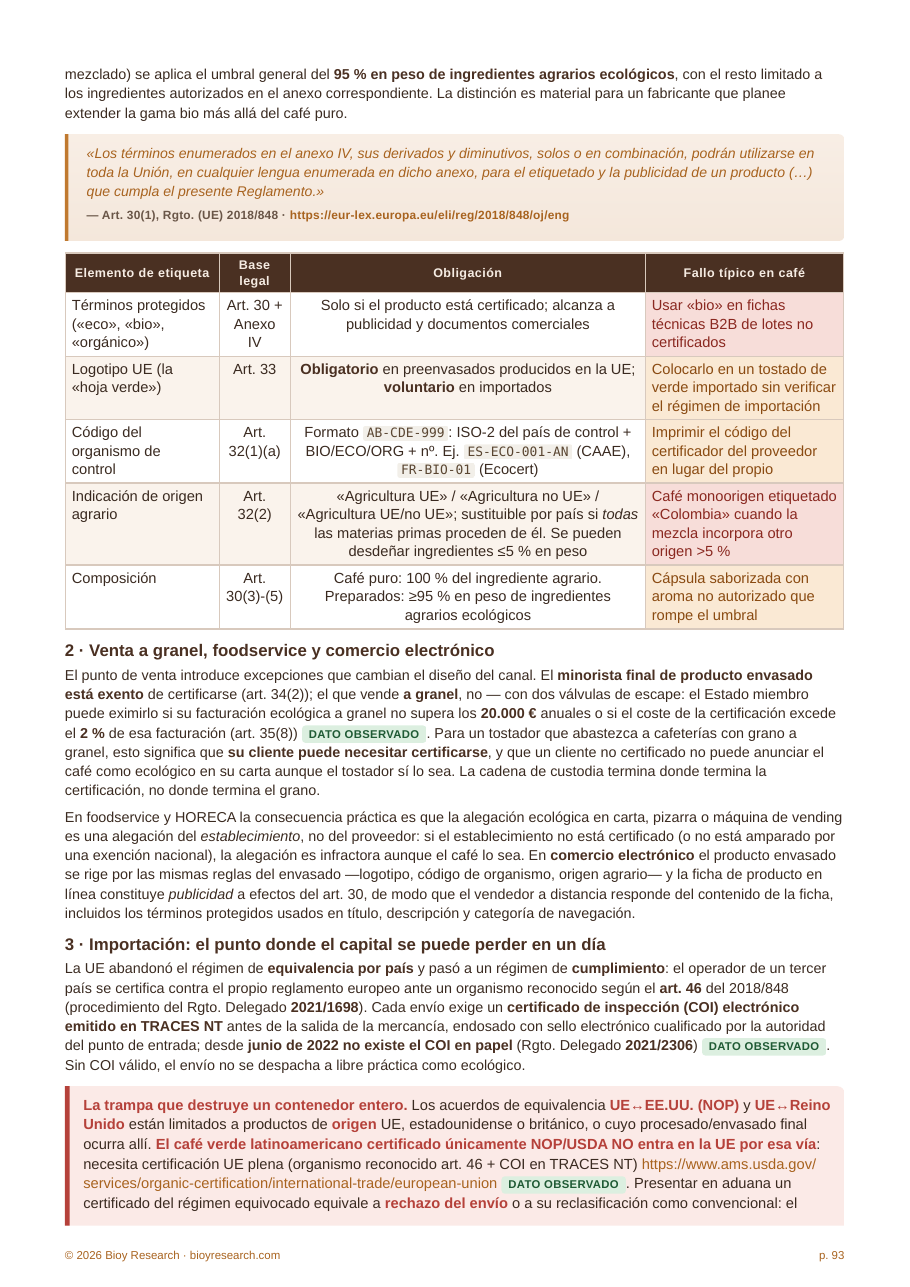
Written for the board or the investment committee of an agri-food company or fund weighing whether to commit capital to the certified organic coffee chain destined for the European Union. This is not a guide to getting certified: it is the folder on which the disbursement is approved or rejected, with the financial model inside and the question of the link in the chain —where do you put the money?— already worked out on paper.
Real PDF pages: cover, executive summary, charts and competitive tables.
An investment decision file, not an overview of the organic seal. Every figure comes out of a financial engine that ships with the report, and every decisive claim carries its source, its date and the confidence we place in it.
The intuition sells: "we certify, therefore we charge more." It does not follow. Between the kilo a control body certifies and the euro of premium that lands in the till there are four distinct layers —certified volume, volume sold with an organic claim, premium actually collected, and premium that reaches the link that put up the money— and the report separates them one by one. A large share of the world's certified coffee is sold as conventional because no buyer will pay the difference. The report measures that gap, puts it into the model as an explicit commercialisation haircut, and shows what it does to the return.
The leaf logo opens the door to the organic channel and to buyers whose procurement policy demands it; it does not guarantee a higher price by definition. For anyone reasoning in euros, the dominant value is not the shelf premium: it is access to a channel, approval by B2B customers who without the seal will not even take the meeting, and the cost you avoid. The report's lever bridge breaks the value of the seal down piece by piece —premium collected, access and volume, cost avoided— against what it costs —conversion, lower yield, certification, segregation— and shows which one really rules in each archetype.
At origin, converting a farm or a producer group means three years selling with no premium, with a structural yield gap that cuts the kilos harvested from day one. That is a certain sunk cost against an uncertain revenue, and no certification brochure puts it that bluntly. The report brings the calendar, the real fee schedule —farm certification with an internal control system and EU operator plant certification, initial and recurring— and the cost of segregation on the factory floor, so the lag between outlay and collection shows up in the cash flow and not in a footnote.
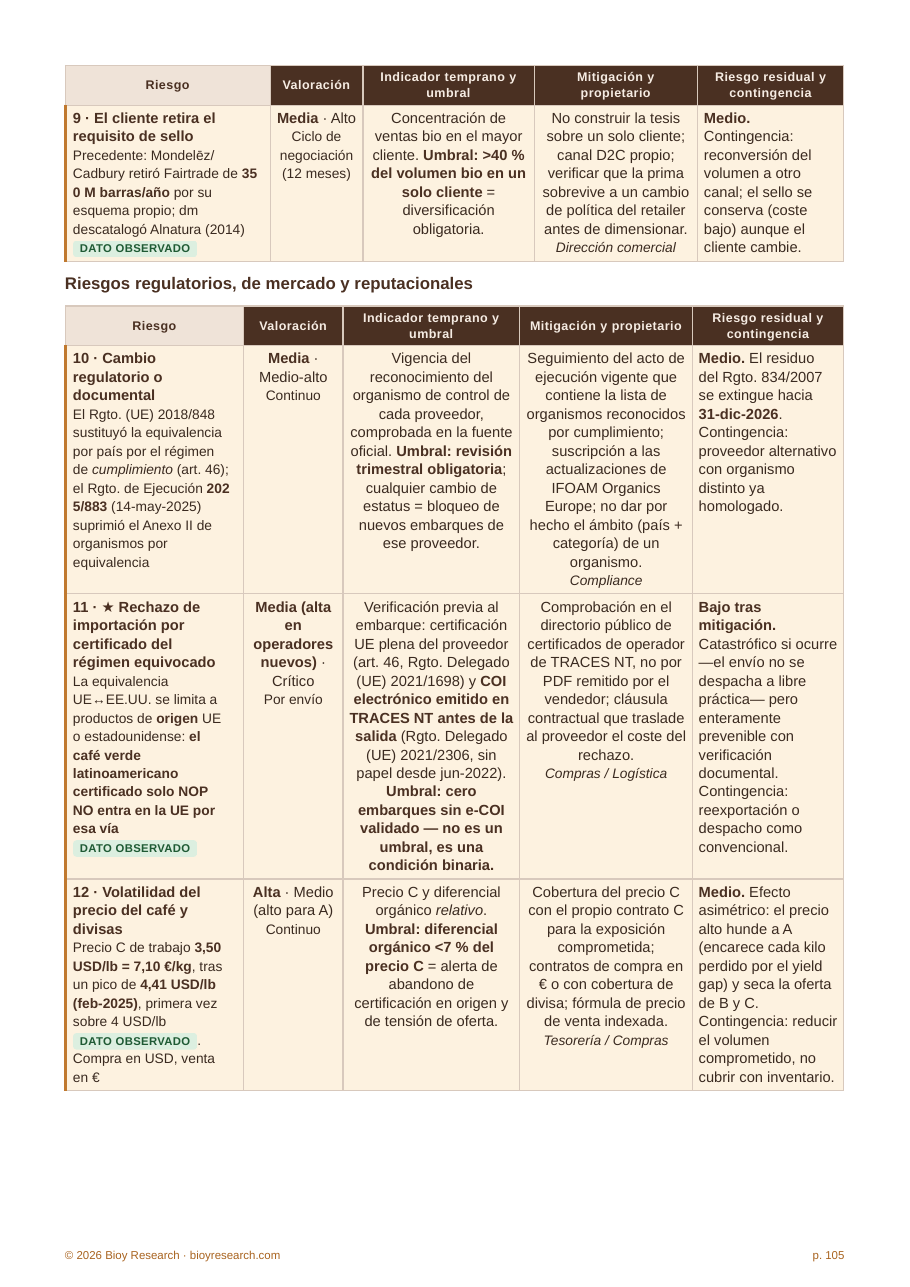
The point that sinks whole shipments at customs. Since Reg. (EU) 2018/848, imports run under an operator-by-operator compliance regime, with an electronic certificate of inspection in TRACES NT and a recognised control body; and equivalence arrangements with third countries have a far narrower scope than people assume —the US one, for instance, does not cover coffee from a third-country origin merely because it was processed there. The report explains which certificate works for which destination, which document travels with each lot, and what happens when the documentary chain breaks.
There is no single verdict for "getting into organic coffee": there are three links where the money can go, and the same seal behaves differently at each one. Convert production at origin, buy certified green and roast it, or certify the plant you already run and launch an own or private-label range —plus a capsule format variant. All four cases run through the same engine: full P&L, NPV, IRR, payback, lever bridge, break-even, sensitivity tornado and base, adverse and severe scenarios. So your CFO can redo the numbers, argue with them and break them.
We do not ask you to take a table on trust. The report comes with the complete financial model —the calculation script, its documentation and the results in structured form— so your team can change the assumptions they disagree with, run it again and check whether the verdict survives their own numbers. And so the chain from data to conclusion is auditable: twenty-three decisive claims go into a register with their source, the exact location within that source, the date consulted and the confidence we place in them.
Before publishing we put the thesis through an adversarial review briefed explicitly to refute it: the real size of demand, the durability of the premium, stated willingness to pay against purchased willingness to pay, the conversion costs almost everyone omits, and the fragility of traceability. The chapter tells you which objections held, which knocked us down and what we changed —including our own mistakes. And every claim that moves the verdict says so when confidence is low or when a figure is merely a party's own claim, with direct links so you can verify it yourself. All inside the PDF.
Download a free sample with the cover and the full table of contents.
The sample includes the cover and the contents, so you can see the full scope of the report. The analysis, the financial model and the verdicts are in the full edition.
For the board or the investment committee of an agri-food company or fund —and the team preparing the deal— weighing whether to commit capital to the certified organic coffee chain destined for the European Union. It is not a how-to on getting certified or an overview of the organic market: it is an investment due-diligence file, built on three real archetypes —convert at origin, buy green and roast, certify the plant— plus a format variant.
No, and that is one of the report's central theses. Between certified volume and the premium that reaches the link that invested there are four layers, and the report deliberately separates them: a large share of the world's certified coffee ends up sold as conventional because no buyer will pay the difference. The report measures that gap and puts it into the model as an explicit commercialisation haircut. If your investment thesis assumes all certified volume is placed at a premium, it has a hole in it, and the report shows you where.
It depends on the archetype, which is why there are three plus a format variant. Each one runs through the same financial engine and receives a verdict —GO, conditional GO, WAIT or NO-GO— with the explicit conditions where the verdict is conditional. The report does not give a generic "yes to organic coffee": it gives a verdict per link in the chain, with the numbers already run and the model shipped so your team can redo them, argue with them and break them.
The whole of Reg. (EU) 2018/848 from the investor's angle —protected terms, logo and control-body code, indication of agricultural origin— and, above all, how importing works today: under an operator-by-operator compliance regime, with an electronic certificate of inspection in TRACES NT, and what the real limit of third-country equivalence arrangements is. Plus the two clocks that cut across the seal: the EUDR (Reg. 2023/1115), with its application dates and its cost per kilo, and the PPWR (Reg. 2025/40) for anyone considering the capsule format.
The financial model reasons in euros (EUR), because the anchor of the decision is the European Union: it is the currency in which green is bought at destination, roasted coffee is invoiced and the return on the investment is measured. Where a source is in dollars —the arabica C price, the origin premium— it is kept in its currency with the reference conversion alongside. The report sells for €3,499 per single licence, as an instant-download PDF.
The report is available in Spanish, English, German and French. Each version is a full edition, not a summary: the same analysis, the same financial model and the same verdicts, adapted to the language.
Before publishing, we put the report's thesis to the explicit task of destroying it, angle by angle: the real size of demand, the durability of the premium, the distance between what the consumer says and what the consumer pays, the conversion costs almost everyone omits and the fragility of traceability. The review chapter tells you which objections held, which knocked us down and what we changed, including our own mistakes. It is the part that gives most confidence in the final verdict.
Three archetypes with a verdict plus a format variant, the gap between certifying and collecting measured, the import framework with its traps, and the financial model shipped so you can redo it with your own numbers.
Buy the report · €3,499