PDF interior
What you will see inside
Real PDF pages: cover, executive summary, charts and competitive tables.
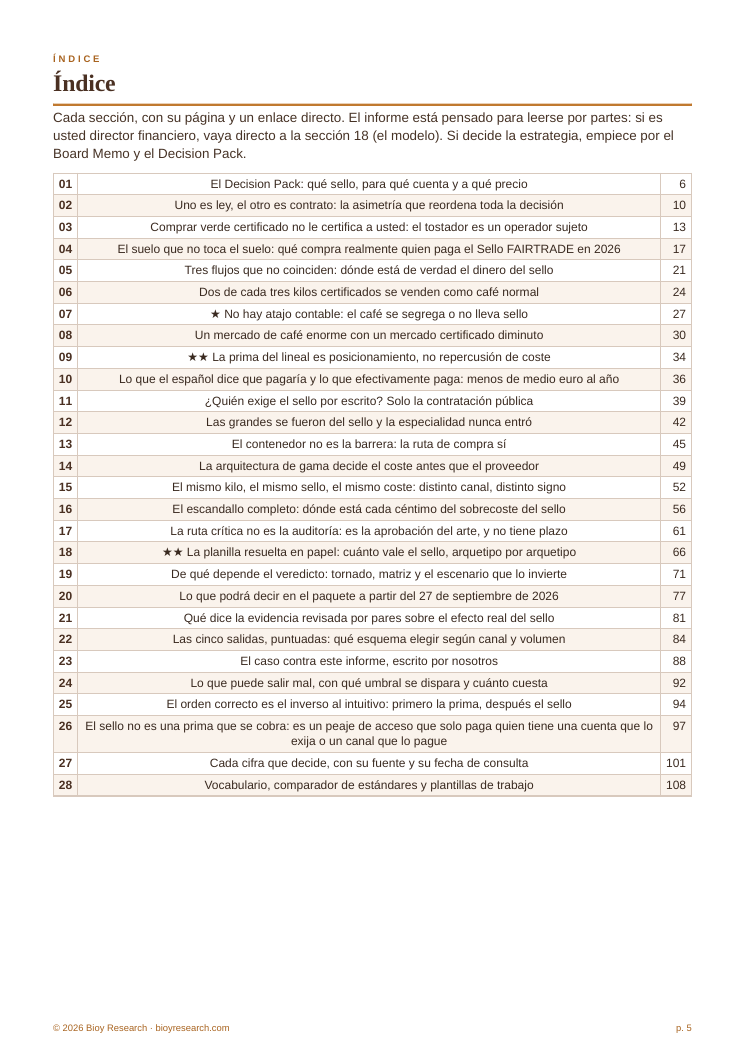
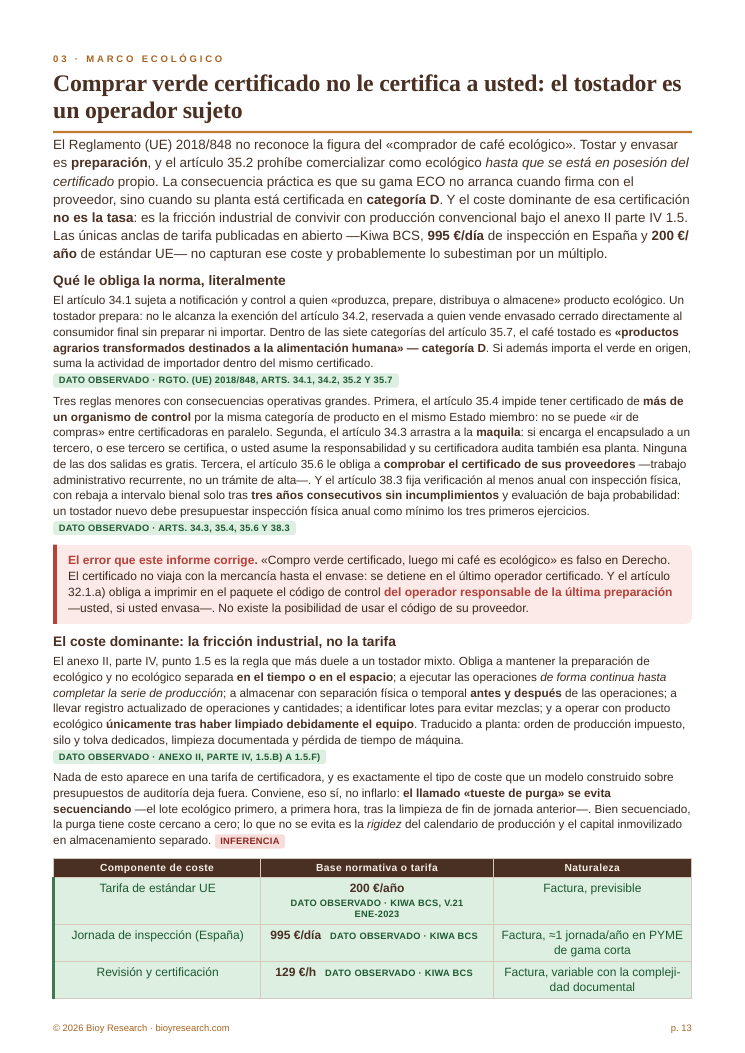
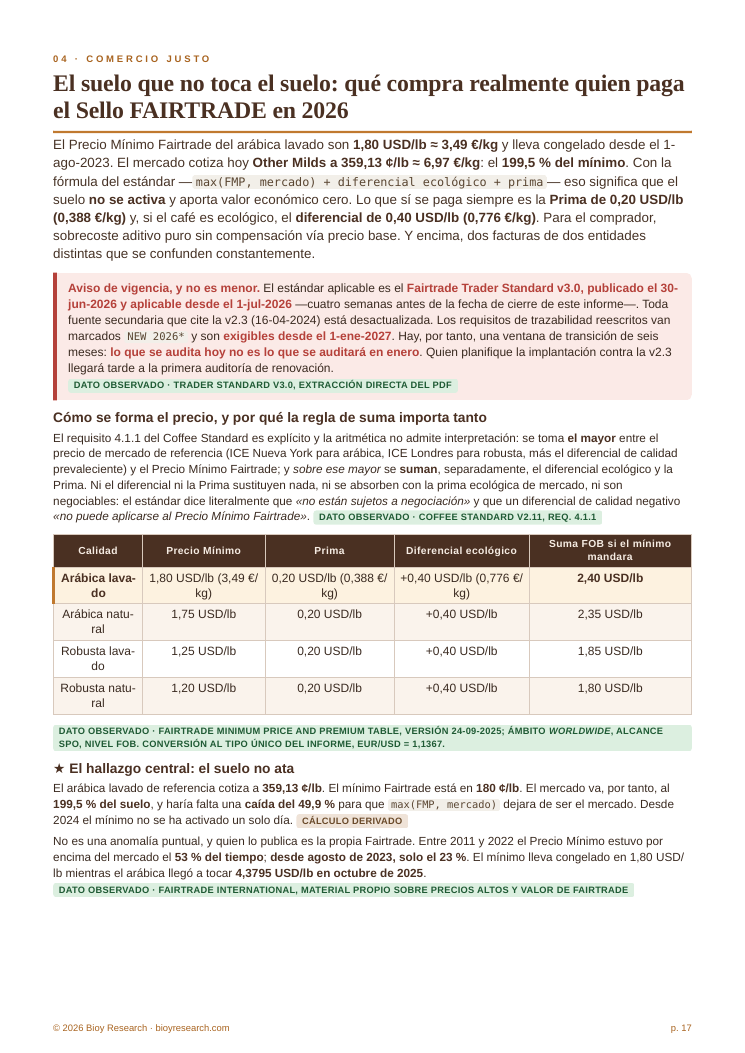
Written for the board of an EU SME coffee brand or roaster — Spain as the lead market — that buys green coffee and must decide whether to launch an organic range, a fairtrade range, both at once or neither. Not an overview of sustainable coffee: it is the folder on which certification is approved or rejected, with all four routes settled through one engine.
Real PDF pages: cover, executive summary, charts and competitive tables.
A decision report, not a survey of certification. Every figure comes out of a single financial engine, and every claim capable of moving the verdict carries its source, its date and the confidence we place in it.
The board conversation nearly always opens badly: "we have two seals on the table, do we take one or both?". The premise is false. "Organic" is a term protected by Union law, with a competent authority, mandatory official control and a public enforcement regime behind it. "Fairtrade" is a private standard: a minimum price, a premium and a trademark licence agreed with an organisation. You breach one in front of the administration; the other, in front of the licensor. Everything else follows from that founding asymmetry: why the costs behave differently, why the risk is not of the same kind, and why the two decisions cannot be appraised on the same template.
This is the most common mistake in this vertical and the most expensive to discover late. Roasting and packing is "preparation" under Arts. 34.1 and 35.2 of Reg. (EU) 2018/848: even if you buy coffee already certified at origin, you need your own processor-operator certificate before you sell a single bag as organic. The report walks the whole file: registration with the regional control body, the electronic COI in TRACES, labelling and composition rules, and what triggers the precautionary marketing ban of Art. 41 and the whole-lot loss of the organic reference under Art. 42.1.
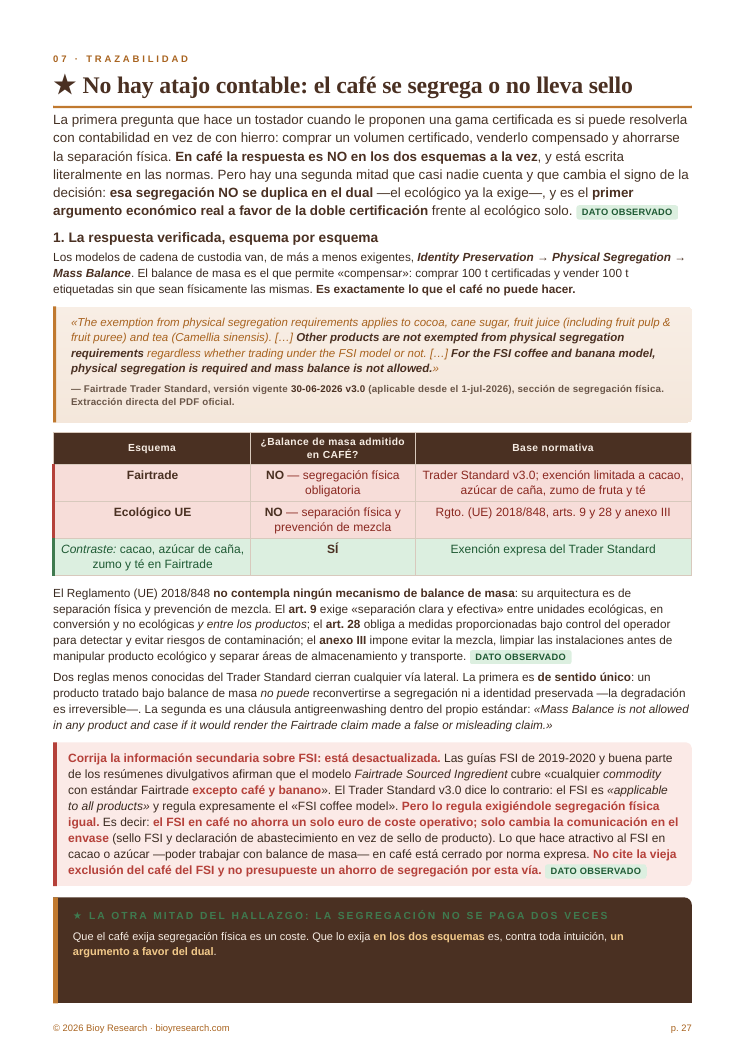
This is the most expensive traceability trap, and the answer is NO under both schemes at once, written literally into the rules. The Trader Standard exempts cocoa, cane sugar, fruit juice and tea from physical segregation; coffee is expressly left out of that exemption. And Reg. (EU) 2018/848 does not even contemplate the mechanism: its architecture is physical separation and the prevention of mixing. Segregating means separate lots, dedicated roast orders, duplicated warehouse locations and documentary reconciliation. The report separates the cheap from the expensive and explains why the dominant cost is industrial friction in your own plant, not the certifier's fee.
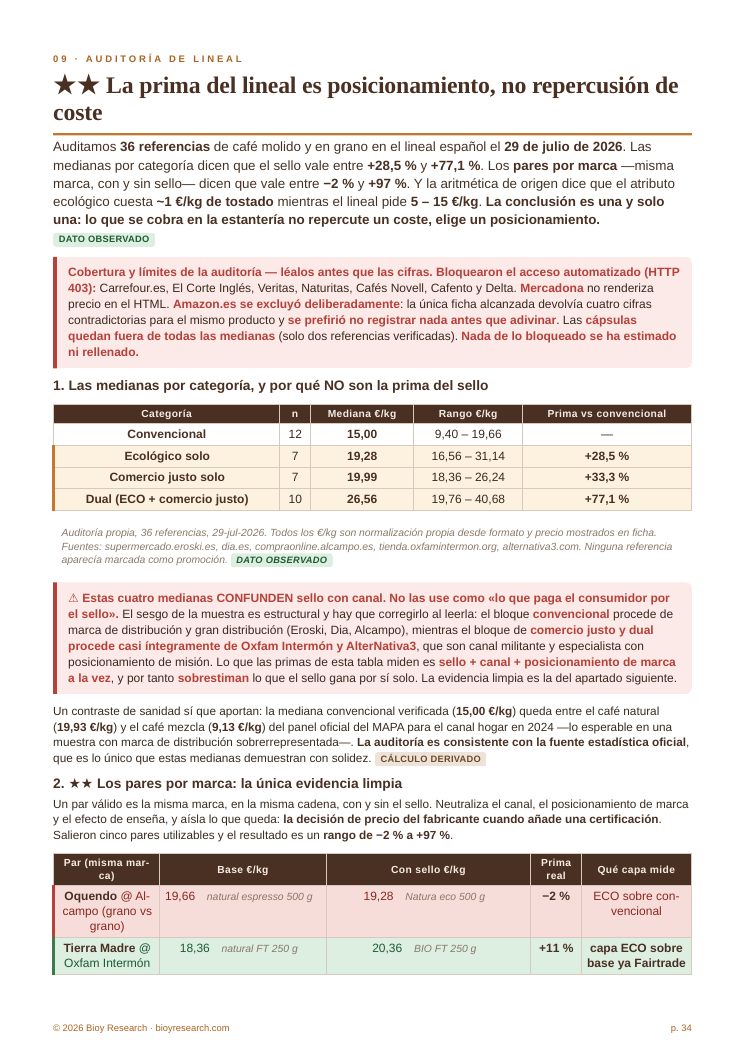
Category medians confuse the seal with the channel, so the report does not stop at them. We audited the Spanish shelf and isolated the pairs from the same manufacturer — the same brand, with and without the seal, same format, same day — which is the only evidence that separates what the attribute earns from what the positioning earns. And we declare coverage before figures: which chains blocked automated access, which references were deliberately excluded, and which pairs still need manual checking in store. Nothing blocked has been estimated or filled in.
The question that decides is not "who likes the seal?" but "who refuses to buy from you without it, in writing and signed?". Having swept Spanish B2B demand — grocery retail, private label, foodservice, offices and public procurement — the report identifies where the seal is a condition of admission and where it is merely a preference, and reproduces the public tender that goes further and prices the differential per serving. A preference will not carry an investment case; an admission clause will, and the report explains who actually wins that contract and what that means for your brand.
Four archetypes, one engine: a five-year P&L, NPV, IRR, payback and an NPV-equivalent break-even, always measured against the counterfactual of "the same brand without a seal". On top of that sits the sensitivity work: a tornado of levers ranked by swing, a twenty-five-cell matrix crossing volume against retail price, and decision thresholds solved by bisection. And on top of everything, a prudent scenario adding the two framing assumptions — retail prices net of VAT and a commercial launch ramp — because the numbers you commit treasury against are not the ones that isolate the effect of the seal.
A declared limit adds credibility rather than removing it. The report publishes the exact perimeter of what its numbers can and cannot support: which inputs are reasoned assumptions rather than firm quotes, which assumption has no public series and what range we treat it with, which fee the Spanish licensor does not publish and what declared proxy we substitute, and which open regulatory review could rewrite the anchor figures. It closes with an operating table: what to measure, whom to ask, and what it would change. Beside it runs the register of 56 sources with consultation date and confidence level.
Download a free sample with the cover and the full table of contents.
The sample includes the cover and the contents, so you can see the full scope of the report. The analysis, the financial engine and the verdicts by archetype are in the full edition.
For the board of an SME coffee brand or roaster established in the EU — with Spain as the lead market — that buys green coffee, roasts it and packs it under its own brand or as private label. It is not a farm, not an origin cooperative, not a consumer and not a coffee shop. That distinction has immediate technical consequences for what gets certified, who the responsible operator is and which costs land on you.
That is precisely the axis of the report. All four routes — organic only, fairtrade only, dual and no seal — are appraised one by one with the same financial engine and against the same counterfactual, which is "the same brand without a seal". Each route has its own economic logic, its own legal regime and its own verdict, with a numerical threshold you can test before signing with any certifier.
Yes, and it is the most common mistake in this vertical. Roasting and packing is "preparation" under Arts. 34.1 and 35.2 of Reg. (EU) 2018/848: it requires your own processor-operator certificate before you sell as organic, with registration at the regional control body. The report walks the whole file, including the electronic COI in TRACES, labelling, and what triggers the regulation's precautionary measures.
No, and under neither scheme. The Fairtrade Trader Standard exempts cocoa, cane sugar, fruit juice and tea from physical segregation; coffee is expressly left out of that exemption. And Reg. (EU) 2018/848 does not even contemplate the mechanism: its architecture is physical separation and the prevention of mixing. That forces real segregation in purchasing, warehousing, roasting, grinding and packing, and the report quantifies it archetype by archetype.
No. The organic seal certifies the production method; Reg. (EU) 2023/1115 certifies the geographic provenance of the plot. They are disjoint obligations that add up rather than one absorbing the other: a farm can be perfectly organic and not EUDR-compliant. The report explains what overlaps and what does not, and works with both application dates — there are two, not one — which will reach you through your customers' contracts before they reach you through the rulebook.
The engine reasons in euros, with a single declared exchange rate used to convert the international green coffee quotations, which are published in cents per pound. The horizon is 2026-2030, with an explicit WACC and corporate tax rate. The report sells for €3,499 per single licence, as an instant-download PDF.
Yes: you can download a free sample with the cover and the full table of contents before buying. The report is delivered only as an instant-download PDF; the analysis, the financial engine and the verdicts by archetype are in the full edition. The model is reproducible from the assumptions declared inside the PDF itself.
The four routes compared through a single engine, the legal frame in depth, a shelf audit with same-brand pairs, and every assumption declared so you can redo the sums with your own numbers.
Buy the report · €3,499