PDF interior
What you will see inside
Real PDF pages: cover, executive summary, charts and competitive tables.
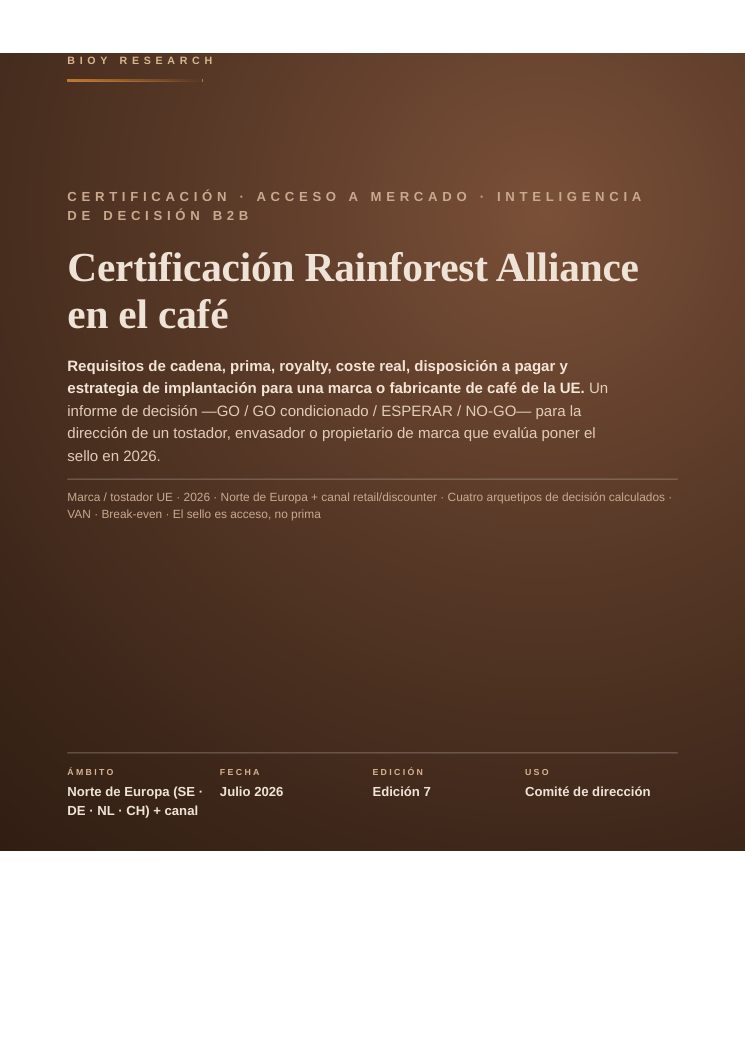
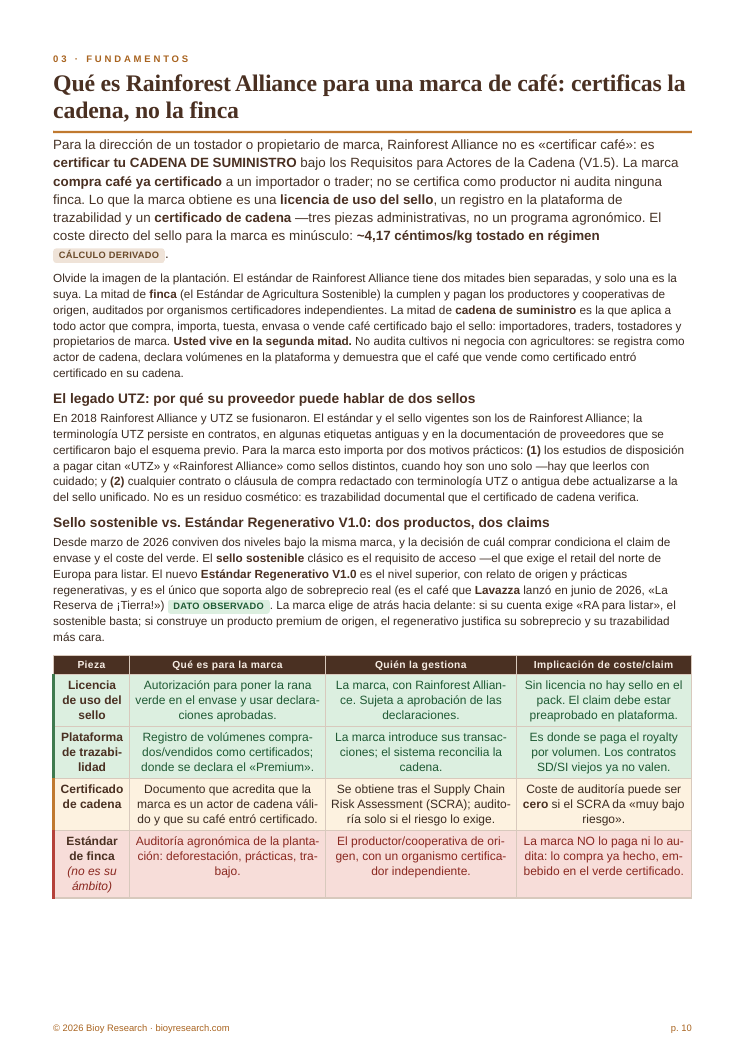
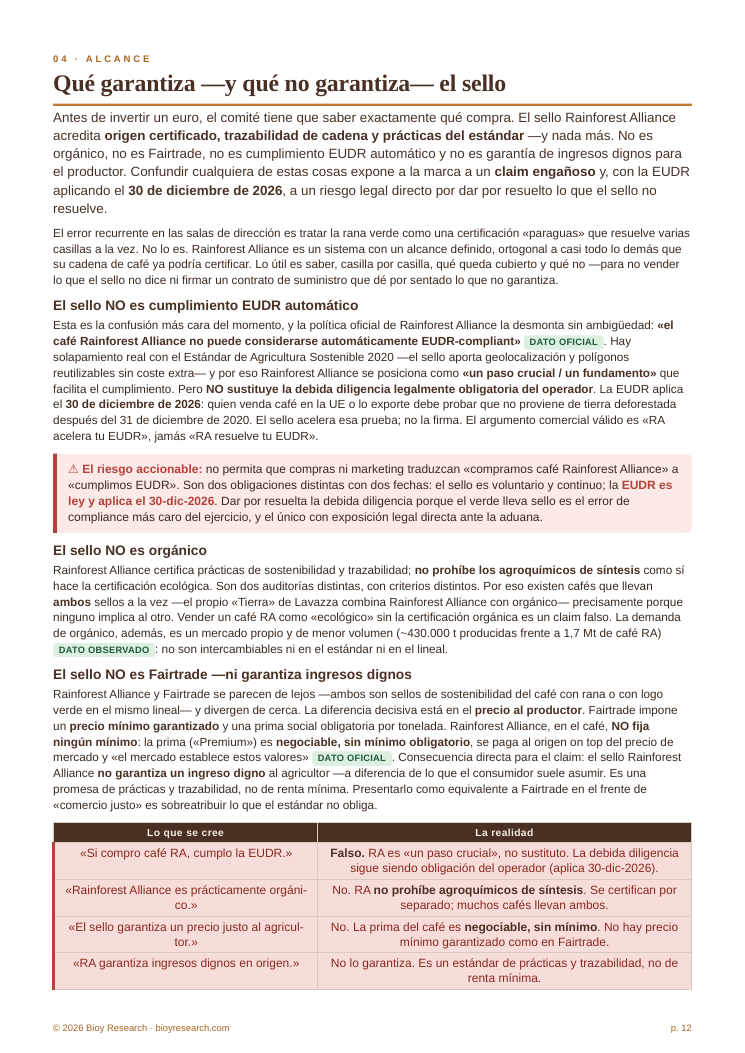
Written for the board of an EU coffee brand or manufacturer weighing whether to certify its chain and put the Rainforest Alliance seal on the pack. This is not a sustainable-farming guide: it is the folder on which certification is approved or rejected, with the financial model inside and the numbers already run for your own chain.
Real PDF pages: cover, executive summary, charts and competitive tables.
A decision report, not an overview of the sustainable-coffee market. Every figure comes out of a financial engine, and every decisive claim carries its source, its date and the confidence we place in it.
The intuition sells: "I certify Rainforest Alliance and charge more." It is almost never true in mainstream coffee. The seal does not lift the shelf price: it stops the retailer from leaving your line off the shelf when it requires the seal as a listing condition. So the right question is not "how much more will I sell?" but "which specific buyer asks me for the seal, and what does it cost me per kilo to give it to them?". If no account requires it, almost all the spend is speculative — and this report exists so you do not make that mistake.
The audit fee is the small line item and the one everyone looks at first. The one that sinks or saves the project is another: the per-kilo royalty on certified coffee paid to Rainforest Alliance, year after year, on all the volume that carries the seal. The sensitivity tornado shows it without ambiguity: the dominant variable is certified volume times royalty; the audit, by a wide margin, barely moves the verdict.
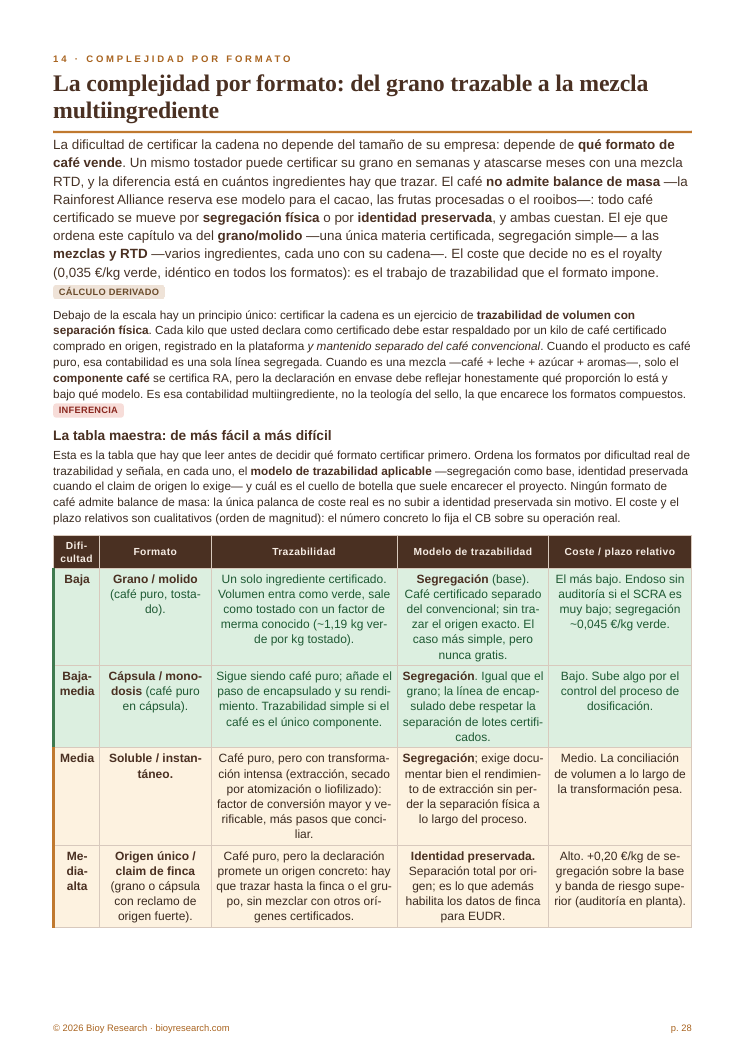
This is the most expensive traceability trap. The seal on the pack promises that this coffee is the certified one, and in roasted coffee that forces segregation or identity-preserved handling: you cannot simply "buy credits" on a mass-balance basis as in other chains. Segregating means separate lots, dedicated silos and a chain-of-custody audit. The report separates the cheap (you already buy traceable green) from the expensive (you must redesign the plant flow) and from what breaks the case (blending origins with no traceability).
You do not choose the seal you like most, but the one your buyer requires. Northern European retail asks for it de facto; foodservice and the south are lukewarm; private label depends on the retailer's policy. The expensive risk is certifying the whole chain for a premium nobody pays and finding out afterwards. The report brings the matrix of which destination and which channel really move access, so you choose starting from the buyer, not from the seal.
Before publishing, we put the thesis through an adversarial review briefed explicitly to refute it from every angle: the size of the market, the logic of the premium, the cost of the royalty and the relationship with EUDR. The review chapter tells you which objections held, which knocked us down and what we changed — including our own mistakes. One lesson was methodological: the "global certified coffee" figure measures certified supply, not demand that pays for it.
This is the most expensive misunderstanding. Getting Rainforest Alliance certified does NOT exempt you from Regulation (EU) 2023/1115 on deforestation (EUDR): they are two distinct systems, with two declarations and two traceabilities. The seal can reuse part of the geolocation, but it does not replace EUDR due diligence. The report explains what overlaps and what does not, and why using the seal as a compliance alibi is a greenwashing risk with the consumer authority behind it.
The claims register collects the numbers that move a verdict, each with its source, its date and the confidence we place in it — and we say so when the confidence is low. Alongside the register runs a table of direct links to the claims that decide, so you can verify them yourself. The report is self-contained: everything you need to judge the verdict is inside the PDF.
Download a free sample with the cover and the full table of contents.
The sample includes the cover and the contents, so you can see the full scope of the report. The analysis, the financial model and the verdicts are in the full edition.
For the board of an EU coffee brand or manufacturer weighing whether certifying its chain with Rainforest Alliance and carrying the seal is worth it. It is not a sustainability guide or an agronomy manual: it is a business decision report, built for the European market, which is where the seal really moves shelf access.
Almost never in mainstream coffee, and that is one of the report's central theses. The seal is a shelf-access requirement: without it, there are retailers and accounts that will not even list you. A real premium exists only in specific niches (specialty, a brand with a strong story, the ethical channel). If your plan assumes a general uplift just for carrying the seal, that plan has a hole in it, and the report shows you where.
No, and it is one of the keys to the cost. Putting the seal on the pack in roasted coffee forces segregation or identity-preserved handling: the certified coffee is kept physically separate from the non-certified one along the chain of custody. Buying mass-balance credits is not enough. That raises the cost of traceability and often forces a redesign of the plant flow, and the report quantifies it archetype by archetype.
No. Rainforest Alliance and Regulation (EU) 2023/1115 (EUDR) are two distinct systems: the seal does not exempt you from EUDR due diligence or the EUDR declaration. You can reuse part of the geolocation, but it does not replace it. Using the seal as if it equalled EUDR compliance is a greenwashing risk, and the report explains exactly what overlaps and what does not.
The royalty is paid per kilo of certified coffee and it is the line item that dominates the model, far above the audit fee; the report works with the current rate and runs it through the sensitivity tornado. The financial model reasons in euros (EUR), the currency of the European market. The report sells for €3,499 per single licence, as an instant-download PDF.
The report is available in Spanish, English, German and French. Each version is a full edition, not a summary: the same analysis, the same financial model and the same verdicts, adapted to the language.
Yes: you can download a free sample with the cover and the full table of contents before buying. The report is delivered only as an instant-download PDF; the analysis, the financial model and the verdicts by archetype are in the full edition.
Four archetypes with a verdict, the real cost of the royalty, what the seal guarantees against EUDR, and the financial model so you can redo it with your own numbers.
Buy the report · €3,499