PDF interior
What you will see inside
Real PDF pages: cover, executive summary, charts and competitive tables.
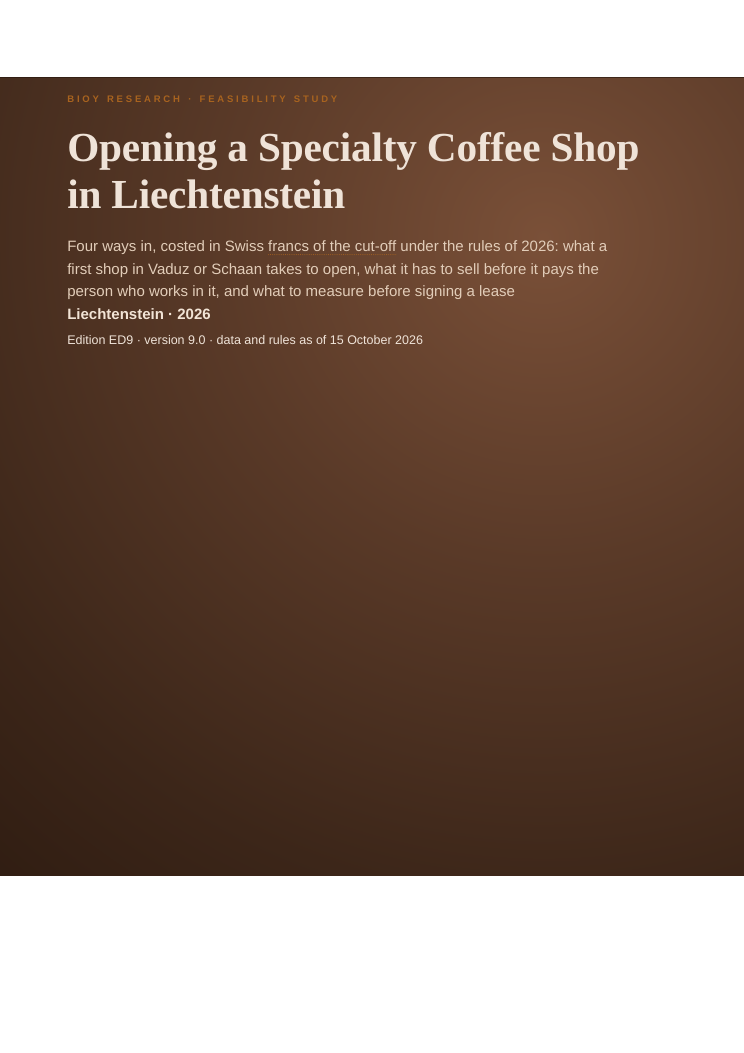
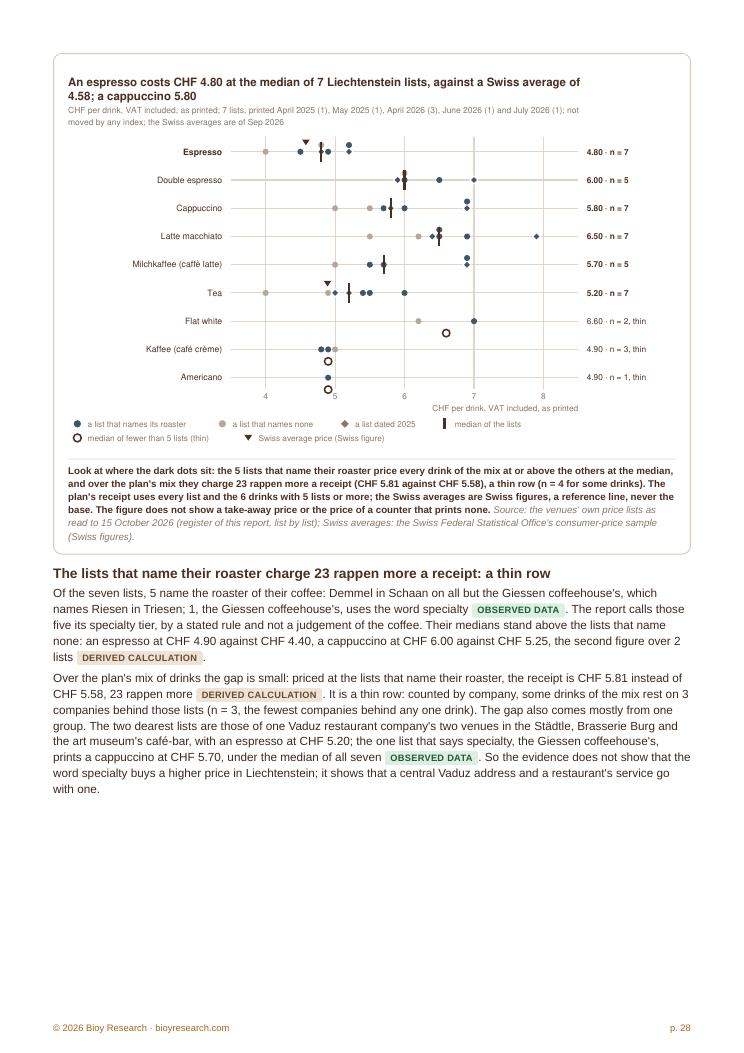
For the founder who wants to open one specialty café in Liechtenstein and stand behind the counter: what a first coffee shop in Vaduz or Schaan takes to open, what it has to sell before it pays the person who works in it, and what to measure before signing a lease. Four ways in, costed in Swiss francs under the rules of 2026 and set beside what the official statistics report for hotels and restaurants, every figure with its source and date. The report gives no verdict for any format and says why: no café's accounts or sales can be read and no owner's statement may be quoted. The answer it can give comes first, in a four-page executive summary, and the chapters hold the evidence behind it.
Real PDF pages: cover, executive summary, charts and competitive tables.
Each chapter answers one question a founder asks before signing a lease, and ends with what is settled. Whatever could not be verified is declared as such, next to what could.
The report opens with a stand-alone executive summary: why no format is given a verdict and to whom the figures apply, what the reference format must take for its owner to be paid, the money to open and to live through the first year, the owner's hours, the readings that carry the result, the evidence that is missing and the three checks to make before signing a lease, each with its thresholds.
A take-away counter, an espresso bar, a café with seats and food and the take-over of an equipped café, each with its fit-out, its staffing, its rent and its prices. The engine builds each from costs that can be named and prints the takings it needs as a band, never as one figure. What the official statistics report for hotels and restaurants is set beside it, with the reasons they cannot judge a specialty coffee shop.
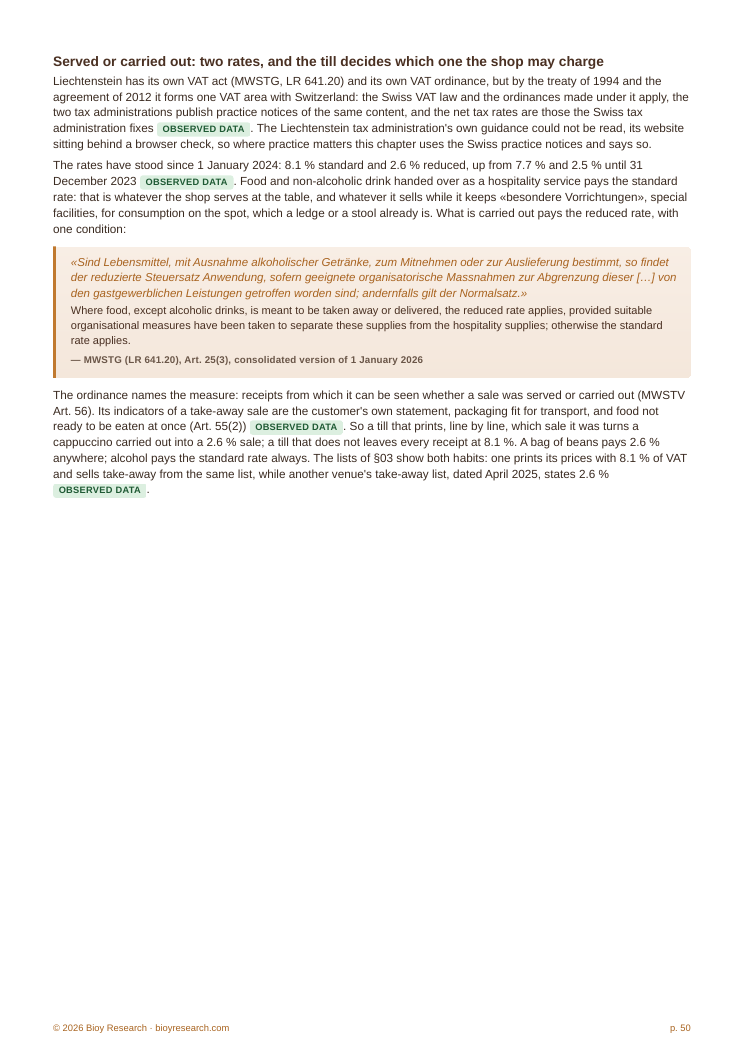
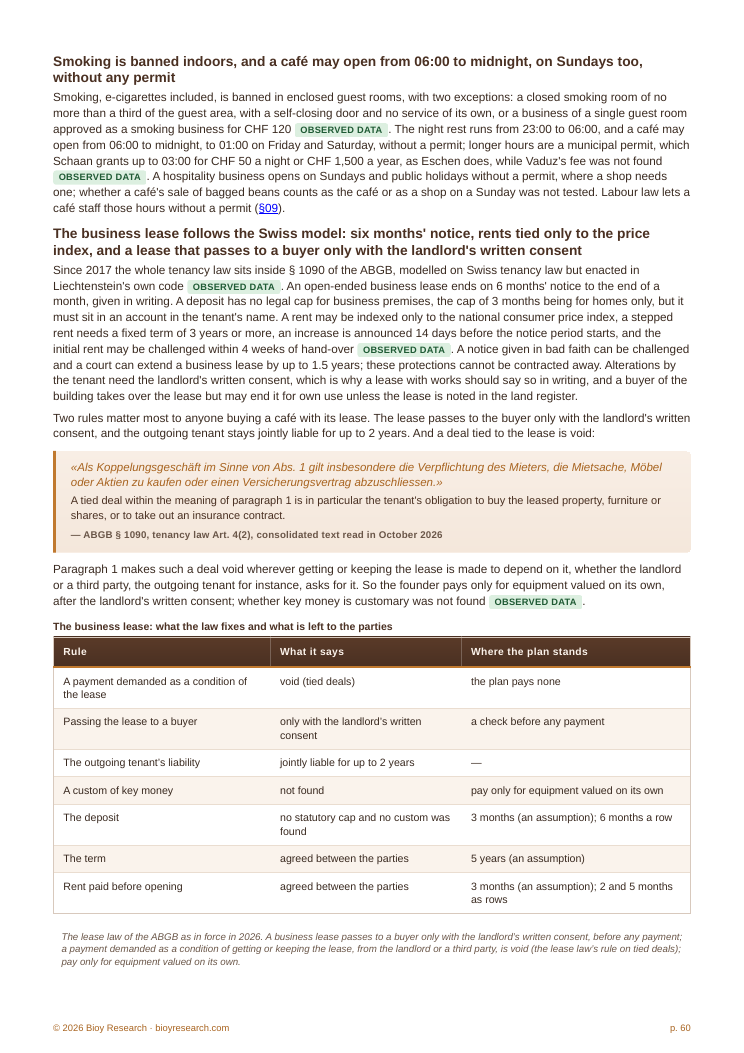
Liechtenstein's own VAT act and the Swiss rules it shares, served against carried out and why the till decides, the registration threshold, the effective and net-tax-rate methods, the opening VAT, card fees, the sole proprietor and the GmbH, the owner's AHV, the national income tax with the municipal surcharge, the employers' wage list where there is no statutory minimum wage, from gross pay to the employer's cost, the hospitality licence and its exam, change of use, parking spaces in central Vaduz, opening hours and the lease.
What is left of a cup, the plan of each format line by line, the lines of the frontier with what each includes, the first twelve months of cash and the second year, the money to open in blocks with what could not be priced, a one-page reckoner for your own account, a risk watch system, a plan with decision gates and the case against the report itself.
Charts and tables built from the same engine, each with its source.
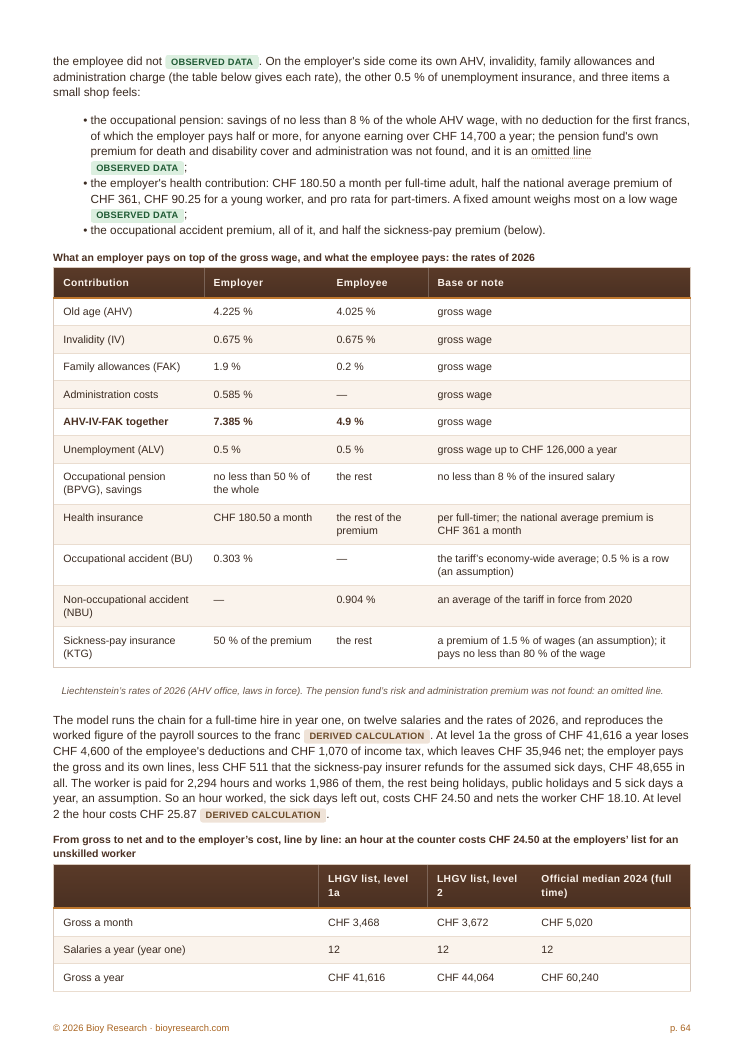
A few pages from the report. The free sample contains the cover and the contents.
For a resident of Liechtenstein, or someone settling there, who wants to open one specialty coffee shop as a first business and work in it full time. It is not written for a chain planning another unit or for an investor who will hire a manager; they will find the evidence useful and different figures.
No, and it says so on its first page. A verdict needs the sales and the owner's pay of shops like yours, and this research could read none: a sole proprietor files no accounts anywhere, a small company files only a shortened balance sheet without its profit and loss, and no owner's statement on sales may be quoted. What it gives instead is what each format must take for its owner to be paid, as a band; where that sits against the official figures for hotels and restaurants; the money to open; and three checks, each with its thresholds in your own units, that turn the band into an answer for your own site.
Four pages right after the cover that can be read on their own: the answer, the money, the conditions and the next step. Every figure in it comes from the same engine as the chapters and is traced to its source there. It is part of the report and is not in the free sample.
From Liechtenstein's laws and ordinances in the official law database, the Swiss rules that apply through the customs and currency treaties, the AHV office, the municipalities' tariffs and minutes, the official statistics office's open data, the employers' association's wage list, coffee shops' and roasters' own websites, Swiss dealers' published price lists, the electricity supplier's tariffs and the asked rents of a property portal and estate agencies. Every input carries its source, date and confidence level in the traceability chapter. What could not be verified is declared, not filled in, and sites whose terms forbid automated reading or commercial use were not read or not used.
No. No source that could be read states what a specialty coffee shop in Liechtenstein sells in a day or a year. Every sales figure in the report is what a costed plan needs, labelled as such, and the report tells you how to count your own.
The base is Vaduz and Schaan, where most jobs and the priced coffee lists are. The other municipalities are given as facts — residents, jobs, tax surcharges and the few rents read — and not as costed results. There is no ranking of places.
Swiss francs of 15 October 2026, under the rules in force in 2026. What is already published for 2027 is shown as a row beside the base, and euro amounts are given only for comparison.
This edition is written in English.
A PDF, delivered by email immediately after payment.
It saves you weeks of research and the risk of entering blind a market you don't know.
Buy the report · €299