PDF interior
What you will see inside
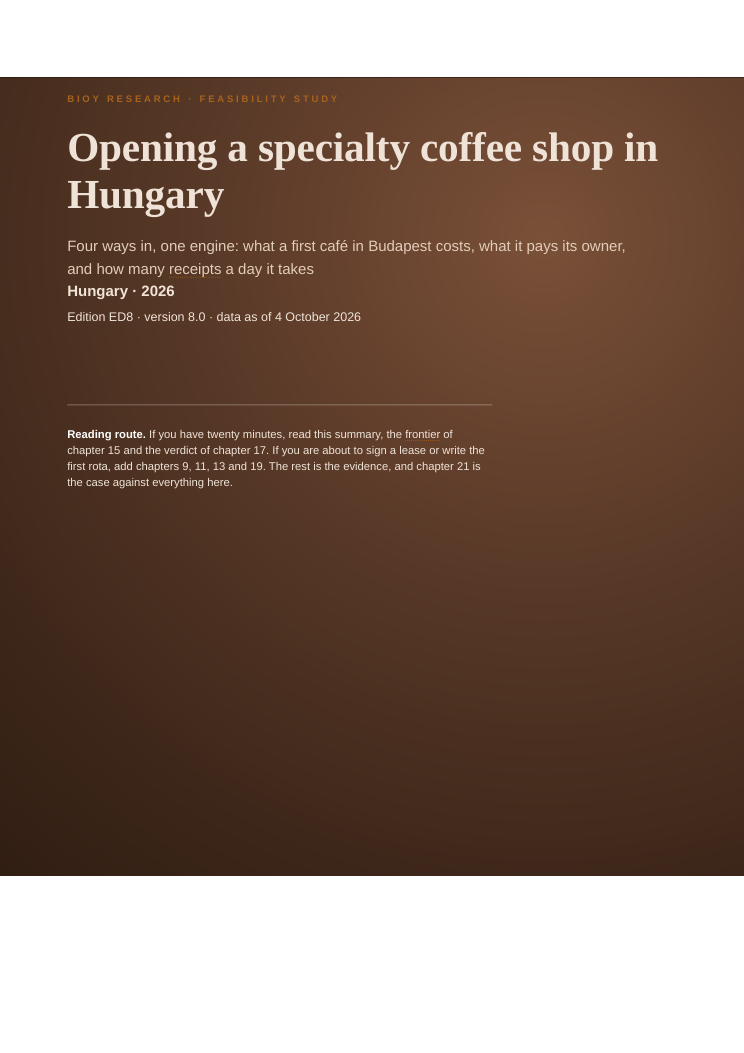
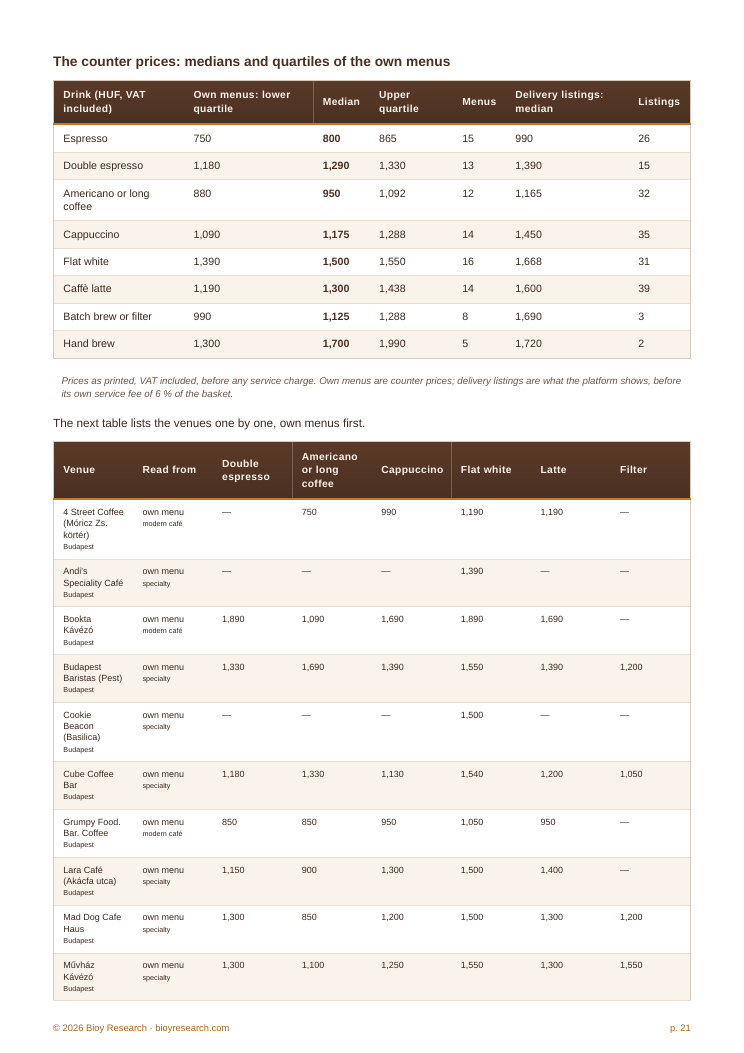
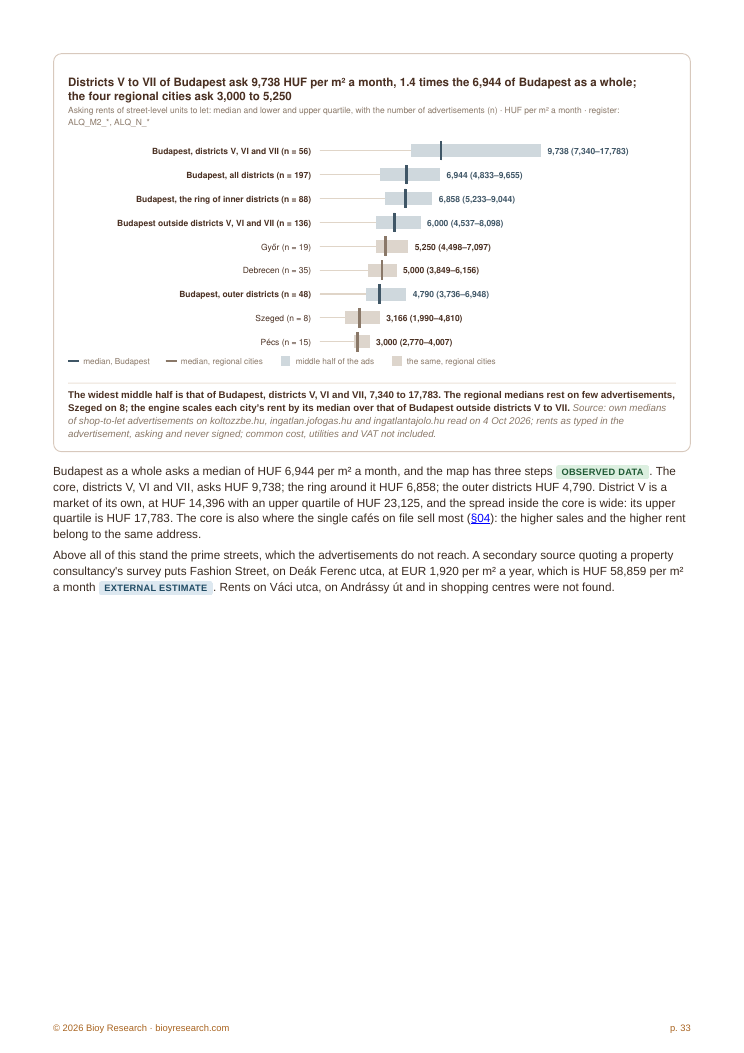
Real PDF pages: cover, executive summary, charts and competitive tables.
For the founder who wants to open one specialty café in Hungary and stand behind the bar: which of four formats to choose, what it really leaves its owner, and whether the money put in comes back. One engine, sixty months, every figure in forints with its source and date, and the frontier at which each answer changes, so that you can replace our assumption with a count of your own street.
Real PDF pages: cover, executive summary, charts and competitive tables.
Each chapter answers one question a founder asks before signing a lease, and ends with what is settled. Whatever could not be verified is declared as such, next to what could.
A to-go window, an espresso bar, a café with food and the take-over of an equipped café, each with its build, its staff, its rent and its volume, judged on the same sixty-month path. The owner is a sole trader: the result is the profit after contributions and income tax, split into the cash of the month and the build written off, and set against the minimum wage and the market wage for the same hours.
A menu audit of 60 venues, 16 of them on the cafés' own menus, the chains beside them, the single-site café companies whose sales and cost lines could be read, and asking rents and key money in Budapest, Debrecen, Szeged, Pécs and Győr.
The VAT on a coffee at the table and to go, the tourism development contribution, the two readings of how a kávézó is classed, the online cash register and NTAK, the flat rate and its cap, the company on KIVA, the minimum wage, the payslip, students through a school cooperative, the Sunday supplement, the notification to the notary, the food-chain register and fee, the change of use, toilets and parking.
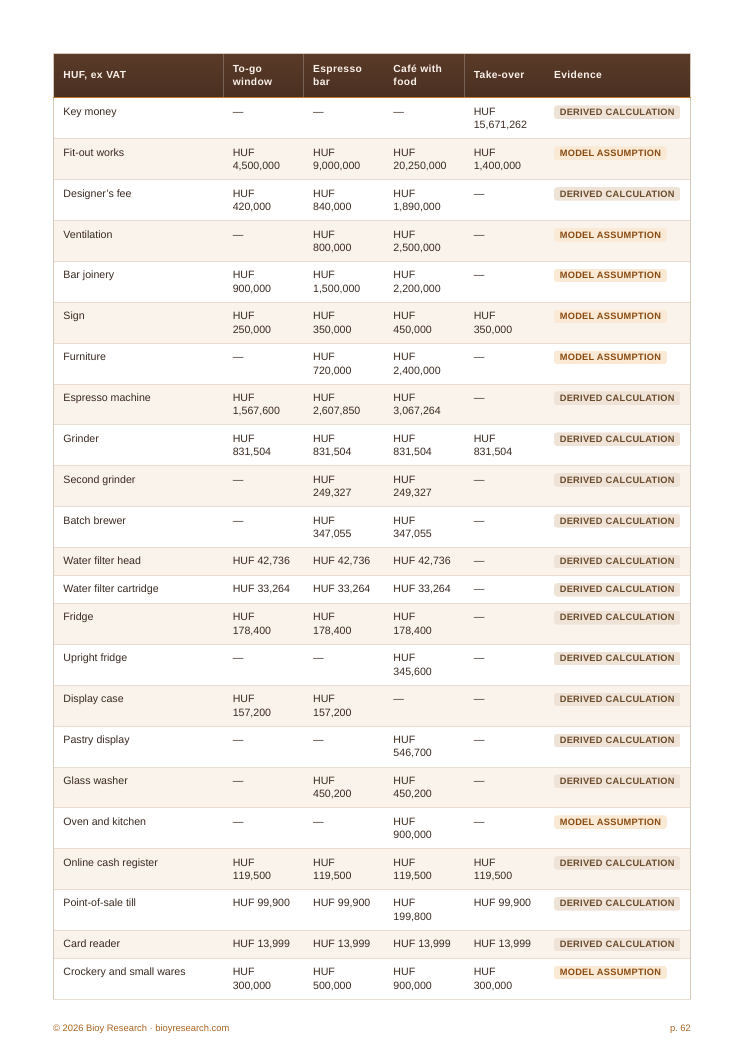
The investment line by line, the cup cascade, the fixed costs and the costs no price list names, the monthly and five-year accounts, the frontier in receipts a day, a tornado and a price-volume matrix, a stress table, the verdict for each format, a risk watch system and a plan with decision gates.
The engine set against the companies' accounts, three adversarial reviews and an independent audit with what each changed, every input with its source, date and confidence level, and the address of every source.
Charts and tables built from the same engine, each with its source.
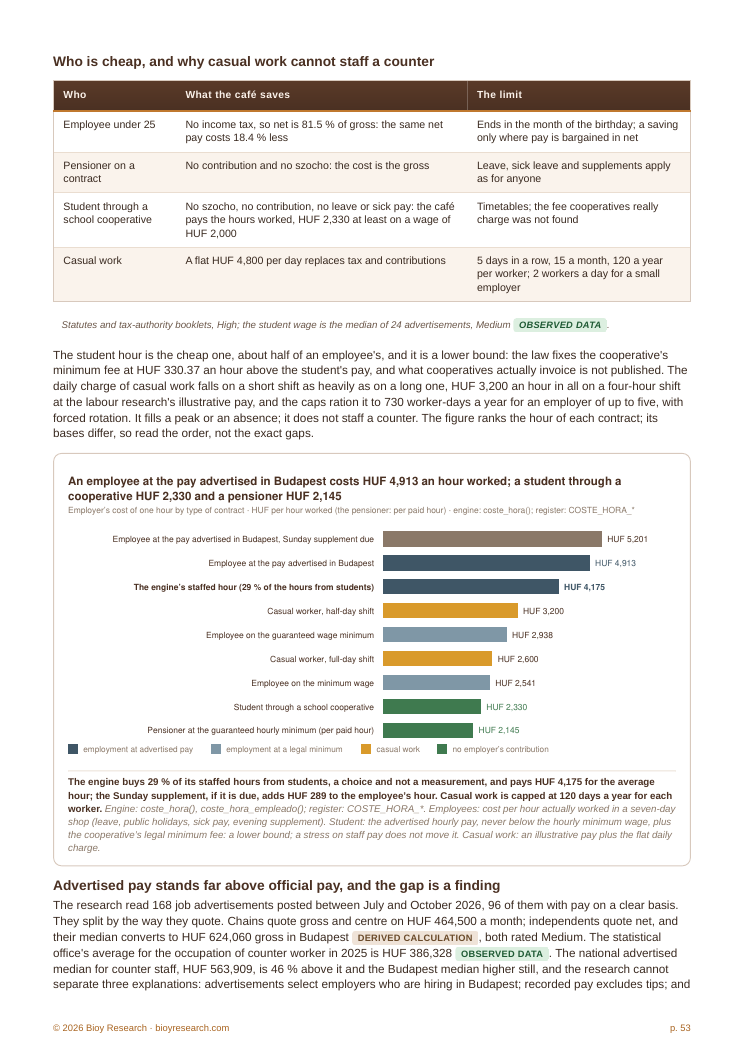
A few pages from the report. The free sample contains the cover and the contents.
For a Hungarian resident, or someone settling in Hungary, who wants to open one specialty coffee shop as a first business and run it personally. It is not written for a chain planning another unit or for an investor who will hire a manager; they will find the evidence useful and a different verdict.
Yes. It gives a verdict for each of the three formats whose sales could be anchored, at a stated base volume, the conditions under which it holds, and the receipts a day at which it would change, so that you can check your own street against it before signing. For the to-go window, whose sales no source states, it gives the receipts it needs and not a verdict.
From laws and official statistics, the tax office's guidance, the sales and cost lines of single-site café companies as an aggregator prints them from the filed accounts, price lists, job and rental advertisements and a menu audit of 60 venues read on 4 October 2026. Every input carries its source, date and confidence level in the traceability chapter. What could not be verified is declared, not filled in: the official register of annual accounts sits behind a captcha and no original filing was read, and the base volumes are derived from sales and never counted, because this research found no Hungarian café that publishes its receipts.
The verdict is for Budapest. Debrecen, Szeged, Pécs and Győr are given their asking rents, wage levels and local tax as a cost comparison, not as verdicts, because the report has no evidence of what a shop sells there.
This edition is written in English.
A PDF, delivered by email immediately after payment.
It saves you weeks of research and the risk of entering blind a market you don't know.
Buy the report · €299