PDF interior
What you will see inside
Real PDF pages: cover, executive summary, charts and competitive tables.
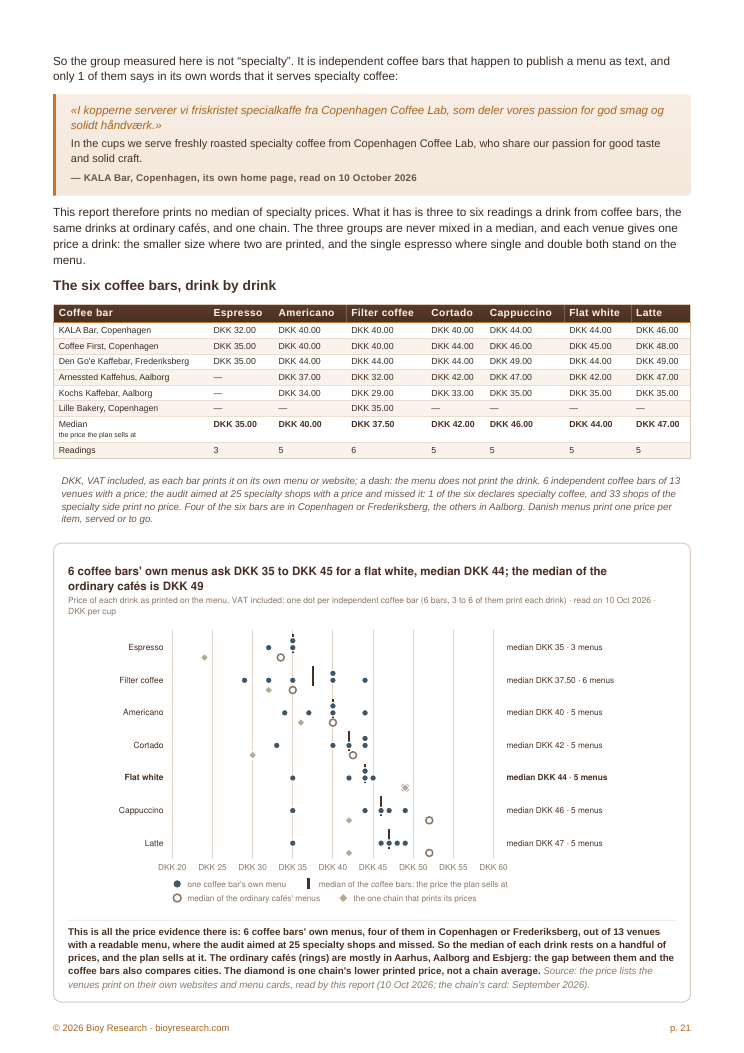
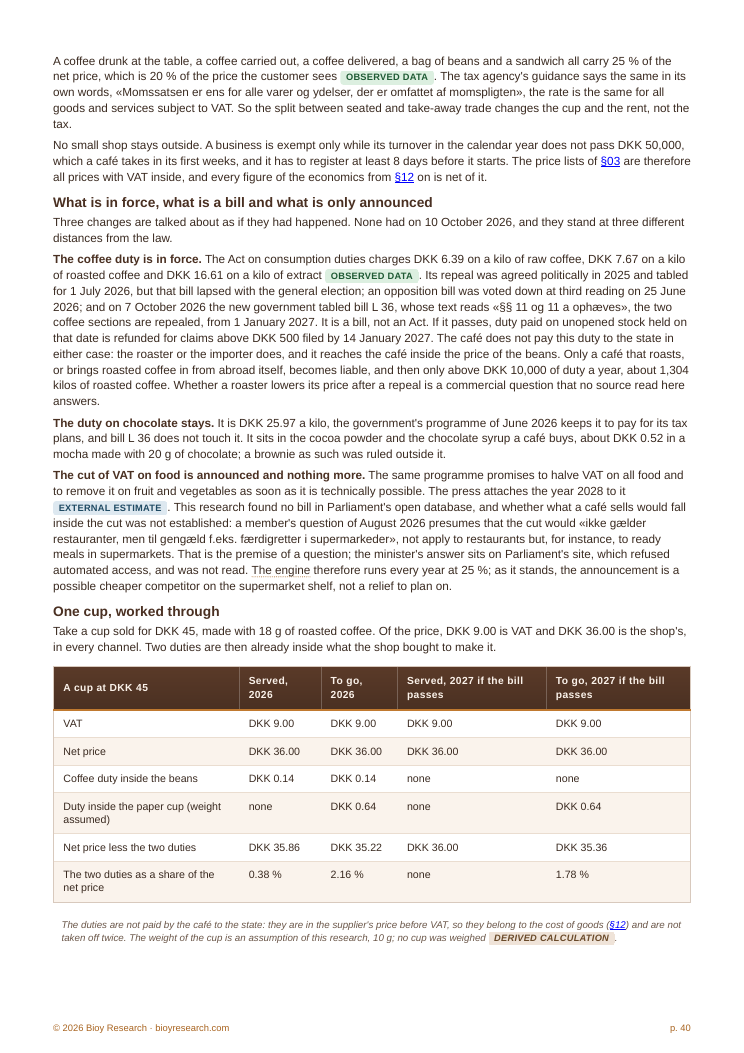
For the founder who wants to open one specialty café in Denmark and stand behind the bar: what a first coffee shop in Copenhagen takes to open, what is left for its owner after staff, and where the evidence stops. Four ways in, read against the accounts that single coffee shops file with the Danish Business Authority, every figure in kroner with its source and date. The answer comes first, in a four-page executive summary, and the chapters hold the evidence behind it.
Real PDF pages: cover, executive summary, charts and competitive tables.
Each chapter answers one question a founder asks before signing a lease, and ends with what is settled. Whatever could not be verified is declared as such, next to what could.
The report opens with a stand-alone executive summary: the conclusion for each size of shop and to whom it applies, the figures that decide it, the money to open and to live through the first year, what the shop must earn, the owner's hours, the assumptions that carry the result, the evidence that is missing and the three checks to make before signing a lease.
A take-away window, an espresso bar, a café with seats and food and the take-over of a running shop, each with its fit-out, its rota, its rent and its prices. The engine is tied to what single Danish coffee companies print in their annual reports — gross profit, staff costs, depreciation and result — by number of employees, and the verdict is worded by size of shop. Where the accounts do not settle the question the report says so, gives the range and names the check that would settle it.
One VAT rate on everything a café sells, the duties on coffee, chocolate and single-use cups and what is only a bill, the sole proprietor and the ApS, pay without a statutory minimum wage, the collective agreement and who it binds, supplements, holiday pay and the cost of an hour actually worked, food registration, building permit and change of use in Copenhagen, the lease, how long it binds and what that does to the write-off of the fit-out.
The money to open in three blocks with the lines that could not be priced listed beside every total, what is left of a cup, the accounts of the sample company by company and by band, the plan of each format line by line, the ladder from covering every payment to market pay, the first year and the five-year path, a risk watch system, a plan with decision gates and the case against the report's own conclusion.
Charts and tables built from the same engine, each with its source.
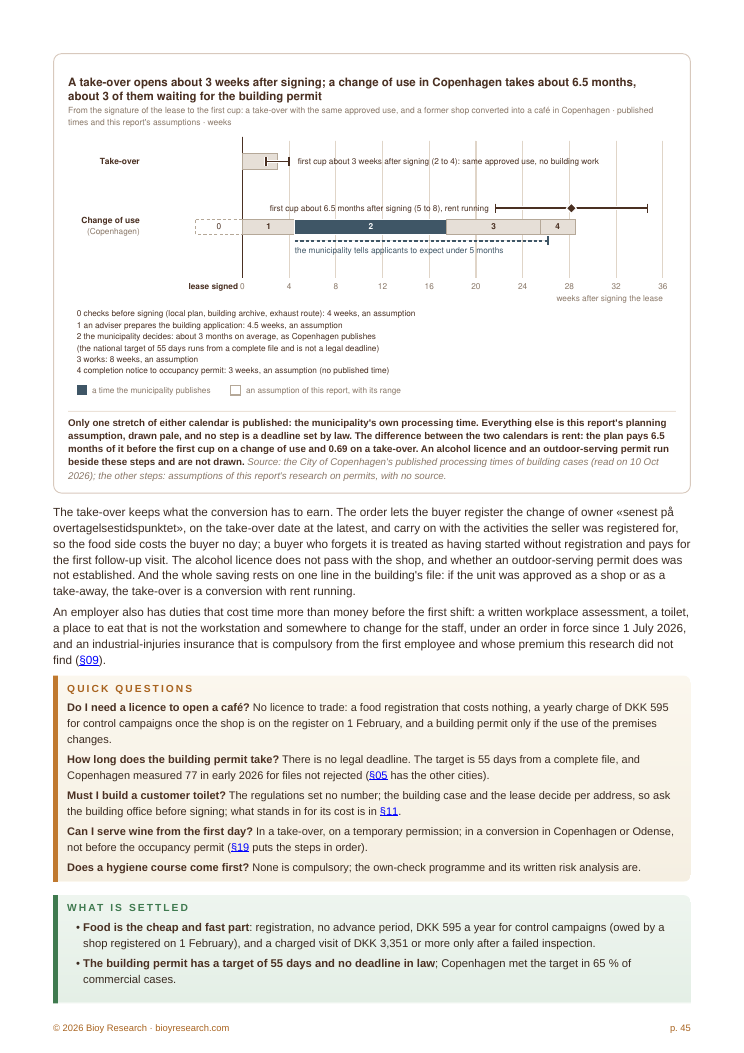
A few pages from the report. The free sample contains the cover and the contents.
For a resident of Denmark, or someone settling there, who wants to open one specialty coffee shop as a first business and work in it full time. It is not written for a chain planning another unit or for an investor who will hire a manager; they will find the evidence useful and different figures.
It gives a verdict by size of shop where the filed accounts allow one, always with its spread — how many companies of that size stand on each side and what distinguishes them — and it says plainly where they do not allow one, what is missing and which check would settle it. The verdict is about a shop that earns what the middle company of its size earns, not about a named site: the summary ends with the three checks that tell you where your own shop would stand.
Four pages right after the cover that can be read on their own: the answer, the money, the conditions and the next step. Every figure in it comes from the same engine as the chapters and is traced to its source there. It is part of the report and is not in the free sample.
From Danish statutes, the tax agency's guidance, Statistics Denmark, the hotel and restaurant collective agreement, the annual reports that companies file with the Danish Business Authority, the Food Authority's public register, coffee bars' own menus and opening hours, advertisements of premises and of running shops for sale, and what the trade states in the press. Every input carries its source, date and confidence level in the traceability chapter. What could not be verified is declared, not filled in.
No. Danish small companies may file without a sales line, and almost all do. The report is anchored on what they do print, and every sales figure in it is derived and labelled as such.
The base is Copenhagen and Frederiksberg. Aarhus, Odense, Aalborg and Esbjerg are given as facts — stated rents, processing times and what was read there — and not as costed results. There is no ranking of cities.
This edition is written in English.
A PDF, delivered by email immediately after payment.
It saves you weeks of research and the risk of entering blind a market you don't know.
Buy the report · €299