PDF interior
What you will see inside
Real PDF pages: cover, executive summary, charts and competitive tables.
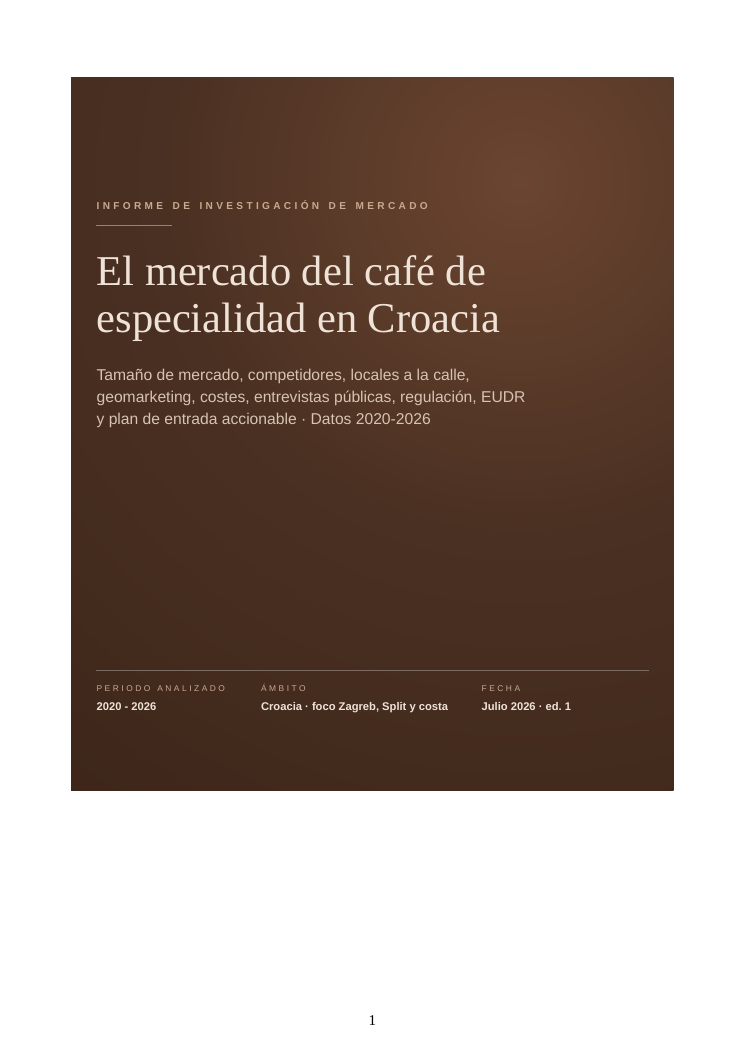
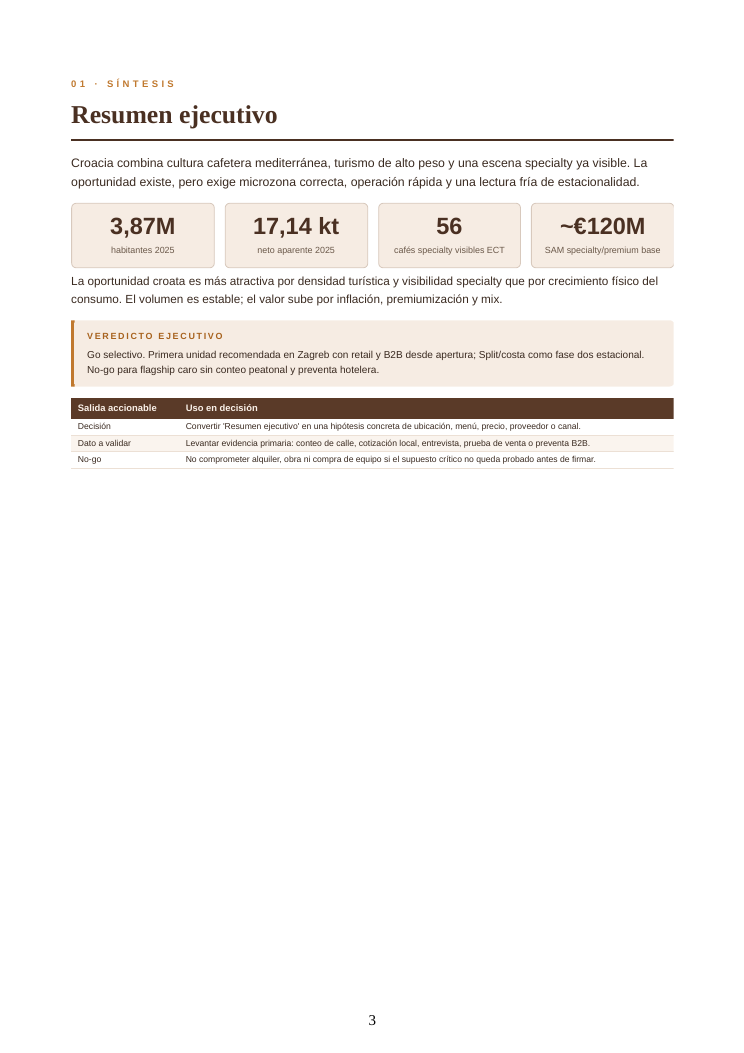
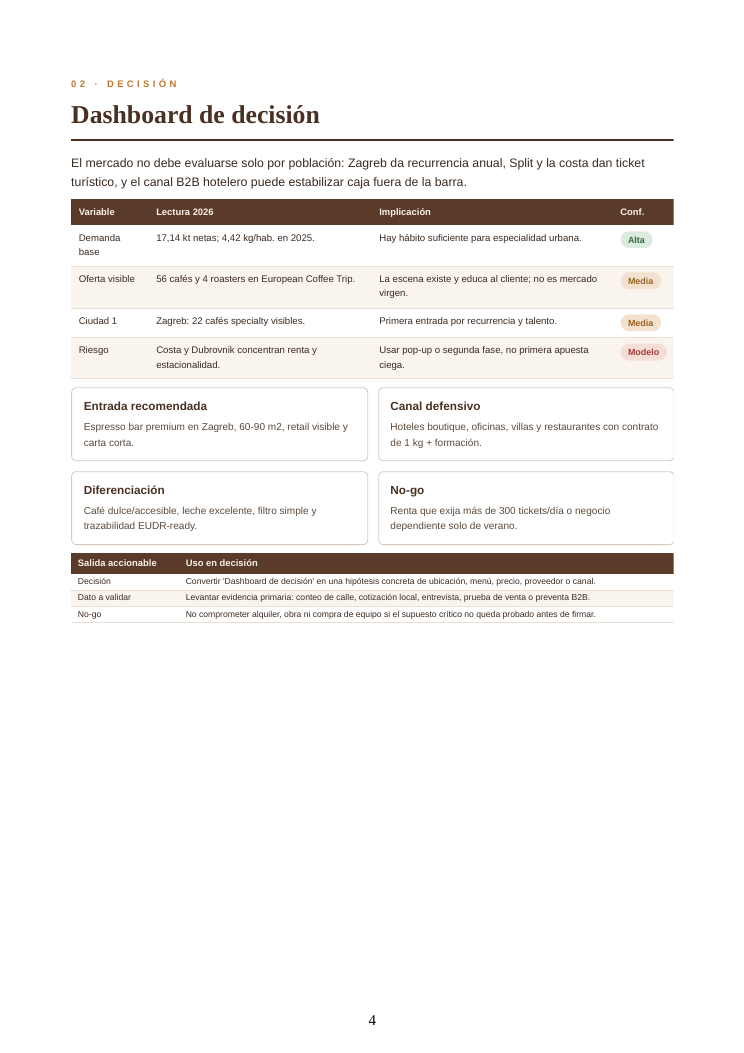
Demand, competition, consumer and strategic opportunity in a market where coffee means a long, unhurried social sit-down in the kafić (café) and where a young but solid specialty scene (Cogito Coffee Roasters, Eliscaffe, D16 in Split) was built against the dark-espresso habit. The intelligence you need before entering: where, against whom and with what economics. Figures in euros (in the eurozone since 2023), with labour cost in figures (minimum wage of €1,050, employer charges of just 16.5%) and a counterintuitive tax nuance (the PDV/VAT on served coffee is 25%, not the reduced rate; only served food goes to 13%).
Real PDF pages: cover, executive summary, charts and competitive tables.
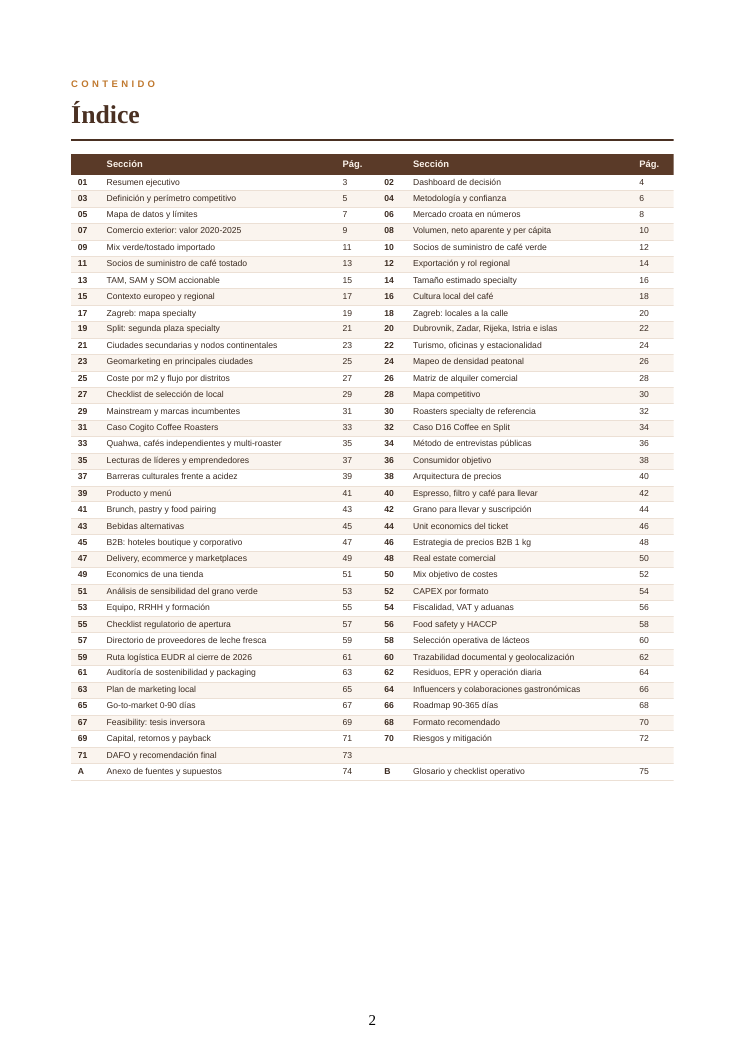
Each section answers a concrete question an entrepreneur or investor asks before entering.
In Croatia coffee is drunk seated and slowly, as a social experience in the kafić, not "to go"; that defines format, table turnover and ticket. In parallel, a young but solid specialty scene in Zagreb and Split that was built through education and better origin. TAM / SAM / SOM sizing and demand drivers 2026–2030, in euros (eurozone).
Reference specialty roasters (Cogito Coffee Roasters with its own network and wholesale, Eliscaffe by Nik Orosi —the country's first barista champion and a WBC competitor—, D16 in Split, Quahwa) alongside mainstream brands (Franck), imports and supply chain, and where the entry gaps sit by channel and by area.
Chains and mainstream, roasters and B2B brands, independent competitors venue by venue, with an integrated block of interviews and verifiable quotes from founders of the Croatian scene (Matija Belković of Cogito, Nik Orosi of Eliscaffe).
Pricing and ticket architecture, unit economics of a store, staffing and labour cost (2026 minimum wage of €1,050 gross / ~€799 net, employer charges of just 16.5%, mandatory hospitality collective agreement), taxation with the PDV (VAT) nuance (served coffee and drinks at 25%, served food at 13%, retail beans at 25% + an excise of ~€0.80/kg), EUDR and PPWR (applicable as an EU member), strong tourism seasonality, and deep dives into Zagreb, Split and the coast (Dubrovnik, Zadar, Rijeka, Istria and the islands).
Professional design, verified data and clear charts in every section.
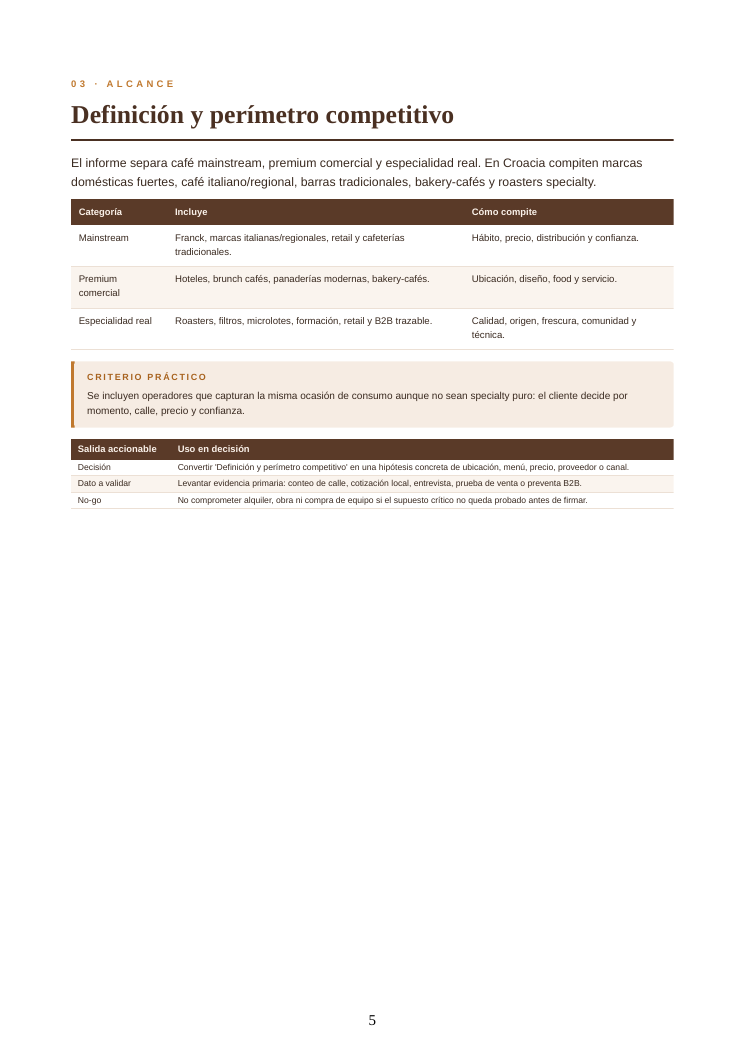
A sample of pages from the report. The full version includes all tables, charts and sources.
A PDF ready to read on any device or to print. You receive it by email immediately after payment.
Croatia joined the eurozone in 2023, so all the economic figures in the report are expressed in euros (€). Each figure is cited with its confidence level.
From primary, verified sources: HS0901 trade data (Eurostat Comext), population (Eurostat), visible supply (European Coffee Trip), taxation (PwC, Porezna uprava), public interviews from the scene and trade press. Each figure is cited with its confidence level and read as an order of magnitude. We never use inflated or invented numbers.
For anyone evaluating entry into Croatia's specialty coffee market: entrepreneurs, expanding brands, investors and sector suppliers. Not for those who already operate and know the market better than anyone.
The individual licence covers personal or single-project use. For broad corporate use or resale, contact us for an extended licence.
It saves you weeks of research and the risk of entering blind a market you don't know.
Buy the report · €299