PDF interior
What you will see inside
Real PDF pages: cover, executive summary, charts and competitive tables.
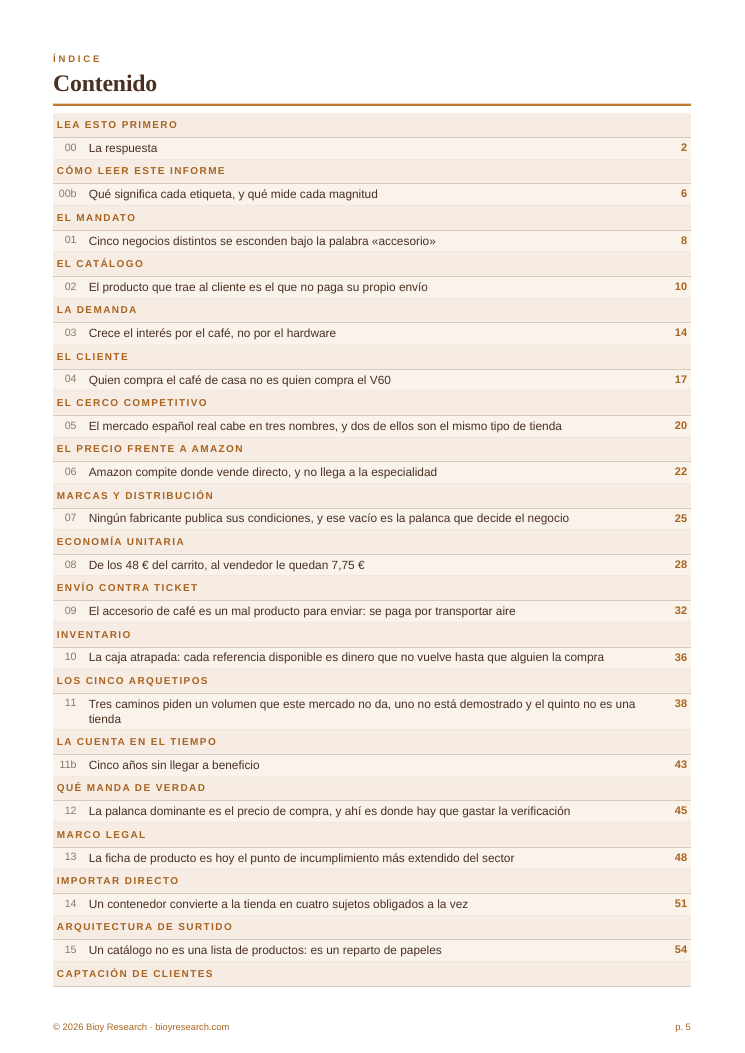
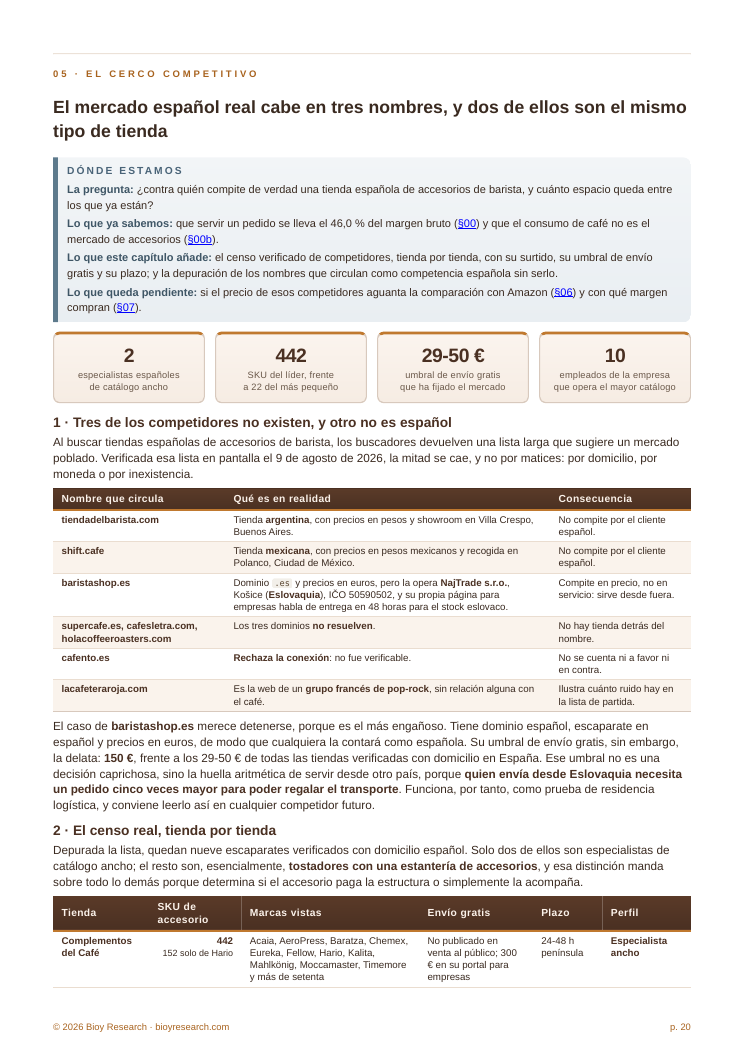
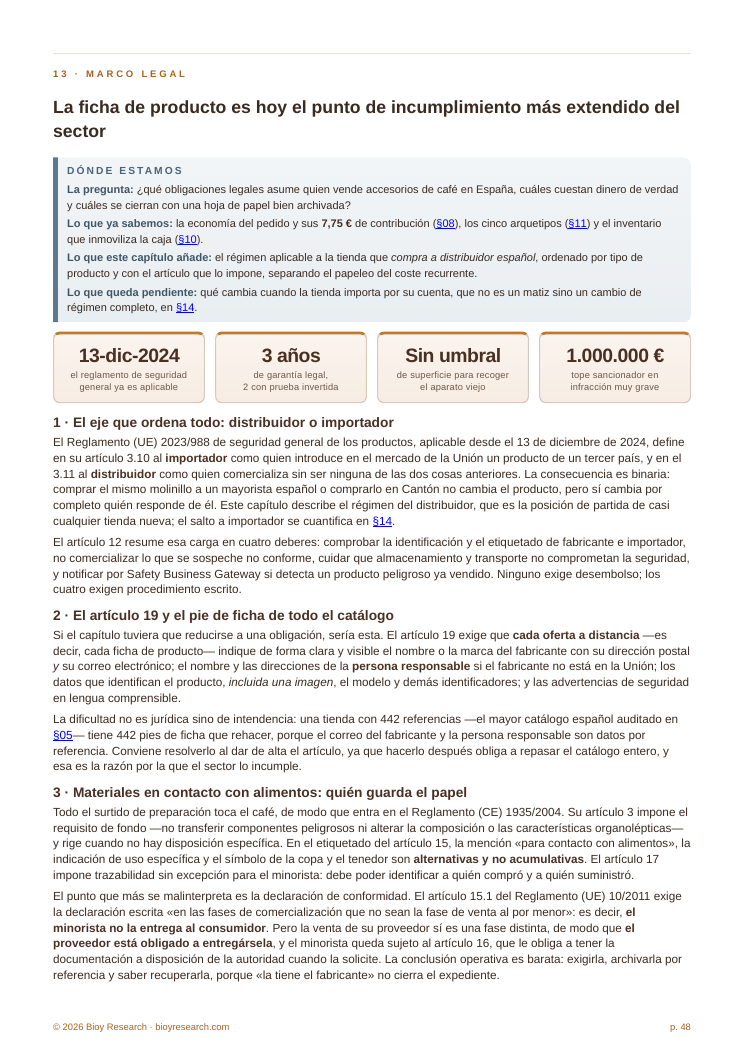
Range, competitor pricing, order-level unit economics, five business archetypes, the legal framework and importing, with an original dated audit and a reproducible calculation engine.
Real PDF pages: cover, executive summary, charts and competitive tables.
A decision report, not an overview of speciality coffee. Every figure comes out of a reproducible engine that names the function producing it, every assumption is published with its source, its date and its confidence level, and the three adversarial reviews are published in full, including the corrections that forced the engine to be rebuilt.
The question that orders the report is not whether people are keen on speciality coffee, but what survives of an average €48 basket once the product, the carrier, the payment gateway and the returns have been paid for. The cascade is worked through line by line, with courier rates, payment commissions and return costs verified for 2026, and with the chargeable weight calculated —not assumed— for each type of parcel. That is where the figure that decides everything else comes from.
An original audit of the range and prices of the Spanish shops in this sector, with the consultation date and the price seen on screen for every reference. It includes the step almost nobody takes: screening which shops are genuinely Spanish —with stock, delivery and invoicing in Spain— and which are shop windows that re-ship from abroad, because benchmarking against the latter produces false conclusions about the margin available.
Instead of an invented average category, twelve concrete references from the range —utensils, consumables, spare parts and small electrical equipment: grinders, scales, kettles— each modelled with its price, its chargeable weight, its box volume and its contribution. That is what shows which families carry the shop and which merely occupy shelf space, and why the product that is most fun to sell is not always the one that pays the bills.
Pure online shop, physical shop, a corner inside a business already trading, and the arrangements in between: five archetypes assessed with the same engine, each with its start-up investment, its break-even in orders, its five-year profit and loss account and three scenarios. The report sets out which variable breaks each archetype before any other, and the volume beyond which the comfortable answer stops working.
Break-even is not published as a loose figure: it is translated into the unit you actually decide with, which is orders per month and customers who come back. With sensitivity on the three levers that move it most —average basket, return rate and customer acquisition cost— and the threshold beyond which a second salary changes the whole structure of the business.
General product safety and the product information duty almost nobody in this sector meets; food-contact materials, which cover a good part of the brewing kit; electrical appliances and their reverse logistics; packaging; the right of withdrawal and the legal guarantee. Every obligation appears with its instrument, its article and what it means in practice for the seller, rather than as a list of headlines.
Customs duties by tariff heading for the families in the range, the anti-dumping duty on Chinese tableware ceramics —which reaches more references than it appears to— and the flat charge on low-value consignments in force since July 2026. With the effect of each on the landed cost of the goods and on the comparison against buying from a domestic distributor.
A matrix of eleven risks —from supplier concentration to a collapse in paid traffic, from stock that does not turn to a dated regulatory change— each with its early indicator, the specific threshold at which you must act, the mitigation, the owner and the residual risk left once it is applied. It is a monitoring tool, not a list of worries.
Every published figure names the engine function that produces it, and the 105 assumptions are published one by one with their source, their date and their confidence level, alongside 17 structural statements with the same traceability. The three adversarial reviews sit inside the report, with the corrections that forced the engine to be rebuilt and the old figures shown next to the new ones: what was got wrong is shown, not deleted.
Download a free sample with the cover and the full table of contents of the report.
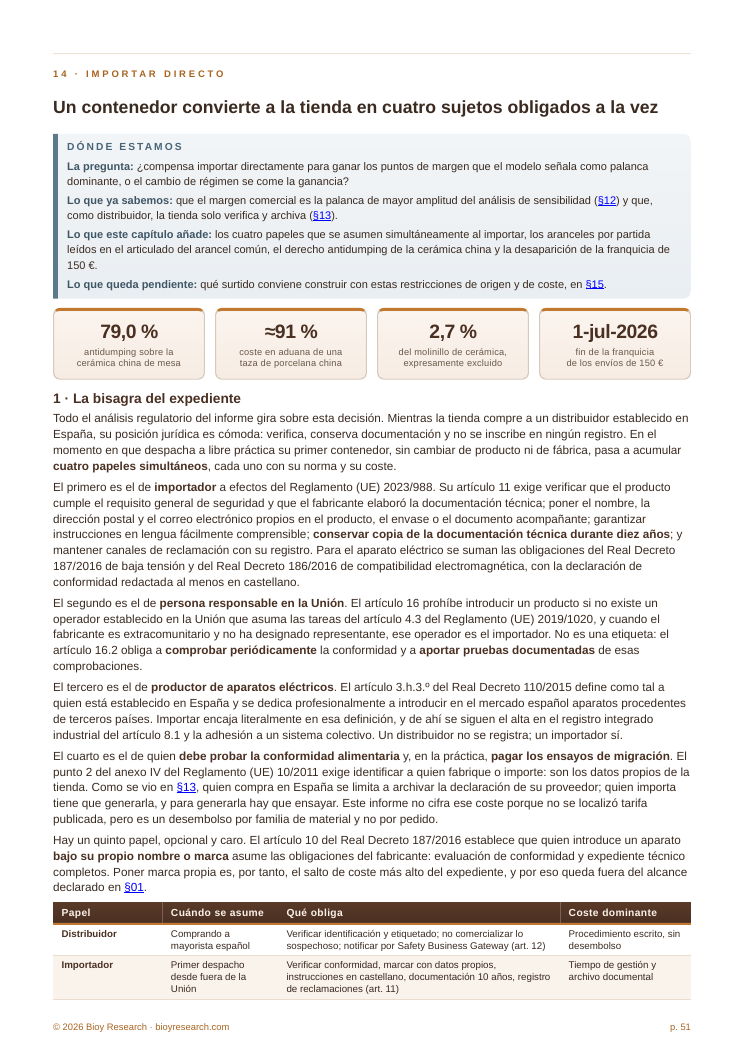
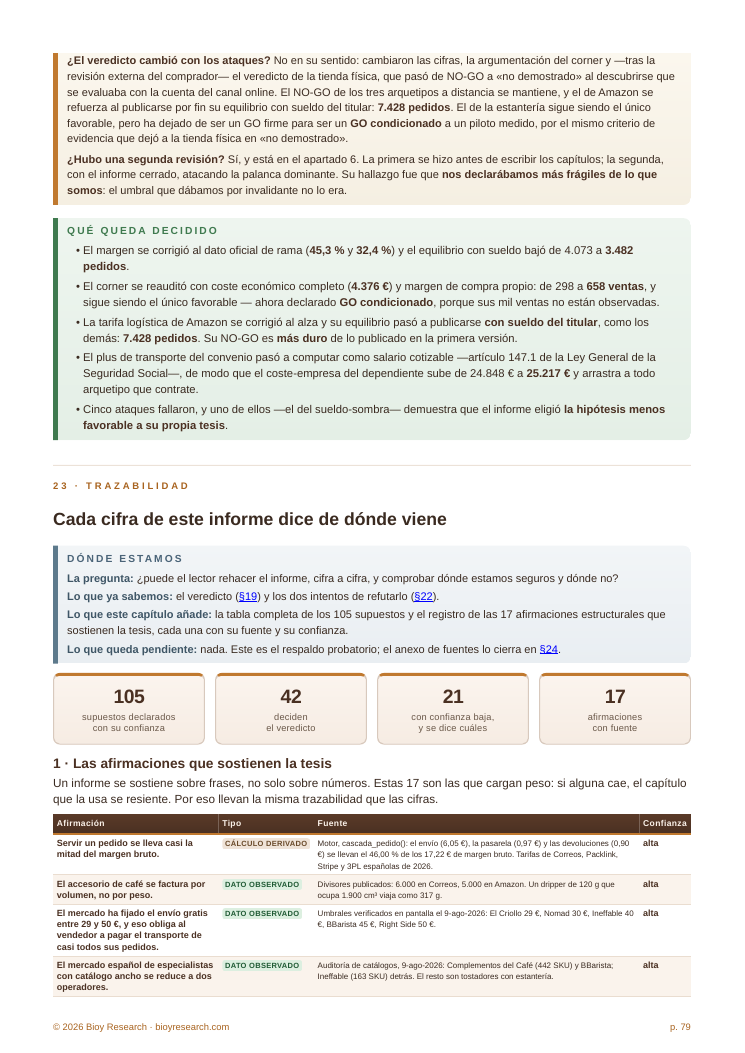
The sample includes the cover and the contents, so you can see the full scope of the report. The analysis, the financial model and the verdicts are in the complete edition.
For anyone weighing whether to open a barista and home-coffee accessories shop —online, bricks-and-mortar, or as a corner inside a business already trading— and for the roaster or coffee shop assessing whether to add a shelf of accessories to what it already sells. The premise is that you are risking your own money and deciding alone, with no committee behind you.
Three, in this order: what is left of an average order once the product, the carrier, the gateway and the returns are paid for; how many orders a month it takes to pay a salary; and which of the five ways of setting it up stands up to that arithmetic and which does not. Each answer comes with the sensitivity that shows the point at which it changes.
That the competition is audited reference by reference, with the consultation date and the price seen on screen, after screening which shops are genuinely Spanish. That the twelve products in the model are real and carry a calculated chargeable weight. And that it publishes its own mistakes: the three adversarial reviews are included, with the corrections that forced the engine to be rebuilt and the earlier figures shown next to the corrected ones.
Yes, and it is reproducible: every published figure names the engine function that produces it, and the 105 assumptions are published with their source, their date and their confidence level, so you can substitute your own and redo the calculation. It includes the order cascade, break-even by archetype, the five-year account and three scenarios.
It does not cover selling coffee beans or the roasting business, nor professional hospitality machinery, nor markets outside Spain. The scope is utensils, consumables, spare parts and small domestic electrical equipment —grinders, scales, kettles— sold in Spain.
The report is published in Spanish and in English, as a PDF, and you download the language you choose at purchase. All figures are in euros, because the market analysed is the Spanish one: prices, carrier rates, commissions and taxes are those applying in Spain.
Edition 8, with a cut-off date of 9 August 2026. The report explicitly flags which obligations and rates carry a date —among them the low-value consignment charge in force since July 2026— and recommends a review horizon.
Five archetypes with their break-even, the full cascade of an average order with carrier, gateway and returns verified, twelve real products modelled one by one, the legal framework cited article by article, importing with its duties and its anti-dumping, and 105 traced assumptions so you can redo the arithmetic with your own.
Buy the report · €990